Tuesday Tip

Tuesday Tip: Don’t go too low

Tuesday Tip: Don’t go too low 📉

It’s tempting when you start trying to lose weight to panic and cut calories drastically – because surely a bigger deficit means quicker results right? To a degree yes but…. It never really works and this is why.

Our bodies are designed and have evolved to essentially make losing weight and fat hard. Fat loss goes entirely against our main drive to survive so conserving energy and maximising fat storage is a good evolutionary strategy. If energy consumption (calories) are reduced drastically the body will adjust processes to ‘fit’ the calories you consume. Now this doesn’t mean you can put on weight if you eat too little – that’s just a myth. What it does mean though is that the body compensates for a lower energy intake by reducing energy expenditure.

It does this in two ways. Firstly it reduces NEAT (non-exercise activity thermogenesis), – these are the subconscious incidental movements and processes in your body e.g. your heart rate may slow, body temperature may change, and hormones such as leptin, T3 and T4 adjust to reduce energy expenditure. As a result your BMR may decrease.

In addition you will subconsciously move or fidget less than you usually would. So you may find you don’t stand up or tap your feet etc as much, you may be less inclined to take the stairs and take the lift instead, you may find you drive instead of walking places as much, you might not get up to go get things you’ve left in other rooms (e.g. not going upstairs to get the hoodie you want to wear and grabbing whatever is handy downstairs instead), not getting up to get a glass of water if you’re thirsty, feeling generally low motivation to exercise/walk etc. You probably won’t even notice you’re doing any of this.

So as you’ll be expending fewer calories the deficit you think you have becomes smaller. In addition you’ll feel low, hungry, tired and tend to obsess over food. This means the tendency to binge/overeat either when you have a ‘cheat’ day or when the diet ends is high. This is why you often find any weight you’ve lost will come back quite quickly.

So rather than heading straight in to an aggressive 800-1000 calories a day diet (for the umpteenth time in the past few years) try aiming for a higher number of calories with a smaller deficit. A smaller deficit allows you to thrive and stick to the newly acquired habits you need to stick to, consistently, to move towards your goals. Work more on delayed gratification. Something that takes longer but feels easier is far more likely to work out the way you want it to.

If this resonates but overwhelms you at the same time, that is also completely normal. We are designed to want instant gratification and results so it’s ok if it feels counterintuitive to start with. But trust me, stick with it and you’ll reap the benefits – play the long game!

Happy Tuesday 🤗xx

Nutrition and Calorie Tips

Eating certain foods doesn’t make you a ‘bad’ or a ‘good’ person…

Eating certain foods doesn’t make you a ‘bad’ or a ‘good’ person… 🍩

I lose count of the number of times I hear clients tell me they’re ‘bad’ because they’ve eaten something they feel they shouldn’t have. How often do you eat something and label it as ‘good’ or ‘bad’ and by extension consider that you’ve been ‘good’ or ‘bad’?

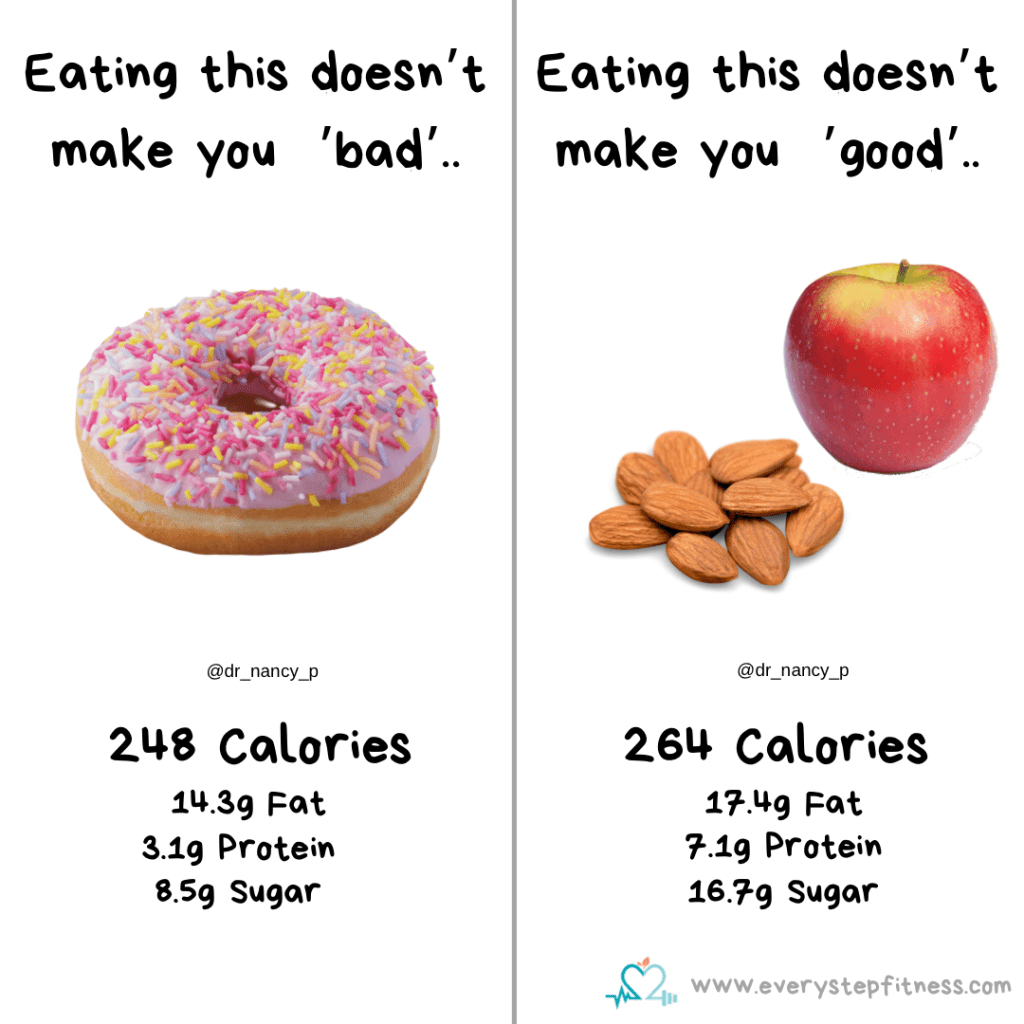
If you succumb to a doughnut at coffee you tell yourself you’ve been ‘bad’ and that you’re a ‘bad’ person. Yet if you have an apple and some almonds (30g in this example) you’d be feeling very virtuous and like you’re a ‘good’ person.

It’s really time we stop labelling foods as good or bad. There are no good or bad foods. There are simply foods which contain a greater or fewer number of nutrients. The foods themselves aren’t bad – the quantities may be though. You are also not a bad person for eating those foods. It’s time we stop attributing some form of morality to snacks etc. What you eat or don’t eat has absolutely no bearing on your worth as a person. You’re not a bad person for snacking on a doughnut. You’re also not a good person for choosing an apple and almonds.

Yes the apple and almonds will have more fibre, more micronutrients (vitamins and minerals) and and more protein. The doughnut undoubtedly has fewer vitamins and minerals, but it will provide you with energy and joy! If you were trying to hit a certain number of calories then the doughnut may even be a better choice as they’re fewer calories but neither is inherently good or bad. They both have a place in a balanced diet. The only reason to describe either as good or bad is in terms of how you think they actually taste! And personally I think they both taste good!

Enjoy!

🤗

Xx

Tuesday Tip

Tuesday Tip: Booze 101

Tuesday Tip: Booze 101 🍸

Many people are trying ‘dry January’ at the moment or considering cutting back. I never tell clients to give up booze, life would be miserable without that if it’s one of your go to ‘treats’ – I do however suggest it could be one way to ‘easily’ cut calories by reducing the amount they consume. Mainly because it’s a discreet, easily identifiable thing to reduce, but also because alcohol can affect weight loss in other ways.

Alcohol contains 7 calories per gram (vs 4 cals for carbs and protein,and 9 for fat). More alcohol means more calories. So alcohol by volume, or ABV, is a good guide for how calorific your drink is relative to others. Drinks that are sweeter will also generally pack more calories (and remember mixers too!).

Unlike food, alcohol contains little to no nutritional value. Alcohol calories don’t fill you up like food calories do, or provide many micronutrients. This isn’t an issue in a balanced diet but just worth remembering when prioritising what you choose to consume.

Alcohol calories are processed differently too. Alcohol is a toxin so the cals are used immediately to generate adenosine triphosphate (ATP) to detoxify it. This detoxification is a labour intensive process so the liver ‘shuts down’ and stops processing fat, carbohydrates and protein because it needs to deal with alcohol. Hence why you get the munchies, because the detoxification of alcohol inhibits gluconeogensis (breaking down of our internal food stores). So not only does alcohol inhibit fat burning it also encourages over eating. The lack of inhibitions associated with alcohol also make it more likely you’ll ‘stuff the diet’ and eat more than you intended; so it’s a triple whammy!

In addition many alcoholic drinks aren’t labelled with calories and they can vary widely so it’s almost always an estimate e.g a can of beer ranges from 100 – 320 cals. If you’re consuming a lot it could impact on whether you manage to maintain a calorie deficit.

Tips to help:

– Alternate drinks with water.

– Use small glasses to make it easier to keep track.

– Swap to spirits with low or zero cal mixers or a dry white wine/ rose etc

– Eat first to keep hunger at bay and make you less likely to overeat later.

– download the ‘Try Dry’ the dry January app if you’re a fan of tracking – it gives you the cals and money saved etc

Happy Tuesday 🤗xx

Nutrition and Calorie Tips

Not all biscuits are created equal

Not all biscuits are created equal 🍪

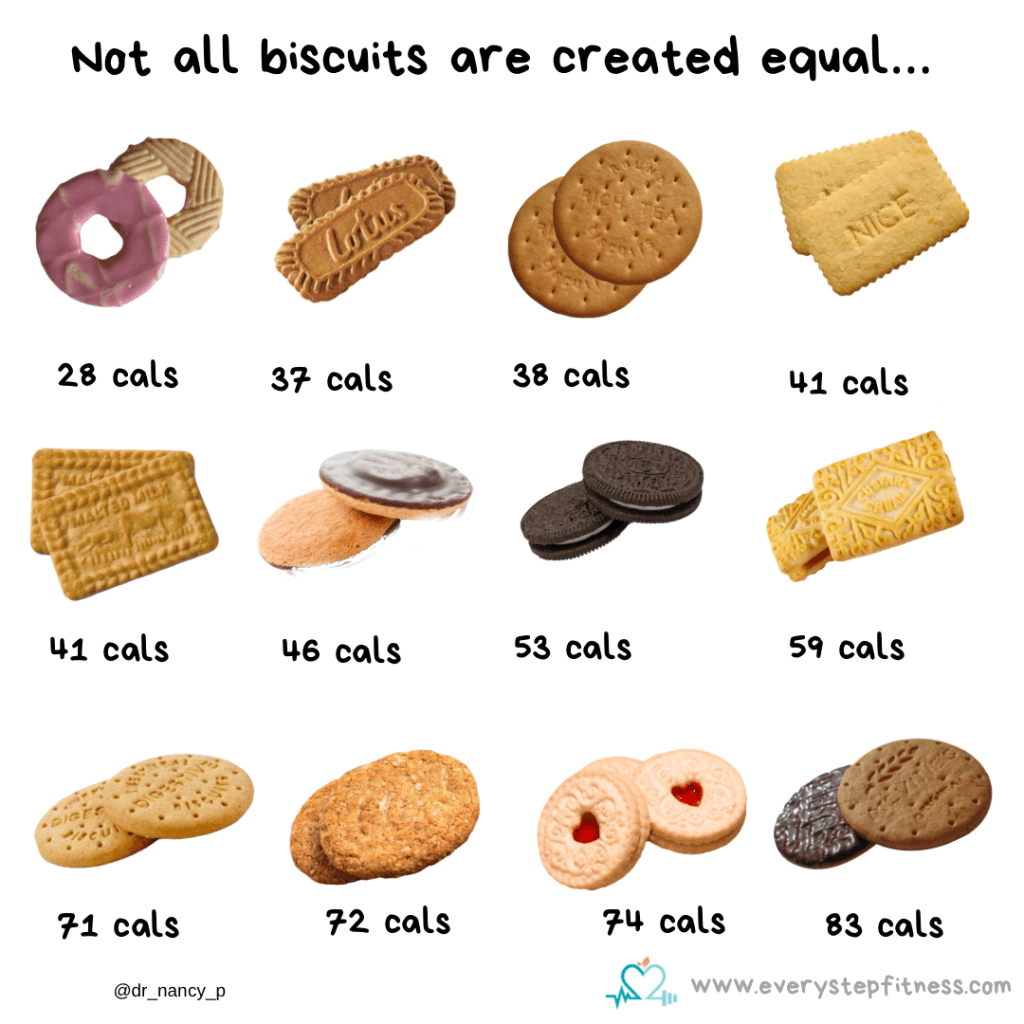
There are more obviously more nutritious snacks than biscuits of course but that doesn’t mean you can’t enjoy a biscuit with a cuppa when you fancy it. The natural assumption is that they’re ‘bad’ and not compatible with trying to lose weight. This is certainly not the case. The main issues with biscuits are usually that you almost eat them without noticing and therefore it’s really easy to eat more than you realise. Clients often say they can’t stop once they open a packet – I know that feeling! You start with one and before you know it you’ve hoovered up 4! However there’s quite a difference between having 4 party rings and 4 chocolate digestives!

The reality is that not all biscuits are created equal so being aware of the calories in various biscuits allows you to make a more informed choice. 4 party rings is only 112 cals which is easy to factor into your daily calories, whereas 4 chocolate digestives are 332 cals which is a much more significant amount. Being aware of the lower calorie options might just help enable you to enjoy a biscuit whilst still moving towards your weight loss goal.

So here are some of the more popular biscuits on the market (calories are for one biscuit) Oh and yes I know I’ve slipped the Jaffa cakes in there… which are officially cakes (for VAT purposes)… but I mean they’re clearly not are they 😉.. and whatever they are they’re still yummy with a cuppa.

The biscuits pictured are:
Party rings, lotus snack pack biscuits, Rich tea biscuits, Nice biscuits, Malted Milk biscuits, Jaffa cakes, Oreos, Custard Creams, Digestive biscuits, Hobnobs, Jamie Dodgers and Milk Chocolate Digestive biscuits.

So remember knowledge is power and biscuits are a perfectly good snack if you want them!

Xx

Tuesday Tip

Tuesday Tip: A few home truths

Tuesday Tip: A few home truths 🏠

A few things you might need to read this January.

#1 Absolutely any food or drink can fit into your diet – if you control the amounts you eat.

#2 There are not ‘good’ or ‘bad’ foods – stop moralising food itself. It’s all about quantity – anything in excess is bad.

#3 Weight loss and health are not the same thing. Your health is a result of lots of factors over time. You can eat for health and you can eat for weight loss, or you can do both! Your health expands beyond what you eat though so take a holistic approach.

#4 Exercise is for physical and mental well being – not to burn calories / lose weight. Separate the two.

#5 Fat loss happens when you’re consistently in a calorie deficit over time – not days, not weeks but months. How you achieve that calorie deficit is up to you but if you want it to be something you can sustain long term then the best approach is to include all the stuff you enjoy eating, just in smaller quantities.

#6 Beware of following ‘meal plans’ to

lose weight without changing your habits and behaviours to help you maintain that loss long term.

#7 You don’t need to be starving to be losing fat but you do need to expect some

hunger if you’re genuinely eating at a calorie deficit. You can help by prioritising high volume foods and including plenty of fibre rich foods, proteins and fats to keep you full. However don’t cut out the carbs as you need them for energy.

#8 If you want to be successful long term then don’t focus on calorie and exercise targets, you need to change your mindset too. Be kind to yourself and try to stop the the all or nothing mentality

#9 Before you rush to follow the advice of some fitness/nutrition guru ask yourself what do they have to gain? Are they selling a book? Are they marketing supplements? Are they touting for online clients? So before you jump on another diet fad stop and consider who actually benefits from it. The basic information you need to lose weight is simply a calorie deficit. Eat less. If you’re not losing weight you’re not in a deficit. Simple. Whether that’s because your target is incorrect, or your calculations of what you’re eating are incorrect, or whether a medical condition is impacting your calorie requirements.. the basic principal remains. No weight loss means no calorie deficit.

Happy Tuesday 🤗xx