Tuesday Tip

Tuesday Tip: Carb Truths

Tuesday Tip: Carb Truths 🥖

There are a lot of myths out there about carbs and there is also a lot of unnecessary fear mongering, so here are a few truths.

# They’re crucial

Technically we CAN survive without carbs but they are absolutely essential for optimal human performance. They are fuel for our brains and muscles and without them you’ll struggle with energy levels and athletic performance.

# They’re not unhealthy

Those that say “carbs are unhealthy” are clearly forgetting about whole-grains, fruit and veg. Many carbs are filled with fibre and an array of micronutrients and even more refined carbs are crucial for fuelling us day to day and in high intensity performance.

# Glycemic Index and blood sugar

People often talk about the glycemic index of a food being important – a low GI means a lower blood sugar response. However even low GI foods aren’t necessarily better because the GI is impacted by ripeness, how a food is cooked, what foods are eaten with it (it’s the GI of the entire meal that matters), how it’s processed etc. More importantly, the glycemic response is different from one person to another, and also in the same person from day to day.

So when it comes to blood sugar, it is not the sugar content of a food that is most important. The total amount of that particular food that you consume (glycemic load) is more important. The individual (genetic differences) in glucose responses and handling is also of major importance.

# Processed/refined carbs are bad

Processed and refined carbohydrate sources have had their bran and germ removed so are more rapidly digested. They’re ideal for fuelling exercise. They’re often less filling and easier to overeat so can lead to over consumption but there is nothing inherently bad, toxic or fattening about them

# Carbs are king for high intensity exercise

Carbs provide energy at a more rapid rate than we can synthesize from fatty acids.

If you are a regular exerciser then you need carbs to fuel your workouts and to replenish muscle glycogen. It’s also the ideal fuel for your brain.

So don’t be afraid of eating carbs!

Happy Tuesday 🤗xx
Nutrition and Calorie Tips

Just a tub of ice cream..

Just a tub of ice cream.. 🍨

I am a big ice cream lover, and even more so now we’re moving towards spring and summer!

If you’re watching a movie or you’ve had a tough day or just fancy some dessert you may be tempted to grab a tub of ice cream

and a spoon and tuck in! And once you start a tub it’s gone before you know it isn’t it? A portion is supposedly two scoops but that can be quite hard to stick to! However if you’re trying to lose or maintain weight it might not be possible to accommodate an entire tub in your calories.

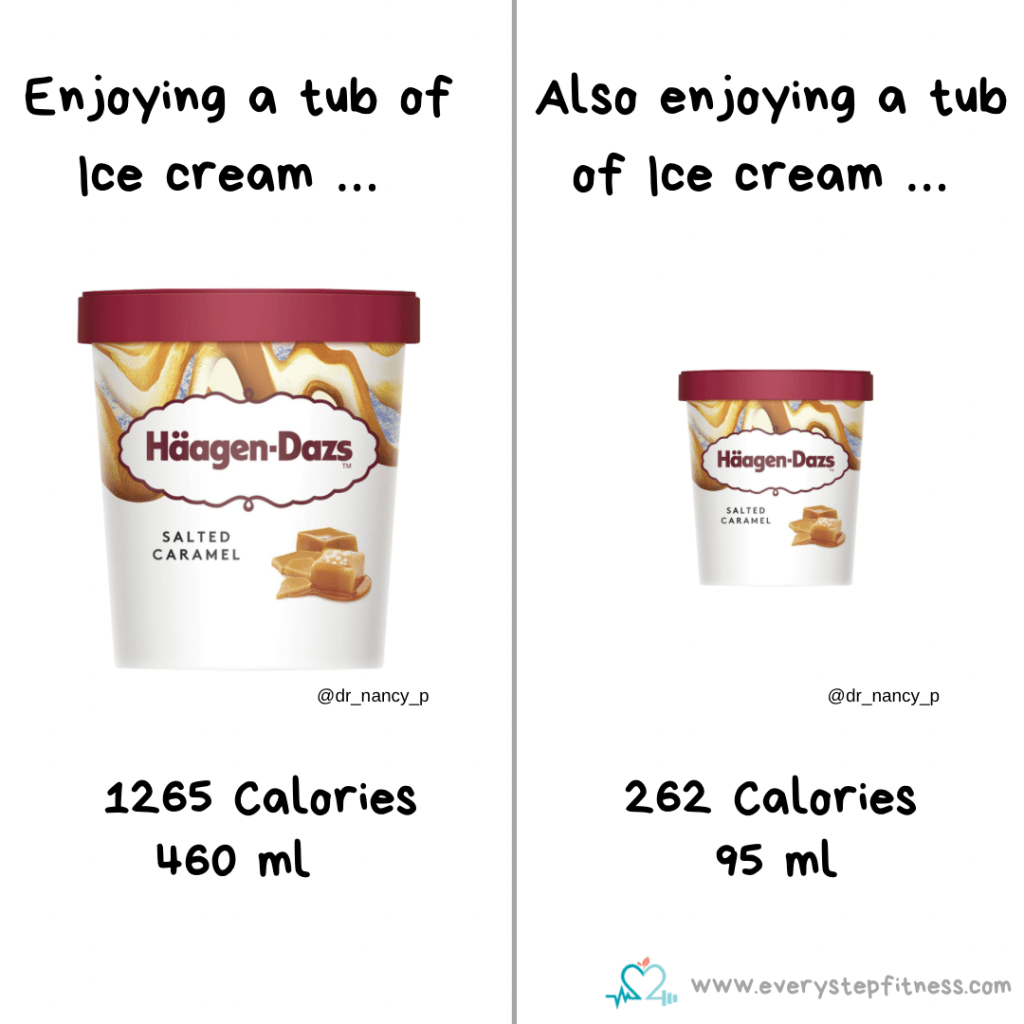
In this example the tub of Häagen-Dazs comes in at around 1265 cals. One option would be to swap to a low calorie alternative (such as Oppo, Halo top, Aldi own brand, etc ) and you’d probably spend around 400 cals max on an entire tub. But sometimes you don’t actually want the lower calorie version or you may prefer the taste of the original Häagen-Dazs. In which case then maybe the better option is to go for the mini tubs instead. One of these is only 262 cals. So technically you could even have 2 or 3 and still be saving some calories!

So if you do want to enjoy some Ice cream but save some cals try going for the mini tubs instead of the full size ones.

🤗xx

Nutrition and Calorie Tips

Weight loss is rarely linear….

Weight loss is rarely linear…. 📉

I’ve had to remind a few clients of this recently so I thought it was worth re-sharing. Most people measure their fat loss progress by stepping on scales. This can create an all or nothing mentality and can impact not only your happiness but your behaviour. If the scales don’t go down when you’ve been ‘good’ then what’s the point? You may as well throw in the towel and enjoy that cake!

Weight loss is rarely linear. It’s normal for your weight to fluctuate on a day-to-day basis. There will be days where your scale weight goes up, just like there will be days where your weight will drop, and there will also be days (maybe even weeks) where your weight will stay exactly the same. Your weight can fluctuate up to 6kg during the day depending on what you eat and drink, and how you exercise. If you drink 2-3 litres of water a day that’s up to 3kg. Then how much do you pee, sweat and breathe out over the day? It’s impossible to measure. Our bodies are mainly water so changes in hydration cause significant weight fluctuations.

In addition a bowel full of food, a big meal the night before, fibrous or salty meals, and menstrual cycle hormone changes can all influence weight and cause greater daily fluctuations so real change can be hidden. Exercise can affect the scale both ways; if, after a workout, you’ve refuelled properly your muscles will be full of glycogen and water. On the other hand if you’ve sweated loads your weight will drop due to dehydration. Alcohol does the same; it’s a diuretic so will dehydrate you initially, but can cause cravings for salty foods leading to water retention.

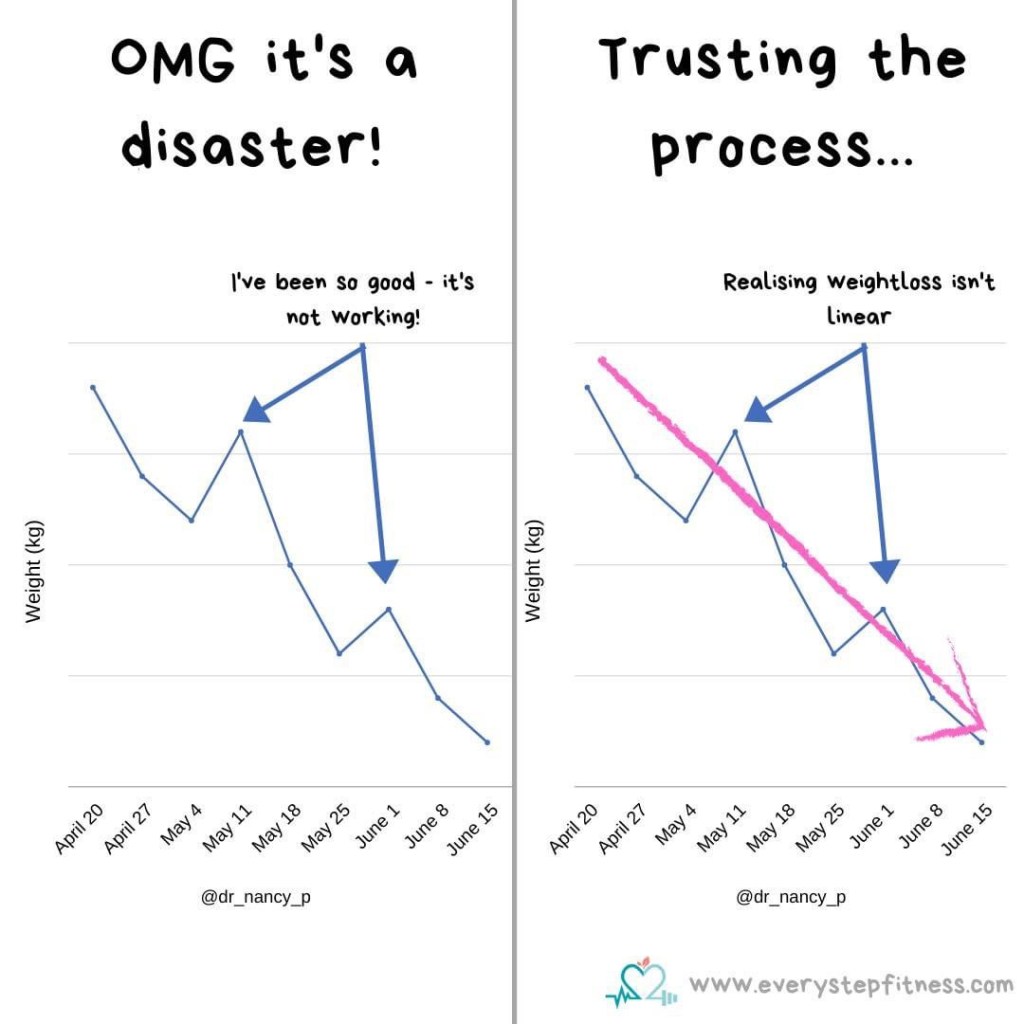
For many of us, seeing that weight go up, despite ‘being good’, can make us give up. It’s vital to trust the process and think long term. This graph is real client data. Look at how the weight fluctuates and look at the overall trend. By trusting the process and not giving up when the scales went up they’ve continued their weight loss over time.

We’re conditioned to focus on weight but instead try to use other measures e.g. items of clothing and how they fit, or cm measurements etc. If you must step on the scales then look at averages over time rather than daily variations and focus on long term trends.

🤗 xx

Tuesday Tip

Tuesday Tip: Are you a snack monster?

Tuesday Tip: Are you a snack monster? 🍪

A common problem many people encounter is that they can’t stop snacking while trying to lose weight. Often the reason people are snacking is actually because they are so focused on saving calories for snacks that their meals are too small and unsatisfying.

I’m very much of the opinion that it’s your calorie budget and you should spend it how you want and I often encourage clients to factor in snacks. However, if factoring the snacks in then means main meals become tiny you may find it backfires as you’ll never feel full.

So if you think this is you then maybe consider restructuring your calorie budget. Instead of saving over 500 calories for snacks, aim for something like 200-300 cals for snacks and divide up the rest of your calories for your main meals.

Also focus on a narrower range of meal options. You won’t ever learn what keeps you full or get used to smaller meals etc if you change them every day. It also makes it far harder to stick to and track things if you’re eating different things each day. Instead come up with 2-3 options for breakfast, lunch and dinner that fit into your calorie budget and stick to them for a while. It will not only help you figure out what helps keep you full but will also removes decision and tracking fatigue which means you’re more to stick with it for longer!

Happy Tuesday 🤗xx

Tuesday Tip

Tuesday Tip: Targeted Fat loss

Tuesday Tip: Targeted Fat loss 🎯

Almost all of us struggle with localized areas of stubborn fat that just won’t seem to shift. We often have a desire to eliminate those areas for either aesthetic or health reasons – this is known as spot reduction.

Sadly there is no such thing as spot reduction – or losing fat in specific chosen areas e.g. you can’t target only belly fat, or just thigh fat. The only way to lose fat in those areas is to lose fat overall, via a calorie deficit. Those areas will eventually lose fat but it may take much longer and requires greater overall fat loss.

Various studies in 2017, 2018 and 2019 review concluded that spot reduction is not possible, that abdominal exercises for example do not significantly reduce belly fat, and that HIIT doesn’t lead to a reduction in leg or belly fat. All it does is work the muscles underneath (which means if you do lose fat they’ll look more ‘toned’ but it doesn’t reduce the fat itself).

Fat distribution is largely determined by genetics (and hormones to a degree) and cannot be changed through exercise or diet alone. This means that individuals with uneven fat distribution will struggle to lose fat in specific areas. So, if you feel you are already at a fat level/bodyweight you’re happy with overall but just want to get rid of stubborn areas of fat, you will need to lose more body fat. This however will require a greater effort, work and greater sacrifices and sometimes this may not be worth the trade off. So you have to decide – is having a slightly smaller belly, thighs, arms etc worth the sacrifice you’ll have to make in calories? If the answer is yes then go for it! If the answer is no then stop trying to target those areas with exercise as it’s not achieving anything and instead just embrace those areas!

Happy Tuesday 🤗xx