Nutrition and Calorie Tips

Eating certain foods doesn’t make you a ‘bad’ or a ‘good’ person…

Eating certain foods doesn’t make you a ‘bad’ or a ‘good’ person… 🍷

I lose count of the number of times I hear clients tell me they’re ‘bad’ because they’ve eaten something they feel they shouldn’t have. How often do you eat something and label it as ‘good’ or ‘bad’ and by extension consider that you’ve been ‘good’ or ‘bad’?

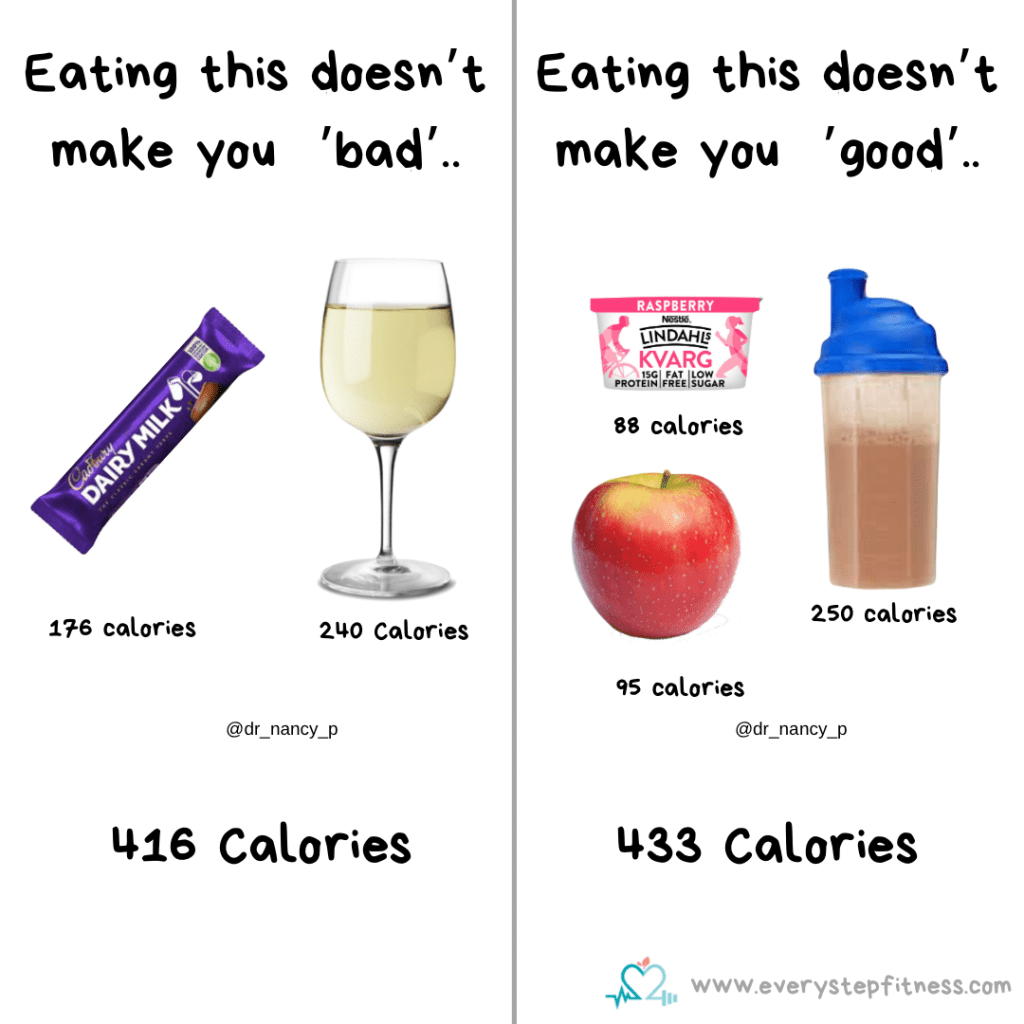
If you succumb to a bar of chocolate and a glass of wine after a long day you tell yourself you’ve been ‘bad’ and that you’re a ‘bad’ person. Yet if you have a yoghurt, apple and a protein shake (in this example a standard protein powder mixed with 300ml semi skimmed milk as per the instructions) you’d be feeling very virtuous and like you’re a ‘good’ person.

It’s really time we stop labelling foods and good or bad. There are no good or bad foods. There are simply foods which contain a greater or fewer number of nutrients. The foods themselves aren’t bad – the quantities may be though. You are also not a bad person for eating those foods. It’s time we stop attributing some form of morality to snacks etc. What you eat or don’t eat has absolutely no bearing on your worth as a person. You’re not a bad person for snacking on a doughnut. You’re also not a good person for choosing an apple and almonds.

Yes the apple, yoghurt and protein shake will have more fibre, more micronutrients (vitamins and minerals) and more protein. The wine and chocolate undoubtedly have fewer vitamins and minerals, but it will provide you with energy and joy! If you were trying to hit a certain number of calories then the wine and chocolate may even be a better choice as they’re fewer calories (and if you swapped to a small glass of wine it would be even fewer!) but neither is inherently good or bad. They both have a place in a balanced diet. The only reason to describe either as good or bad is in terms of how you think they actually taste!

Enjoy!

🤗

Xx
Tuesday Tip

Tuesday Tip: Training for a Summer body?

Tuesday Tip: Training for a Summer body? 👙

As we head towards summer there’s a lot of social media posts around talking about exercising to get your bikini or summer body. Now aside from the fact that, generally speaking, fat loss (which tends to be the real goal) is almost impossible to achieve from exercise (you need a calorie deficit) it’s also not an ideal goal.

The issue with training for a ‘summer body’

is that it’s a merely a goal to be constantly slim or lean without any other performance goals attached. The standards are arbitrary and the likely result is that you’ll never feel slim enough. It’s hard to escape this desire to slim down for summer as it’s so pervasive in our society and we start buying into it from a very young age. Now that’s not to say that wanting to lose fat for summer is necessarily a bad thing or something you shouldn’t do – ultimately it’s your body and you can choose what you want to do with it. But if it’s a pressure you are trying to avoid then perhaps it’s worth considering replacing that summer body goal with more stable goals that will serve you all year round, not just for the summer.

Ultimately the exercise routine and diet that you can do consistently, over the entire year, is the best one for you. Not the one that you can only manage for 4-8 weeks at a time because it’s unsustainable for you and your lifestyle. Try repositioning your goals – for example a goal of longer life, better quality of life, strong bones, quicker recovery from illness. Train for your old man/woman body – you want dense bones, strong muscles, good balance, a healthy heart and functional independence. When you’re 80 you want to be able to carry your shopping, lift your grandchildren, reach to put things away on the top shelf, get up from your chair unaided, stop yourself falling etc. If you try to focus on these sorts of goals you may find you are able to exercise and eat in a way that isn’t overly restrictive (on the food side) or inconsistent (e.g. sudden bursts of over exercising then weeks of months of no exercise). It also won’t feel like punishment.

Think about the long term and think about what will serve to keep you healthy and functioning for longer. Starving yourself, drinking ‘detox’ juices, cutting carbs, hours of cardio etc won’t – eating a reasonable amount of calories from all food types and working to include cardio and resistance training for strong muscles, heart and lungs will!

Happy Tuesday 🤗xx

Nutrition and Calorie Tips

Banning vs allowing foods

Banning vs allowing foods 🚫

You might struggle with overeating particular foods when they’re in your environment. Naturally this may make you

frustrated because it’s getting in the way of your health/weight loss goals. An extremely common approach is to instantly ban certain foods which you may struggle not to over consume. But is banning ‘problem’ foods really a good solution? Eliminating these foods may work, but is it really a long-term solution? Is it feasible for you to never encounter these foods ever again? Does that sound like the relationship with food you want to have?

The issue with banning foods e.g. chocolate/biscuits/ cheese etc is that unless you never want to eat that food ever again you will undoubtedly encounter it in future. When you do you’ll be back in the same cycle of eating it to excess and feeling bad about it. Demonising foods and restricting them has been shown to lead to increased stress and poor mental health. It creates a negative relationship with food and can lead to a cycle of restriction and binge eating.

Instead legalise those foods and allow them in your diet. It will allow a more balanced and healthier relationship with food that’s associated and studies have shown that it’s associated with reduced disordered eating, more self-control, less depression, reduced anxiety, better body image and increased self esteem and fewer food obsessions.

Studies have also shown that over time it leads to weaker desires for potentially tempting food. You become habituated to the food and that means you’re less likely to over eat it to excess. This means you need less self-control and less cognitive (brain) power to deal with it. As a result you can focus your attention on things like hunger signals etc and learn to manage your appetite more naturally.

How do you actually do this?

Use tools like calorie tracking/logging food together with things like rating your hunger and fullness. Eat mindfully – avoid distractions and focus on what you’re actually eating. Use repeated exposure – so have that food regularly in your diet.

So don’t ban foods – learn to enjoy them as part of your overall diet. This will promote long term success, satisfaction and enjoyment, rather than guilt.

🤗xx

Tuesday Tip

Tuesday Tips: Alcohol Truths

Tuesday Tips: Alcohol Truths 🍷

I covered carbs last week so here are a few facts and truths about alcohol and its impact on the body.

# Beneficial?

Alcohol intake in moderation has been claimed to have health benefits e.g. red wine consumption and heart disease. However this largely depends on the individual and their health status. ‘Moderation’ is also interpreted differently by everyone which makes it a hard claim to justify – what does moderation actually entail in real terms? Whilst some studies do show that there may be some protective effects from low levels of alcohol consumption for some diseases, as the WHO states, the potential risk reduction for some diseases is outweighed by the increased risk of cancers linked to alcohol consumption.

# It aids sleep?

Although alcohol may help us get to sleep as it is a sedative, it doesn’t allow good quality sleep and actually disrupts sleep. This is mainly due to aldehydes and ketone production during its’ processing in the body.

# Muscle impact

Alcohol intake reduces anabolic signaling (i.e. it reduces muscle growth) and inhibits muscle recovery. Whilst a couple of drinks won’t have a massive impact over the long term it can affect muscle growth so if that’s a fitness goal then you’d be wise to reduce consumption.

# Performance

I think everyone knows that alcohol consumption impacts performance – both during and the next day. Alcohol intake dehydrates, impairs glycogen metabolism and disrupts cognitive and neurological function so impacts both physical and mental performance.

# Binge drinking

Binge drinking is classified as more than 4-5 units of alcohol in a single sitting (women 4 drinks, Men 5). That’s not actually a huge amount for many people and would probably mean many social occasions would be classified as ‘binge drinking’ when perhaps you viewed them as ‘moderate’ . So once again the term ‘moderation’ actually constitutes far less alcohol consumption than we realise.

# Weight loss

When it comes to weight loss the main issues with alcohol consumption are the additional calories (7 cals per gram) and the decisions we make around food when under the influence or hung over the next day. If you can opt for lighter calorie and/or smaller drinks and make goal-orientated food decisions when consuming alcohol, there is no reason you can’t include it in your diet and lose weight but it does require an awareness of the impact it could have .

Happy Tuesday 🤗xx

Nutrition and Calorie Tips

What you think is slowing weight loss….

What you think is slowing weight loss…. 🤔

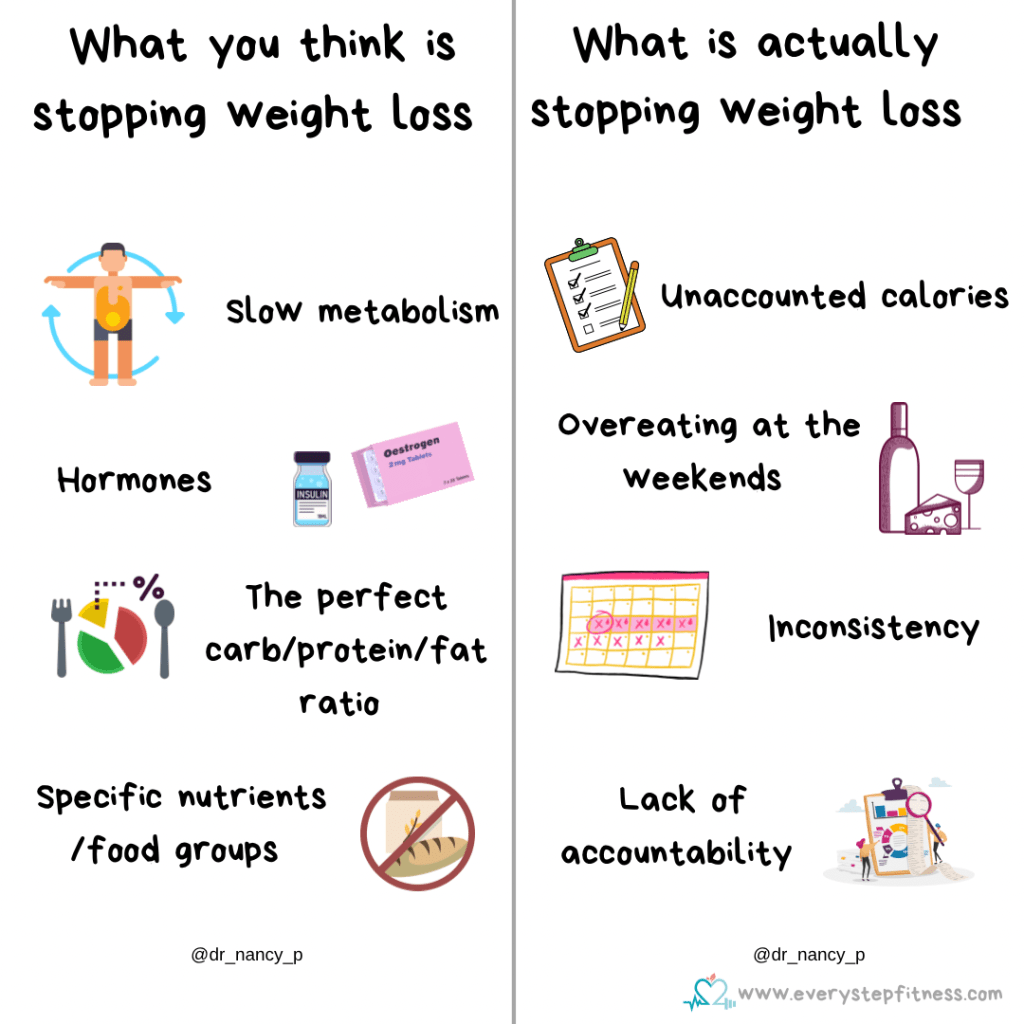
This is a bit of a tough love post. We all do it and we all want to find reasons to explain why we aren’t losing weight but most of the time the reasons people come up with (often thanks to social media/media ) aren’t likely to be their main issues.

# ‘I have a slow metabolism.”

Whilst a small percentage of the population do have a slow metabolism the reality is that, on average, studies show that obese individuals have similar or faster metabolisms than lean individuals.

# ‘It’s my hormones’

Hormones are often blamed but rarely are we specific which hormones or how they are actually affecting weight loss. Some hormones can affect weight loss by increasing hunger or decreasing energy expenditure e.g. thyroid hormones. However most people haven’t actually had their hormone levels tested – if you really think your hormones are at the wrong levels then you need to go get yourself tested. Forget weight loss, it’s a medical issue and can have serious health implications. If you have a hormonal problem, you need an endocrinologist, not someone on social media trying to sell you a new diet plan or supplement.

# Macro ratios

It must be because I’m not eating enough protein or my carb percentage is wrong…. Meanwhile you’re overeating your calories … but yeah it’s definitely the fact you’re having 40 percent protein instead of 45 percent. It’s not. Calories are king. The finer details of specific percentages of nutrients are really irrelevant for most people – unless you have a medical condition or you’re a professional athlete.

# Specific nutrients

One of the most common things people blame is specific nutrients: sugar, carbs, artificial sweeteners, meat, fat etc . In fact research has shown people lose equal weight regardless of what they eat so long as calories are controlled.

So what’s actually preventing weight loss? We cling to these other reasons because they take the responsibility away from ourselves. Meanwhile people are over eating at the weekends, aren’t aware of the cals in certain ‘healthy’ foods, are inconsistent and only sticking with things for a week or two, drinking lots of alcohol and aren’t really being honest about what they’re doing (perhaps subconsciously). Yes some people have genetic and environmental circumstances which make it harder to lose weight but that’s rare. So before you blame metabolism/hormones/sugar/carbs and throw your money at another fad diet / lifestyle trend just stop and think about what you’re actually consuming and how.

🤗xx