Nutrition and Calorie Tips

Anyone for ice cream?.

Anyone for ice cream?.. 🍦

It’s warmed up a bit now so definitely time to crack open the ice cream! I don’t know about you but once I start on a tub it’s gone before I even realise it!

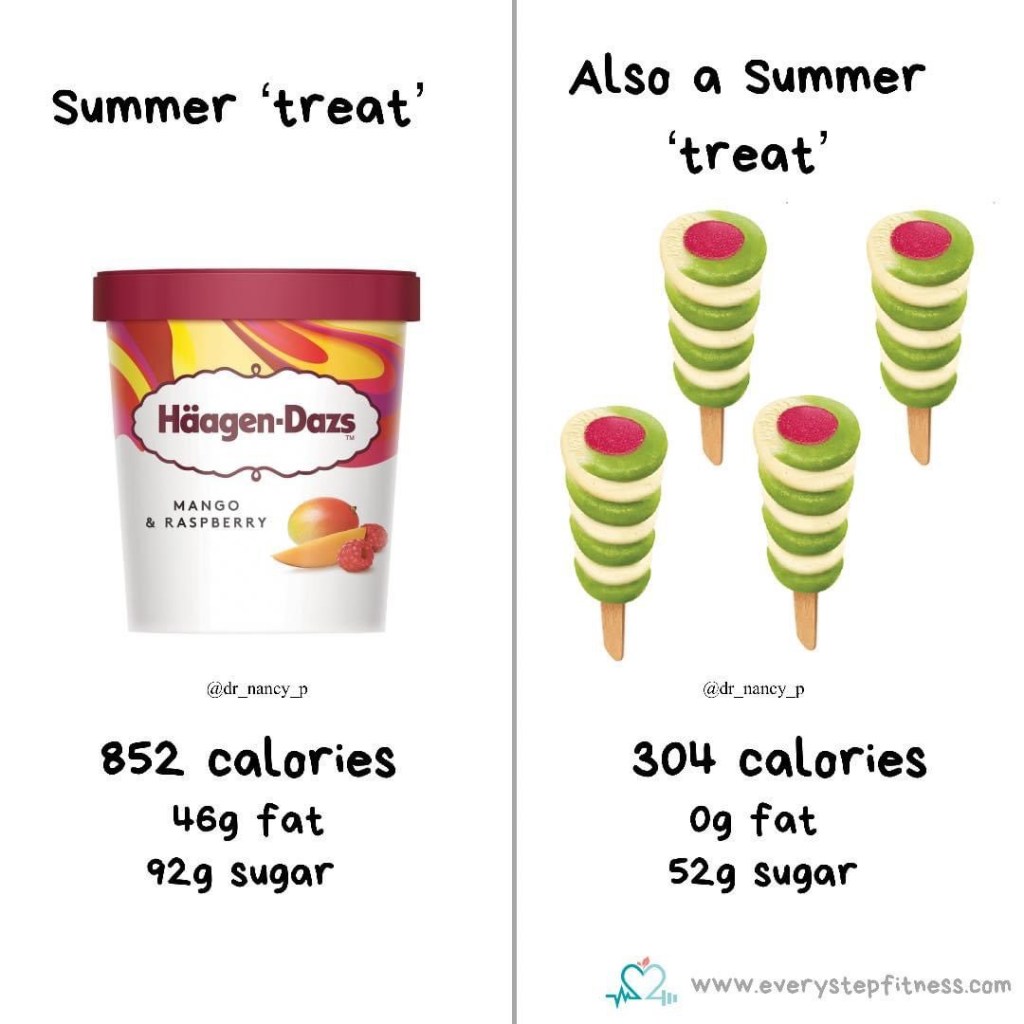
Whilst there’s no problem with including any ice cream you like in your diet, if you are trying to lose weight/fat you may find that fitting a whole tub into your calories quite tricky. So you have two options – either limit the amount you have, or swap from a calorie dense type of ice cream to something that’s similar tasting, but lower calorie. There are the obvious swaps to the low calorie brands like oppo or halo top etc but another option is to switch to something else entirely.

In this example switching from the Häagen-Dazs mango and raspberry ice cream to twisters makes a massive calorie saving. You could have 4 twisters for almost a third of the calories of the Häagen-Dazs. As an added bonus the chances of you eating 4 twisters in a row is considerably less than working your way through a tub anyway. Psychologically it’s much easier to work your way through an open tub than help yourself to 4 lollies in a row.

So if you do want to enjoy some

Ice cream but save some cals try going for the lower cal, higher volume option if you can.

🤗xx
Tuesday Tip

Tuesday Tip: Dealing with stress eating

Tuesday Tip: Dealing with stress eating 🍫

I think many of us struggle to make healthy decisions when we’re feeling stressed or overwhelmed. Heightened emotions can drive you to engage in self-destructive coping strategies which range from eating too much, not eating enough, overthinking, isolating yourself, procrastinating, overworking etc. These are just some ways in we learn to cope, but these strategies often come with a cost. If stress eating is one of your coping strategies then the cost could be that you don’t stick to your plan, and then over eat and feel guilty etc which further adds to the feeling of stress and overwhelm.

So how do you prevent this? The problem is these behaviours are often instinctive. You do them mindlessly. If you want to change them then you have to actually remember that at the time when you’re feeling overwhelmed. It helps to anticipate these situations in advance – identify which situations tend to leave you feeling overwhelmed. Then the key is to take ‘REST’ – relax, evaluate, set an intention, take action – R E S T!

A good indicator that you need a REST is when you feel an intense emotion, or have a desire to act impulsively, even if you don’t know why. These are moments of choice.

You can either do what you normally do – react impulsively and potentially cause more distress for yourself. Or you can relax, evaluate, set an intention, and take action using a healthier coping skill.

RELAX – Pause. Take a breath. Step away from the situation to get a different perspective.

EVALUATE – Observe what is happening for you physically, emotionally, and mentally.

How do I feel? What’s happening? What are the facts?

SET AN INTENTION – Ask yourself, ‘What do I need right now?’ Coping, problem solving, self-soothing, communication.

TAKE ACTION – Put your plan into motion (call a loved one, go for a walk, distract yourself with a hobby etc).

Proceed mindfully, moving ahead slowly and with awareness of what you’re doing.

So instead of the old approach which was to feel stressed, act impulsively and eat, then feel guilty, instead you pause, notice the overwhelm, breathe,use your plan (talk to a loved one etc), feel better hopefully.

This can take some time to put into practice. But it’s a skill well worth learning.

Happy Tuesday 🤗xx

Tuesday Tip

Tuesday Tip: Ideal Body Fat %?

Tuesday Tip: Ideal Body Fat %? 🤔

I’m often asked what the ideal body fat percentage should be. You’ll hear various numbers mentioned from anything between 10 -25% for men and 20-30% for women.

A recent study showed that the lowest risk of mortality (from all causes) was associated with a 22% BF in men and 30% in women. So what is the ‘ideal’ body fat?

Firstly it’s important to note that there’s no completely accurate way of determining BF% – all the various methods are essentially estimates of varying quality – be it from hi tech scales, body scans or callipers. Some will vary depending on hydration and food content in the gut too (notably the scales). They just give a relative measure- which is fine if you’re using it to gauge progress and measure change, but isn’t something to get too hung up on in terms of the specific value.

Also importantly genetics controls your fat distribution and level- different people have different numbers of fat cells and a tendency to carry more or less fat. The same BF% can look very different on different people.

Finally fat plays an important role in our metabolism – too much or too little can negatively impact health. A high BF% can increase the risk of chronic disease and cardio- metabolic diseases like diabetes, cardiovascular disease. A low BF% isn’t a good thing either as it can impair hormone production, suppress your immune system, make you more prone to injury, affect your performance, energy levels and your relationship with food.

Balance is key – you don’t want to carry too much fat but nor should you be trying to be ‘shredded’ all the time either. So the ideal BF% is highly individual. Essentially you want a BF% which allows you to enjoy your lifestyle and remain healthy. So it should be within or close to the healthy ranges for men (I usually suggest <30 % for women and <25% for men as a starting point) but not so low that it’s impossible to maintain without being overly restrictive with your eating. Being lean isn’t a bad thing. But for most people, you can be healthy without a visible six pack and even if you did have a six pack

it doesn’t always equate to being healthier

Regardless of what your BF% is, you should focus on things that actually improve your health, such as exercise, sleeping well, having a diet filled with a range of food types including fruits, vegetables, whole grains and ‘enjoyment’ foods like ‘junk’ food in moderation , etc.

Happy Tuesday 🤗xx

Nutrition and Calorie Tips

What you tend to focus on… and what you should focus on…?

What you tend to focus on… and what you should focus on…? 📉

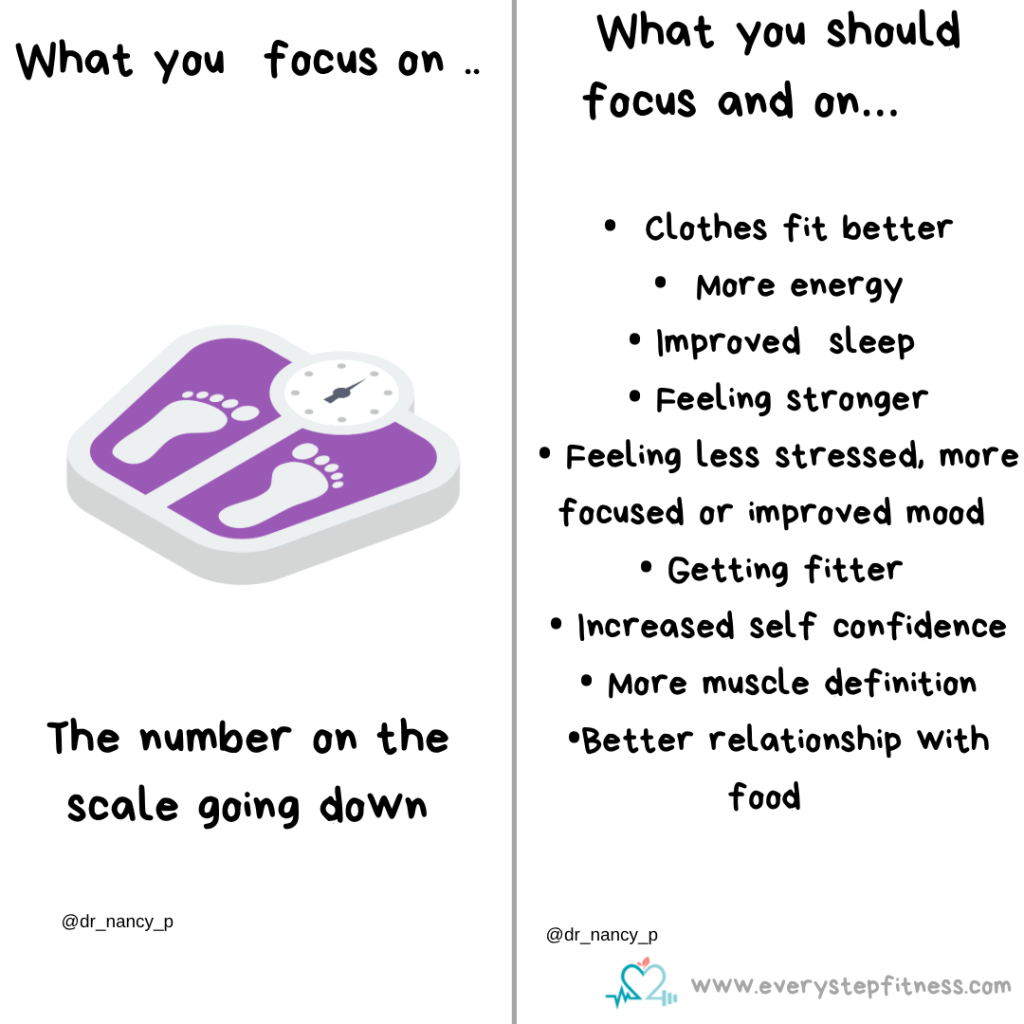
If you’re trying to lose weight (by which we really mean body fat as that is what actually results in body shape change) then it’s important to find ways to measure progress. We tend to focus on a single goal and most often it’s weight related and it’s the ‘final’ goal. This can be one of the reasons you may self sabotage and struggle to stick to your weight loss journey. The goal is so far away that you don’t feel like you’re making progress and in addition because it’s focused on the scales if that number stays static or goes up that can cause you to give up.

We are all conditioned to use body weight scales. They can be a great tool to assess whether you’re making progress. However, the number the scale shows is JUST a number. It’s merely your relationship to gravity at that particular moment in time. It’s not actually the best way to measure progress. Just because the number on the scale hasn’t gone down in a while, doesn’t mean you’re not improving your overall health.

If you decide to use the scale, you need to overlook the day to day changes you will inevitably experience. Scale weight is affected by lots of factors – amount of food in your system, hydration levels, glycogen levels, hormones, salt content of your diet, recent exercise, type of food you ate yesterday (diff foods can result in more or less temporary water retention) etc. None of which are a reflection of how much fat you’ve lost/gained or how your shape has changed. Think about it – if you had the body you wanted and felt confident to wear anything you liked, would it matter what that scale number was? No!

It’s vital to trust the process and think long term. The reality is your body shape can change without the scale going down – in fact a recent client actually put on weight (muscle and fluid probably) yet has lost body fat and cm’s.

So instead of focusing on the end goal weight try to use other measures and do use on the daily/weekly changes outside weight and the number on the scales. e.g. items of clothing and how they fit, sleeping better, feeling stronger, getting fitter, improving your relationship with food etc. Try to focus on some of these other, arguably more important, measures of progress. If you must step on the scales then look at averages over time rather than daily variations and focus on long term trends.

🤗

Xx

Tuesday Tip

Tuesday Tip: Protein Truths

Tuesday Tip: Protein Truths 🍗

There are a lot of myths out there about protein, so here are a few truths.

# You must have protein 30-60 mins after exercise

The anabolic window (the window in which you supposedly need to eat protein to enable muscle growth) is a highly controversial topic, but research shows it is not as important as we once believed. Whilst it can be helpful to have a meal/snack high in protein in the hours following a workout to ensure adequate protein intake if you’re trying to build muscle, it is not a magic window that is only open for 30 minutes after exercise. Especially so if you had eaten already before your workout. The actual window is more like 5hrs plus.

# More protein is better!

People are somewhat obsessed with prioritising protein to recover, gain muscle and lose fat. But the more protein you eat is not always better in terms of muscle mass gain. It requires an adequate amount of energy as well as protein intake. Eating an excessive amount of protein on an already adequate intake of calories will not provide any further benefit and in fact is likely to lead to over consumption of calories and actually gaining fat too. If muscle building is your goal – it takes TIME, and doubling your protein intake past your baseline needs will not speed up this process. If fat loss is your goal, the calorie deficit is king and although protein helps you feel full, extra protein won’t specifically enhance fat loss.

# Protein is bad for your kidneys.

There is no evidence, in human clinical trials that a high protein intake >1.5g per kg of bodyweight is harmful for your kidneys in a healthy population (healthy is a key word here).

# You need protein shakes to meet your daily protein intake.

Protein shakes can be an easy and convenient way of meeting protein requirements if out and about. However a protein shake is not required for muscle protein synthesis after exercise in order to recover effectively. You can get your protein from your main meals etc. So if you’re a fan of them great but if you’re not then don’t worry – you don’t need them!

Happy Tuesday 🤗xx