Nutrition and Calorie Tips, Tuesday Tip

Tuesday Tip: Blood glucose/ Gut microbiome diets

Tuesday Tip: Blood glucose/ Gut microbiome diets 📉

There are a lot of companies at the moment that track your blood glucose, blood fat and gut micro biome – are they really the answer to all our health and weight loss goals?

Healthy individuals without diabetes shouldn’t be worried about their glucose levels since glucose spikes are a totally normal physiological response.
But even if you decide to ignore that statement and use a glucose monitor anyway a recent study found glucose monitors can vary quite wildly in their response to the same meal eaten at different times. So much so that the individual variability in post-meal blood sugar response to eating the same meal had as much variability as eating an entirely different meal. I don’t think people should overhaul their entire diet based on potentially faulty readings.

Even if they were accurate does it translate to more weight loss or better health (which they equate to a ‘better’ glucose response) when following the advice? A 2022 study found no difference in weight loss over 6 months between a control group on a low-fat diet or a personalised diet based on glucose response to foods. A 2023 study found that the personalised diet didn’t lead to greater reductions in blood sugar variability or HbA1c levels compared to a standardised diet.

But what about gut microbiome?
In truth we still know very little about what impact the gut microbiome has on overall health, despite how confidently some people on the internet talk about it. A recent study suggested most diseases are not in fact linked to an altered gut microbiome. Also, the claims that an imbalance in the Firmicutes/Bacteroidetes ratio of the gut microbiota in humans is a hallmark of obesity hasn’t actually been reproduced in human studies. So it’s difficult to associate the gut microbiome with health status and obesity.

In addition a recent study found an increased risk of disordered eating from the use of these glucose monitors in healthy, non diabetic people.

A personal observation – of the clients I know who’ve tried these products – their supposedly personalised diets were all identical which is an interesting coincidence. Remember these companies want your money and are cherry picking studies to support them. If you’re worried about your insulin sensitivity, your first priority should be losing body fat and doing regular physical activity as these will have a far bigger impact on improving your overall health than anything else. As for the gut microbiome, just do what most people already know they should be doing–eat a varied diet of with plenty of whole foods, fruit and veg.

Save your pennies until the research is clearer!

Happy Tuesday 🤗xx

Uncategorized

Tuesday Tip: Blood glucose/ Gut microbiome diets

Tuesday Tip: Blood glucose/ Gut microbiome diets 📉

There are a lot of companies at the moment that track your blood glucose, blood fat and gut micro biome – are they really the answer to all our health and weight loss goals?

Healthy individuals without diabetes shouldn’t be worried about their glucose levels since glucose spikes are a totally normal physiological response.

But even if you decide to ignore that statement and use a glucose monitor anyway a recent study found glucose monitors can vary quite wildly in their response to the same meal eaten at different times. So much so that the individual variability in post-meal blood sugar response to eating the same meal had as much variability as eating an entirely different meal. I don’t think people should overhaul their entire diet based on potentially faulty readings. Even if they were accurate does it translate to more weight loss or better health (which they equate to a ‘better’ glucose response) when following the advice?

A 2022 study found no difference in weight loss over 6 months between a control group on a low-fat diet or a personalised diet based on glucose response to foods. A 2023 study found that the personalised diet didn’t lead to greater reductions in blood sugar variability or HbA1c levels compared to a standardised diet.

But what about gut microbiome?

In truth we still know very little about what impact the gut microbiome has on overall health, despite how confidently some people on the internet talk about it. A recent study suggested most diseases are not in fact linked to an altered gut microbiome. Also, the claims that an imbalance in the Firmicutes/Bacteroidetes ratio of the gut microbiota in humans is a hallmark of obesity hasn’t actually been reproduced in human studies. So it’s difficult to associate the gut microbiome with health status and obesity.

In addition a recent study found an increased risk of disordered eating from the use of these glucose monitors in healthy, non diabetic people.

A personal observation – of the clients I know who’ve tried these products – their supposedly personalised diets were all identical which is an interesting coincidence. Remember these companies want your money and are cherry picking studies to support them. If you’re worried about your insulin sensitivity, your first priority should be losing body fat and doing regular physical activity as these will have a far bigger impact on improving your overall health than anything else. As for the gut microbiome, just do what most people already know they should be doing–eat a varied diet of with plenty of whole foods, fruit and veg. minimally

Save your pennies until the research is clearer!

Happy Tuesday 🤗xx

Nutrition and Calorie Tips

Ice creams / Lollies for 100 cals or less …

Ice creams / Lollies for 100 cals or less … 🍦

The weather has been extremely warm lately so Ice creams and lollies have certainly formed a large part of mine and my client’s diets! There’s a perception that ice creams / lollies are ‘bad’ and something that is a bit ‘naughty’ so if you’re trying to lose weight you might deny yourself these cooling treats believing them to be ‘bad’ (aka high calorie). However, there’s no reason you have to give up ice creams and ice lollies to lose weight as it ultimately comes down to whether you’re in a calorie deficit.

Obviously there are many frozen desserts out there which are high calorie and some can be 300 cals or more. So if they’re on top of your main meals then you might end up racking up unwanted calories. However in this weather everyone needs a cold snack or dessert right? So if you do fancy an ice cream or lolly, but want to stay within your calories then here are a selection of lower calorie options at 100 cals or less. This list is by no means exhaustive – but it’s just a range of the options out there.

Oppo Salted Caramel balls 22 cals each
Mini milk 32 cals
Rocket lolly 39 cals
Mini twister lolly 39 cals
Fruit pastille lolly 57 cals
Little moons mochi balls 70 cals each
Fab lolly 75 cals
Regular twister lolly 76 cals
Jude mini ice cream tubes 70
Jude mini ice creams 94 cals
Exotic Solero lolly 98 cals
Calipo Lolly 100 cals

So you can fill up on ice lollies to stay cool this summer without worrying it’s going to derail your progress!
Enjoy 🤗
Xx

Tuesday Tip

Tuesday Tip: Do diet breaks work?

Tuesday Tip: Do diet breaks work? 🤔

Diet breaks are quite a common thing for people to encourage and are often purported to ‘reset’ your metabolism and therefore increase fat loss long term. But do they work?

A diet break is a strategy in which you take planned breaks from a calorie-restricted diet, during which you consume calories roughly equivalent to your maintenance level (so it’s not a free for all to eat as much as possible).

This temporary pause from the calorie deficit provides a psychological and potentially physiological relief, allowing individuals to experience a break from the rigors of continuous energy restriction.

Studies have looked at the impact of diet breaks on both body composition and metabolic adaptation. The findings show that although the diet breaks did result in an increase in resting metabolic rate it was less than 100 calories a day and temporary. So in real terms they have very little impact on your metabolism and very little impact on fat loss. That doesn’t negate the fact that they may provide psychological relief of course.

So what does this mean? Diet breaks are fine if they help you and make it easier for you to stick to your diet long term. However they won’t have a significant impact on your metabolism or boost fat loss. In addition you have to ensure you are still tracking calories and only going up to maintenance calories on such a break otherwise you will actually end up putting fat back on.

Happy Tuesday 🤗xx

Nutrition and Calorie Tips

Stop doing… and start doing ….

Stop doing… and start doing …. 🙌🏼

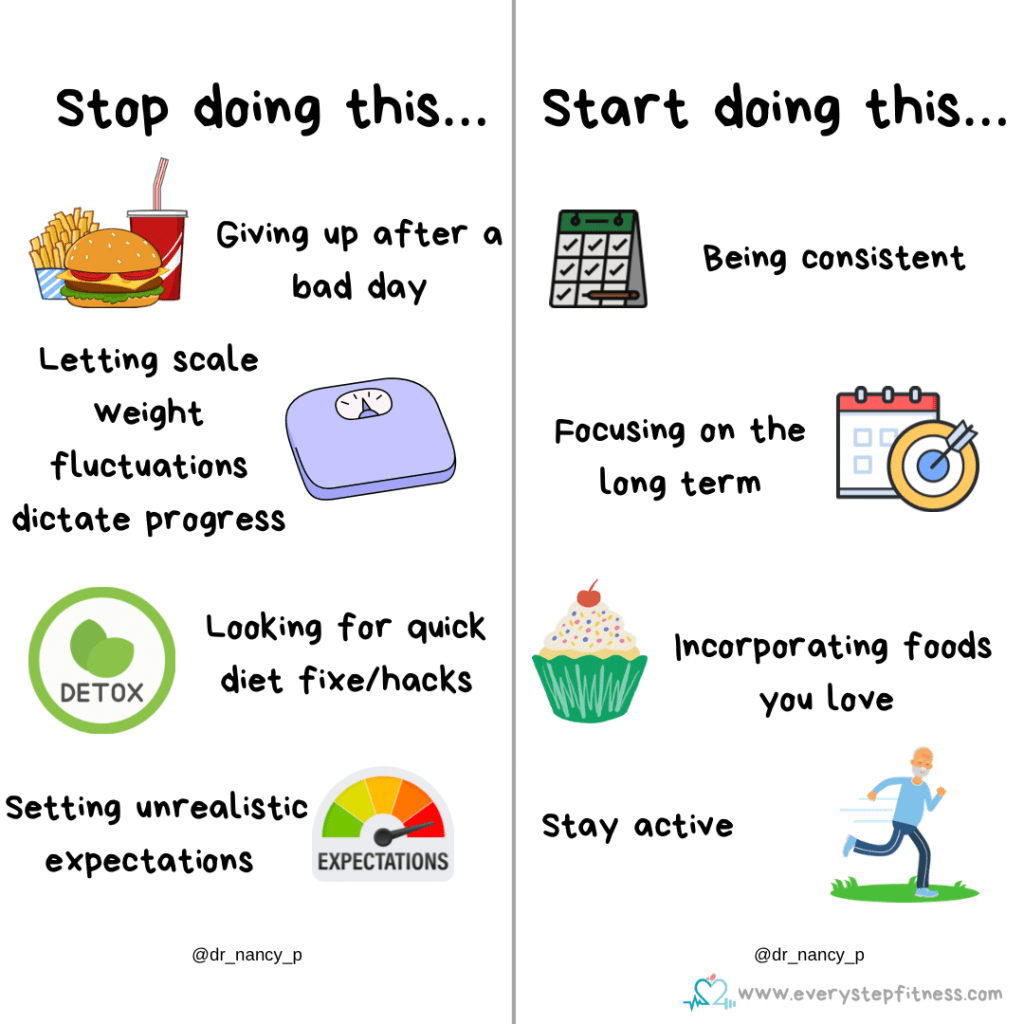
Short and sweet today and a bit of tough love. There’s a lot that goes into reaching your goals – both physically and mentally. On some level you just need to accept that it will be hard. There will be bad days where you eat way more than you planned on eating – but you can’t throw in the towel every time it happens. You won’t linearly make progress every week and if you rely on the scales to determine whether you’ve progressed or not then you will forever be setting yourself up for disappointment. If you expect to reach your goal in a few weeks you’ll also be setting yourself up for failure.

It’s tempting to follow the latest diet fad, or whatever trend everyone is talking about on social media, or to cut whatever the latest ‘demon’ food group is. This won’t work – unless you learn to incorporate all the foods you enjoy in this process you’ll never succeed long term. You need to try to be as consistent as possible, stay active, and play the long game.

Ultimately, you face a choice: remain stagnant in your current situation or just move on past those “off” days or weeks when the scale doesn’t drop etc and get back on track. Whether it takes a few extra months to attain your objective is inconsequential, what truly matters is reaching it. If you give up, you will never reach it. So keep on keeping on!

Enjoy 🤗

Xx