Tuesday Tip

Tuesday Tip: Why weight loss plateaus

Tuesday Tip: Why weight loss plateaus 📈

Usually a few months into a new diet (or eating regime) we start to see plateaus – this is despite people claiming they are still eating the same amount (at a calorie deficit) and exercising the same. Why?

It could be that you’ve lost so much that your caloric requirements have dropped slightly and therefore you need to adjust your calorie goals, but there’s another more common reason.

A couple of recent studies found that as weight (fat) loss dropped participants subconsciously increased their calorie intake. For every 1kg of fat lost, they were consuming an extra 100 calories per day, without realising they were doing it. This is due to increased hunger in response to weight loss, and as the kgs drop, the extra calories sneak back in. So after losing 3-4kg that’s an extra 300-400 cals a day which puts you back at maintenance calories, stalling weight loss.

Another study also found that for every 1kg lost participants expended 20 – 30 cals less energy per day. This is a subconscious reduction in NEAT (non-exercise activity thermogenesis) such as standing less, walking less etc and a decrease in bodily functions e.g. blinking less, breathing slower etc

Over the course of several months, with a fat loss of say 4kg you could be unknowingly consuming an extra 400 cals, and burning 120 cals less, that means an extra 520 cals a day which wipes out your deficit, can stall any fat loss and even cause weight regain.

So what can you do?

Usually a few months in, with fat loss going well, people go back to eyeballing portion sizes and that’s where those extra calories will sneak in from slightly larger portions, an extra 5g here and there etc so I encourage my clients to go back to basics and measure portions. Also be mindful of extra mouthfuls of things you’re not tracking (grabbing the odd handful of cereal, crisp, etc).

Focus on more filling foods to help combat the hunger too – foods high in fibre, protein and good fats.

In terms of energy expenditure – try to be as active as possible – add a few more steps to your day for example, be mindful of standing more than sitting etc.

Happy Tuesday 🤗

Xx
Nutrition and Calorie Tips

‘High protein Babybel? Must be the best one…’

‘High protein Babybel? Must be the best one…’🧀

I often talk about marketing when it comes to the foods we eat and protein is often something that’s used to market products.

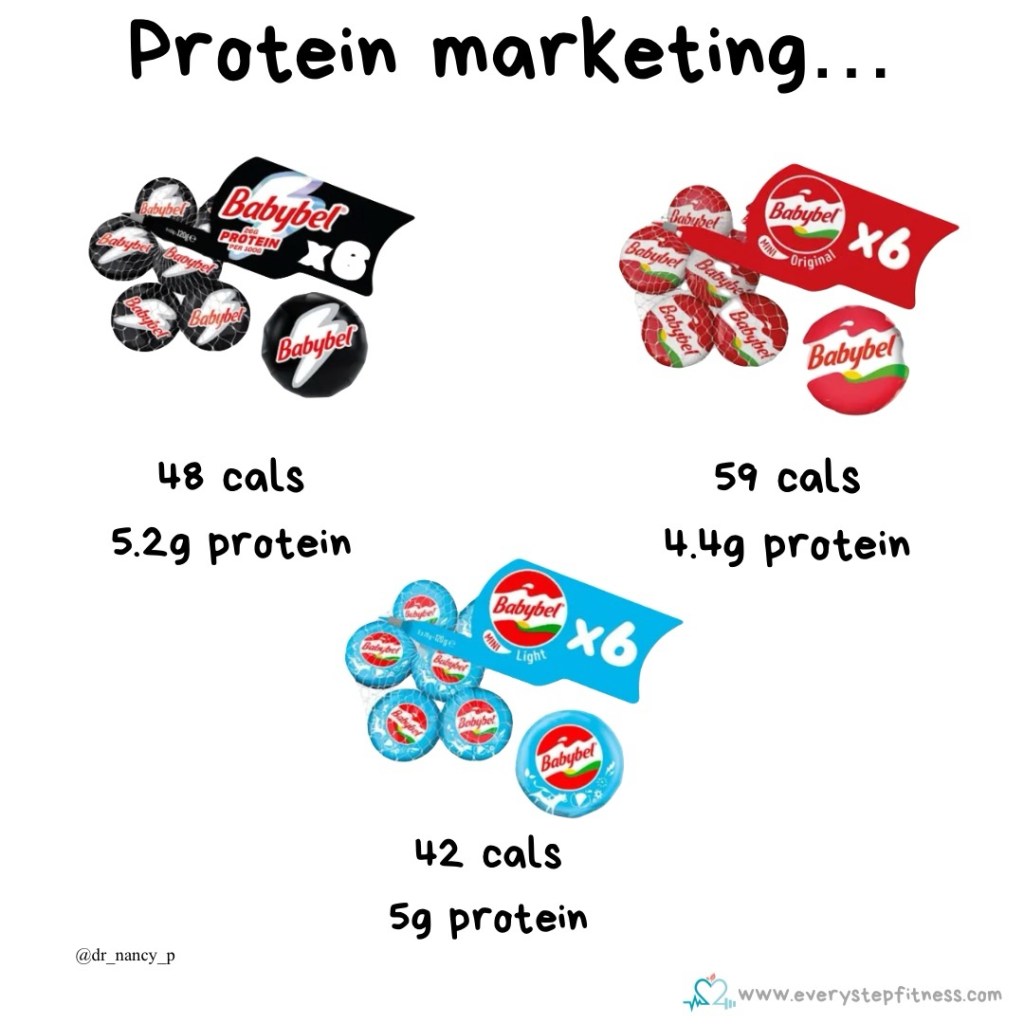
This is a great example – three types of Babybel. All small, all cheese, all decent snacks, but one is branded ‘High Protein’ with bold black packaging. So it must be the healthiest and best right?

Not necessarily!

‘Protein’ Babybel: 48 cals, 5.2g protein

Light Babybel: 42 cals, 5g protein

Original Babybel: 59 cals, 4.4g protein

So despite being marketed as a ‘protein’ has just 0.2g more protein than the light version and 6 more calories. It’s a minor difference, but branding it ‘high protein’ makes it feel like a superior option. In reality, they’re all pretty similar – and the light version is arguably better in terms of protein per calorie.

In this example it’s not really a major issue – they’re all pretty similar calorie wise but often you’ll find the ‘high protein’ options may be higher in calorie and not that high in protein really. Brands know that protein sells. Stick ‘protein’ on a label and it taps into everything we associate with health, fitness, and weight loss. But if you take two almost identical products and just call one ‘high protein’ most people will gravitate toward it, even if the numbers don’t back it up.

In this example all of these option are great snack choices but don’t let flashy packaging override common sense. Always flip the product over and read the label. Don’t pay more in calories or cash for an illusion of health. Don’t let marketing labels decide for you. Read. Compare. Choose based on facts, not hype.

Knowledge is power!

🤗Xx

Tuesday Tip

Tuesday Tip: Muscle Confusion ≠ Muscle Growth

Tuesday Tip: Muscle Confusion ≠ Muscle Growth 🏋🏻‍♀️

There’s a common belief that constantly switching up your workouts is the “secret” to building muscle and progressing with strength. The idea is that you have to “confuse your muscles” for them to grow and get stronger. But is that really how progress works?

Muscle confusion is just another trendy approach rather than a proven strategy. In reality, your body thrives on repetition, not randomness. Growth and strength come from doing the same key movements consistently over time.

That means:

• Sticking to foundational lifts (think squats, presses, rows)

• Tracking your progress

• Gradually increasing weight, reps, or control

• Staying consistent, not chasing the latest TikTok workout trend

Studies show that people who followed a structured program using familiar movements with progressive overload made better strength progress than those who constantly changed their routines.

So what should you focus on?

• Progressive overload (adding challenge over time)

• Mastery of key movements (like squats, presses etc)

• A well-designed plan that supports your goals

• Consistency, not novelty

Random variety might feel fun, and there’s nothing wrong with enjoying your workouts, but don’t confuse “feeling the burn” with actual progress. The goal isn’t to just sweat. It’s to improve.

You don’t need to shock your muscles to grow. You need to train them with purpose. Keep it simple, stick with what works, and watch your strength build week after week.

Happy lifting! 🤗xx

Nutrition and Calorie Tips

8 Habits to help with fat loss

8 Habits to help with fat loss 😊

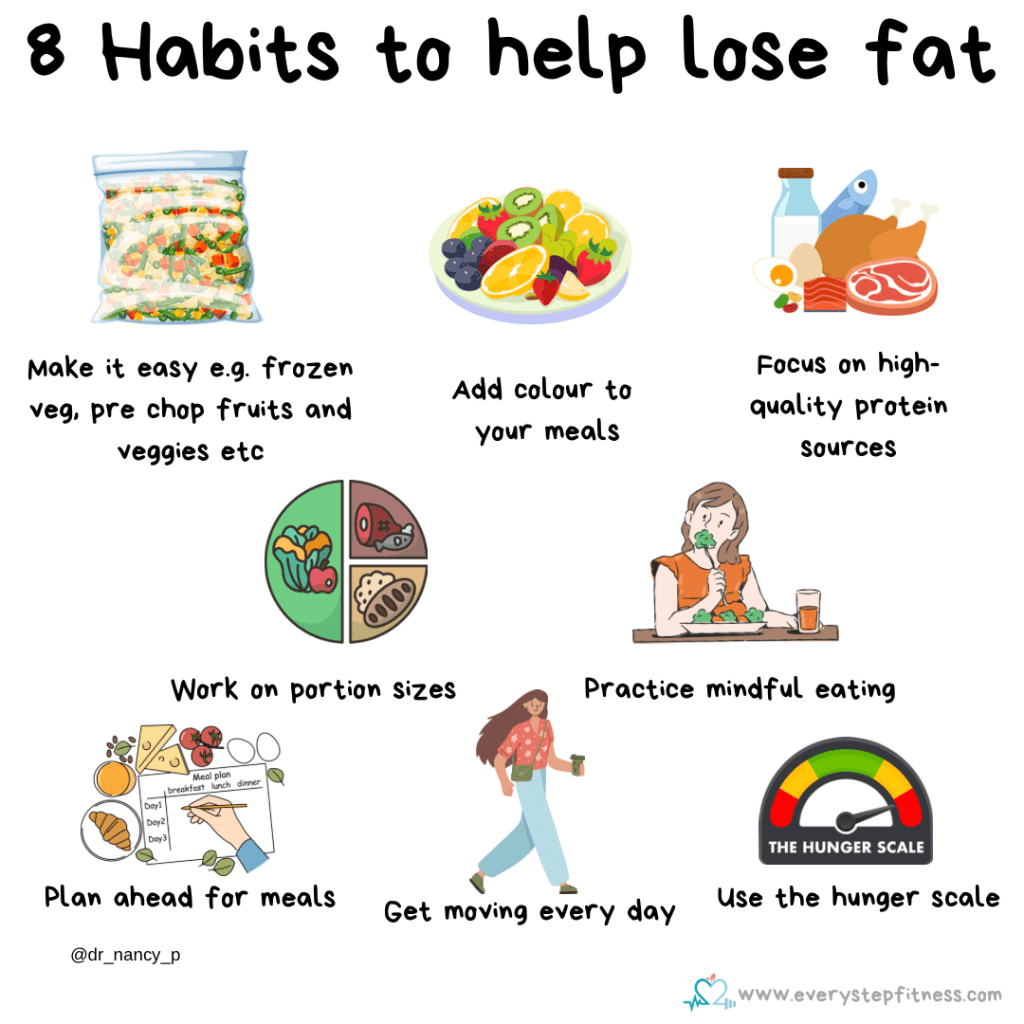
Although I’m a big fan of tracking calories I know it’s not for everyone so here are 8 habits that don’t involve calorie tracking that can help with losing fat (they can also be used alongside tracking of course!).

# Make Healthy Food Easier to Grab

• Chop fruits/veggies in advance

• Keep them visible in the fridge or on the side.

• Use canned/frozen produce, they’re just as nutritious as fresh

# Add Colour to Your Plate
Fruits and veggies are packed with vitamins, fibre, and water. More color equals more nutrients and fullness. Aim to include as many colours as possible at every meal.

# Prioritize Protein
Protein helps control hunger and supports muscle. Include it in every meal.

• Pure proteins: chicken breast, egg whites, tuna, white fish, whey

• Protein with fat: salmon, whole eggs, cheese

• Protein with carbs: beans, lentils, milk, edamame

(NB: Peanut butter is mostly fat, not a great protein source!)

# Think About Portions
Use this plate method:

• ½ veggies

• ¼ lean protein

• ¼ carbs

• Healthy fats in moderation

# Eat More Mindfully
Slow down when you eat and notice the taste, texture, and aroma. Put your phone away- the more present you are, the easier it is to stop when full.

# Use the Hunger Scale
Tuning into hunger cues helps avoid emotional or mindless eating. Use the hunger scale 1-10 : 1. Ravenous – 2. uncomfortably hungry – 3. very hungry – 4.‘I could eat’ – 5.Neutral – 6. satisfied – 7. full – 8. very full – 9. uncomfortably full – 10. ‘I feel sick’

Start eating around “I could eat” (4) and stop near “satisfied” (6–7).

# Move More
No fancy workouts required – Walk, stretch, garden, clean, take the stairs. NEAT (non-exercise activity) adds up and burns more than you think.

# Plan Ahead
When you’re starving with no plan, take away win. So instead meal plan once a week, prep in batches and cook extra for leftovers.

Focus on consistency overt perfection and build small habits that last and make fat loss feel daunting.

🤗Xx

Tuesday Tip

Tuesday Tip: Processed ≠ Unhealthy

Tuesday Tip: Processed ≠ Unhealthy 🥦🍗

There’s a common belief that processed food automatically means it’s ‘bad’. But is that really true?

Almost everything we eat is processed in some way. A processed food is simply any food that’s been altered from its original state, which means the majority of what’s in your fridge or cupboard qualifies.

That includes:

• Pre-cut fruit and veggies

• Frozen veggies

• Canned beans or fruit

• Boneless, skinless chicken

• Whole grain bread

These foods are technically processed, but that doesn’t make them ‘bad’ or unhealthy. Processing can actually make food safer, more convenient, and even more nutritious e.g. frozen spinach that retains its nutrients better than ‘fresh’ spinach sitting in your fridge for a week.

But what about ultra-processed foods?

Ultra-processed is more of a buzzword than a clear scientific category. Definitions vary widely across studies, and the term includes everything from chips and pastries to protein bars and shakes.

So, should you avoid them altogether?

Not necessarily. Many so-called ultra-processed foods are can be nutrient dense e.g protein powders, snack bars fortified cereals etc . So what is the real issue? Some ultra-processed foods are engineered to be hyper-palatable meaning they’re super tasty and easy to overeat, which can lead to excess calorie intake over time. That doesn’t make them ‘bad’, it just means we need to be mindful.

Here’s what matters more:

• The overall quality of your diet

• Whether you’re eating enough whole foods (lean protein, fruits, veggies, whole grains)

• Managing your portion sizes and total calorie intake

Bottom line? A healthy diet doesn’t have to be 100% ‘clean’ (a meaningless term). It’s okay to enjoy convenient, processed options, especially when they support your goals, save time, and help you stay consistent. So next time you hear the word processed don’t panic. Nutrition isn’t black and white. It’s about the big picture and that includes balance, flexibility, and a bit of common sense.

Happy Tuesday! 🤗xx