Tuesday Tip

Tuesday Tip: Hunger Management

Tuesday Tip: Hunger Management 😝

Hunger management plays a crucial role in successful weight loss. People often over restrict and starve themselves which, whilst obviously may work temporarily , usually leads to cravings, binge eating, and hunger. All of which derail progress and of course make it unsustainable.

With a sustainable calorie deficit there will still be some mild hunger. This isn’t a cause for concern and it’s to be expected but it’s helpful to have some strategies to help manage this so you can stay on track. Essentially it comes down to making food choices which maximise feelings of fullness whilst minimising calories. Remember total calories still count when it comes to weight loss so these are all within that context.

Here are a few things that can help:

#1 Higher protein intake may lead to improved feelings of satiety and less cravings. But, if you already eat a high-protein diet (1.6g/kg+) then it won’t make much difference. Also be aware that prioritising protein too much may lead to to eating fewer carbs which you also need and can mean you end up low on energy and more hungry. So don’t remove carbs either!

#2 High fibre foods help by bulking food volume, slowing digestive time and increasing gut fermentation – all

Of which lead to feelings of fullness. Low energy dense high fibre foods like fruit and veg are a great option.

#3 Fats can help with feelings of fullness (especially when combined with protein) but

they may not be the best option for

hunger management, especially if you

have a tight calorie budget. Fat provides more then double the energy of carbs / protein so it easy to eat more cals with a smaller serving of a high-fat food, compared to a high-carb food

# 4 Go for high volume foods or combinations of foods. If you’re having a lower calorie snack bulk it out with things like fruit or veggies, or a zero cal drink (water or soft drink) to help.

#5 include whole , unrefined carbs as they aid in satiety, muscle recovery and training performance /energy levels (and they’re tasty!)

#6 Our beliefs and perceptions impact feelings of fullness. Perceptions of what a ‘normal’ portion size is impacts whether we feel full after eating it. Equally our beliefs about certain foods have the same effect e.g. if you believe a protein in bar is more filling it will feel that way. Increasing knowledge around calorie content can help with this.

Happy Tuesday 🤗

Xx
Nutrition and Calorie Tips

Best methods for recovery?

Best methods for recovery? 🧊

Like everything in the fitness and diet industry the subject of recovery and methods to aid recovery are full of fads and social media trends. Common post workout recovery options include, foam rolling (with expensive, fancy rollers), massage guns and cold water immersion, with the latter gaining popularity as ice baths have become a must in “self-improvement/discipline” circles recently. Social media is full of celebrities and fitness personalities sharing their cold water immersion practices, with dedicated tubs/barrels etc.

Studies have shown that cold water immersion, massage guns and fancy foam rollers don’t actually result in significantly better recovery than just resting and good nutrition. In fact some are less effective. Several studies have also found that ice baths can negatively impact muscle and strength adaptations. A recent overview of studies found that taking an ice bath immediately after a workout leads to less muscle growth than resistance training alone.

Whilst often promoted as “game changers” these methods aren’t really that at all – at best they may help reduce soreness and perceptions of fatigue but don’t come even close to the effect that sleep and nutrition have on your recovery and muscle growth.

For competitive athletes, it may be important to incorporate some of these things into their recovery leading up to a competition, in conjunction with adequate rest and food, particularly at time where fatigue needs to be quite low. If you’re someone looking to increase muscle mass, cold water immersion should be used sparingly (e.g. only after very hard training sessions) as it can interfere with hypertrophy (muscle growth).

For most of us simply spending more time and energy focusing on good sleep and good nutrition will not only help you recover better and faster, and benefit your progress in the gym, but it will also likely positively contribute to your overall health and wellbeing.

🤗xx

Tuesday Tip

Tuesday Tip: 3 tips to help weight loss

Tuesday Tip: 3 tips to help weight loss 🙏🏻

#1. Stop labelling foods GOOD or BAD

Foods don’t have a moral compass. No food is inherently bad or wrong but beating yourself up over eating foods you enjoy is bad. Yes, some foods have a higher nutritional value than others but it’s not helpful to demonise the less nutrient dense options. It’s always dependent on the context. Ask yourself – will this food satisfy me? Is eating it right now helpful to my goals or does it fill another need (emotional etc)?

Does it fit into my remaining daily calories?

#2. Stop depriving yourself of everything delicious in life!

It’s not realistic to avoid sugar, fried foods, pizza, alcohol and cake for weeks or months on end. It’s also not necessary. Instead embrace an 80/20 balance. 80% whole foods, 20% more indulgent foods like cookies and pizza (all within your calories)

You’ll feel less deprived and more likely to stick to your diet long enough to actually see results

#3. Learn your hunger triggers

Are you truly hungry? We’ve all eaten when we are not hungry. And that’s OK! But when you’re trying to lose weight, knowing the difference between physical and psychological hunger is helpful. Use the acronym BLASTED ( am I – bored, lonely, angry, stressed, tired, emotional, distracted) to identify emotional eating triggers and try to tackle the root cause rather than eating something which won’t fix the actual issue

These 3 simple mindset shifts can take some of the struggle out of your weight loss journey.

Happy Tuesday 🤗xx

Nutrition and Calorie Tips

Optimal vs reality….

Optimal vs reality…. ⭐️

One of the keys to losing weight and maintaining it is consistency, and one of the key things that help with consistency is learning not to throw in the towel and say f*ck it every time things don’t go to plan.

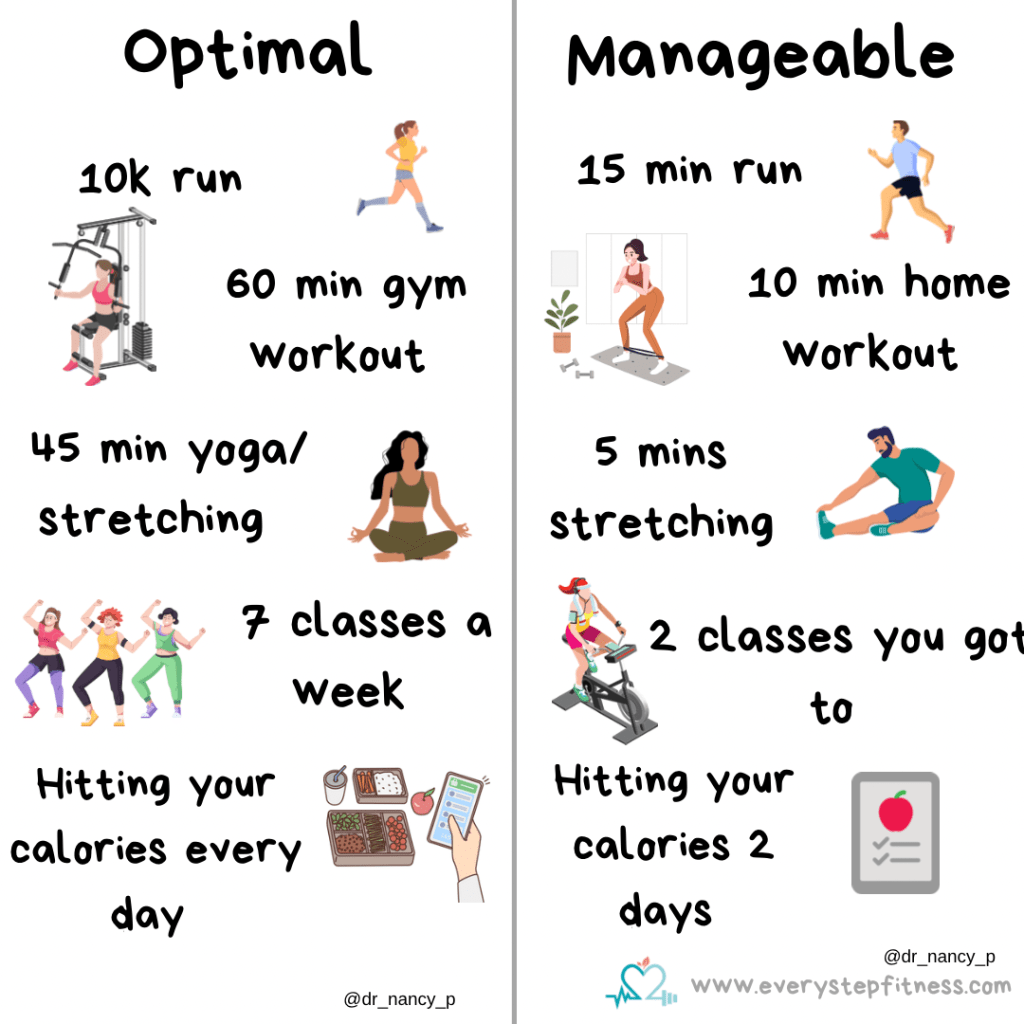
Obviously in an ideal world we’d all have an optimal workout routine – you’d manage 7 classes a week, you’d fit in 45 mins if stretching and your 10k run, and hit your calories every day. But life isn’t optimal and optimal is irrelevant if you don’t or can’t do it. Imperfect action is better than no action! The 5-10 min workout you actually do is better than the 45 min workout you don’t manage to fit in at all.

Life is full of unexpected obstacles. You can either let it defeat you and use it as an excuse to come off the wagon completely , or you can change your mindset and accept that it’s not about being perfect every single day. It’s about doing the best you can in the circumstances – that day/week.

So maybe you can’t fit in your planned 45 min workout, but could you do ten mins instead? Can’t fit in a 10k but can manage a 15 min run instead? Not going to hit that step goal – could you do a 5 mins walk anyway just to get a few more steps in? Not tracking your calories like you planned – ok well can you focus on making some different choices, fill up half your plate with veggies, cut back on a the dessert or booze? Had a rubbish day and eaten half a packet of biscuits? Stop stressing and just make sure the next thing you eat is back on track.

Even doing something, no matter how insignificant it may seem, is better than doing nothing!

🤗xx

Tuesday Tip

Tuesday Tip: Weights won’t make you bulky

Tuesday Tip: Weights won’t make you bulky 💪🏼

Many female clients often tell me they don’t want to lift weights because they’re afraid of getting too big or bulky. What they mean when they say this is that they don’t want to put on too much muscle mass – they have visions of chunky thighs, thick necks, huge biceps, heavy set shoulders etc.

The reality is that over 30 you’re losing lean muscle at a rate of 3-8% a year if you don’t regularly do resistance workouts. As you age oestrogen levels drop which contribute to this loss. So getting ‘bulky’ is actually a pretty big uphill battle.

To get to a bulky or body-builder level of muscularity, you’d not only have to train and diet in an extreme fashion, but you’d have to keep at it for years. I’ve got clients actively trying to ‘bulk’ and it’s a slow process that requires dedication to weight training and to eating … a lot! Body builders and those types of athletes work extremely hard to look the way they do; you won’t end up there by accident, I promise. If you want to gain significant amounts of muscle mass, you’re looking at five to six days of heavy lifting a week, every week for months and months. Doing a few weights workouts a week, or a few pump classes will not make you bulky. Gaining muscle mass comes from a combination of heavy weight training and an excess in calories.

So if you are aiming to lose fat and are at a calorie deficit (or even maintenance/ slight surplus ) then doing weights workouts 3-4 times a week won’t result in large amounts of muscle growth. What it will do though is increase your lean body mass. This has two benefits – it increases your metabolic rate which means you’ll burn more calories at rest. It will also help provide the ‘sculpted’ or ‘toned’ look many people want. By working those muscles you’ll create a solid muscular base so that as you lose fat you’ll start to see the shape you’re looking for. It will also make you feel strong – and that’s a great feeling!

So don’t be afraid of lifting weights – they’re an important component of any fitness program. They’re also vital – especially for women as we age – as a way to help protect against osteoporosis. So try to to get over the fear of getting “too muscly”, and step away from the obsession with thinness and instead focus on getting stronger!

Happy Tuesday 🤗xx