Nutrition and Calorie Tips

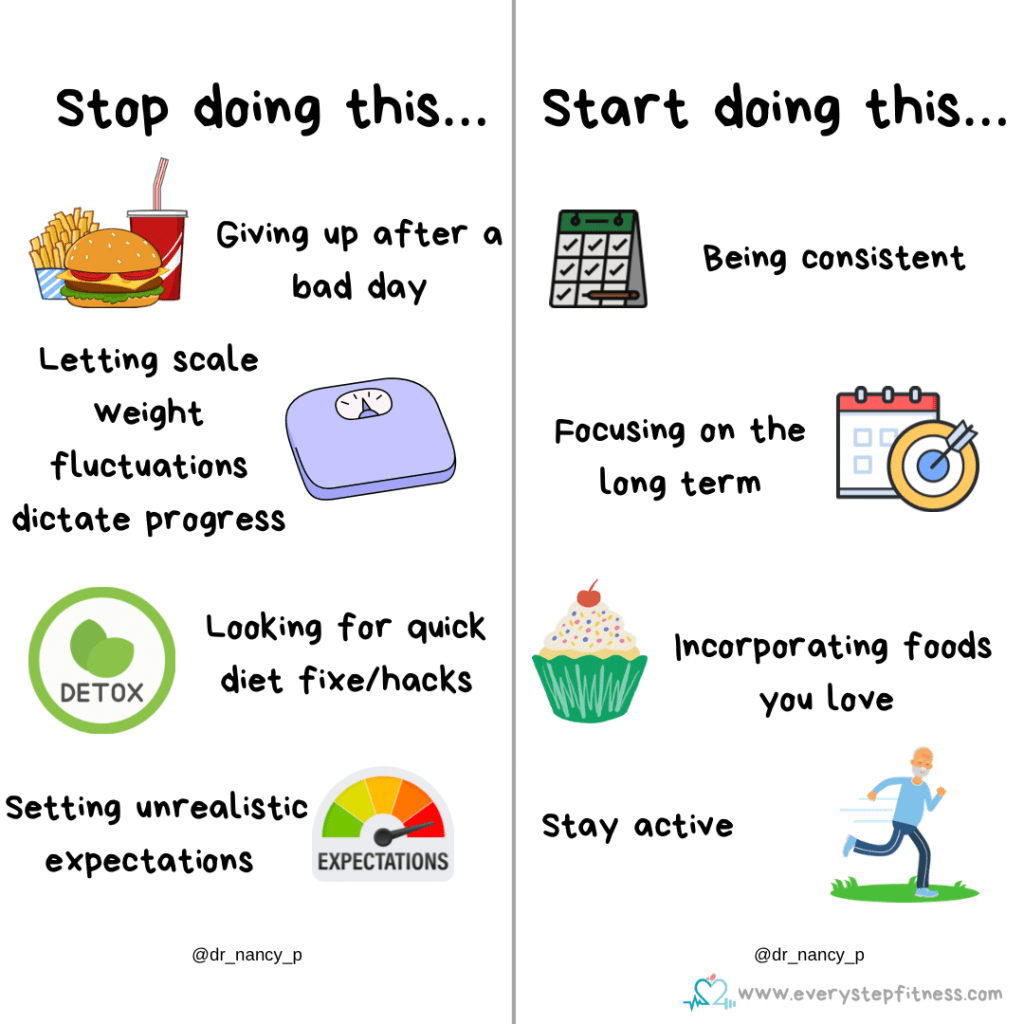
Stop doing… and start doing ….

Stop doing… and start doing …. 🙌🏼

Short and sweet today and a bit of tough love. There’s a lot that goes into reaching your goals – both physically and mentally. On some level you just need to accept that it will be hard. There will be bad days where you eat way more than you planned on eating – but you can’t throw in the towel every time it happens. You won’t linearly make progress every week and if you rely on the scales to determine whether you’ve progressed or not then you will forever be setting yourself up for disappointment. If you expect to reach your goal in a few weeks you’ll also be setting yourself up for failure.

It’s tempting to follow the latest diet fad, or whatever trend everyone is talking about on social media, or to cut whatever the latest ‘demon’ food group is. This won’t work – unless you learn to incorporate all the foods you enjoy in this process you’ll never succeed long term. You need to try to be as consistent as possible, stay active, and play the long game.

Ultimately, you face a choice: remain stagnant in your current situation or just move on past those “off” days or weeks when the scale doesn’t drop etc and get back on track. Whether it takes a few extra months to attain your objective is inconsequential, what truly matters is reaching it. If you give up, you will never reach it. So keep on keeping on!

Enjoy 🤗

Xx
Tuesday Tip

Tuesday Tip: Diet Mistakes

Tuesday Tip: Diet Mistakes 🫣

Whatever dietary approach you choose MUST be sustained in order for you to get and maintain the results. If the approach is unsustainable then so are the results.

Here are some common mistakes:

# Choosing a diet that doesn’t align to your lifestyle.

No diet is inherently ‘better’ than any other as long as it creates a calorie deficit and fits in with your lifestyle. Choose a diet that is sustainable for you.

# Expecting fast results

You didn’t put the weight on in a few weeks, you won’t lose it on a few weeks. It takes time. Stick with it and you will see results.

Consistency is key.

# Food restriction

Excluding certain foods or food groups instead of incorporating them into your calorie targets is a recipe for unsustainability. Instead focus on healthy moderation to reduce the risk of cravings and binge-eating episodes and help you maintain long term.

# Adding back calories burned from exercise

Never ever eat back the calories burned from exercise. Aside from the fact that our bodies adapt rapidly to activity levels devices that measure calorie expenditure have been shown to overestimate calories burned by 28-93%! That means if you burned 500 calories, your device might tell you that you burned anywhere between 630-1000. That would take you out of your calorie deficit if you eat that back. Separate the exercise – view it as something for mental and physical well being, not weight loss.

# Setting unrealistic goals

Make your goals realistic and achievable – e.g. losing a stone in 3 weeks isn’t realistic.

Remember, you are working to build a new lifestyle and not a quick fix!

Try to avoid these mistakes and focus on making your dietary approach a lifestyle that you can sustain for the long term if you truly want life changing results.

Happy Tuesday 🤗xx

Nutrition and Calorie Tips

A day of snacks…

A day of snacks… ☕️ 🍫

There are lots of strategies you can use when trying to stick to your calorie deficit to lose weight/fat. Being aware of the calories in the foods you choose to consume and swapping to lower calorie foods which you also enjoy is an obvious option. As well as the calories though it’s worth considering the quantity and volume of the food you’re choosing.

Snacking is a common problem and an easy way to extra calories to sneak in. It’s not hard to accumulate over 1000 cals of snacks in a day. A coffee when you get to work with a couple of biscuits (medium semi skimmed latte and chocolate digestives), a ‘healthy’ snack mid morning of 30g cashews and an apple, a Mars bar to give you a bit of an energy boost in the afternoon, and a small bag of kettle chips when you’re waiting for dinner. None of that will seem excessive at the time, in fact you may not even notice much if it. You can see, however, how easily it could take you over your calories for the day.

There are some easy swaps you could make that won’t impact too much on your satisfaction, still allow you to follow your preferred pattern of eating but save 500 cals. In this example you could swap the coffee to a flat white and the digestives to a couple of lotus biscuits. You could just have the apple for your ‘healthy’ snack, swap to a curly wurly to give you an afternoon boost and some pop chips pre dinner and you’ll save over 500 cals, and it’s still a lot of snacks so you won’t feel deprived.

Obviously you may decide instead to cut a few of the snacks and have the higher calorie options, but that’s where knowing the calorie content comes in! You can have whatever you want, if you can fit it into your calories, this is just another strategy to add to your toolkit to help you stick to those calories.

Enjoy 🤗
Xx

Tuesday Tip

Tuesday Tip: Mindless Snacking

Tuesday Tip: Mindless Snacking 🍪

Many of us suffer from mindless snacking which can slow your weight loss progress and stop you reaching your goals. Here are some tips to help.

# Control your environment

Don’t buy the snack in the first place. Easier said than done sometimes but if they aren’t in your cupboard you’re far less likely to eat them.

# Be intentional with meals

Take time to sit down and enjoy yours meals. Try to stay off your phone, don’t watch TV or try to do other things while yon eat. Focus on the food and flavours to enjoy it more.

# Make it harder to snack

If you are going to have snacks in the house, make it harder to eat them. So for example keep things like fruit out and easily accessible but keep the biscuits and chips in a cupboard in a different room/ at the back of the cupboard/inside a tin etc.

# Know your trigger foods

Everyone has food that triggers them to overeat. Be aware of them and try to avoid them, keep them out of the house or pre-portion them.

# Find other stress relievers

This could be working out, going for walks, doing yoga, mediation, journaling, time with family or friends, other hobbies etc.

# Stay busy

This keeps your mind off food and snacks. Use the extra time to do something productive if you can – be it towards yours fitness, a hobby or even some productive self care like a bath etc.

# Stay hydrated

This can help reduce hunger and cravings throughout the day.

# Try to get more sleep

This will help you feel like you have more energy and therefore be less likely to use food as a pick me up, and it will reduce the production of the hormones that cause hunger too.

Happy Tuesday 🤗xx

Nutrition and Calorie Tips

What happens when you eat carbs at night?

What happens when you eat carbs at night?🥔

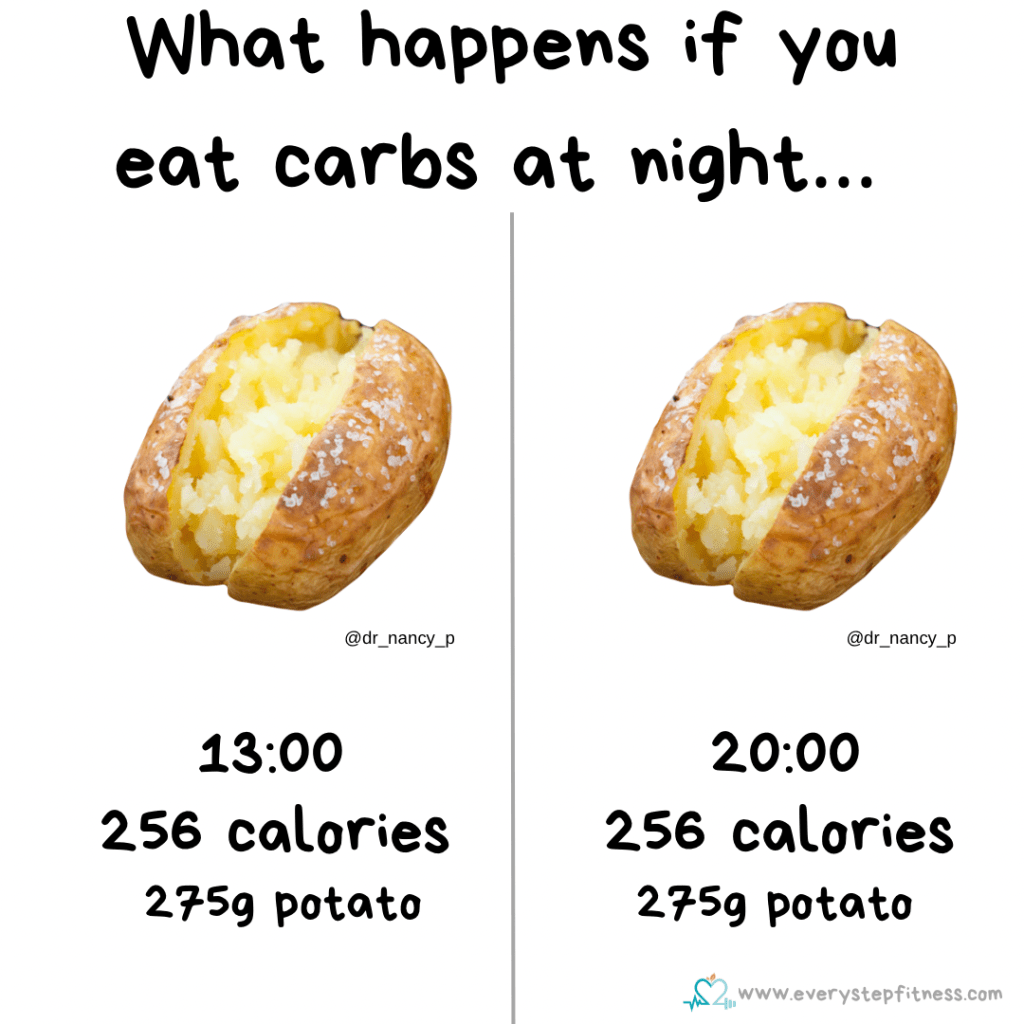
Some people have suggested that eating carbs at night, before you sleep should be avoided because you are more likely to store fat since you are sleeping shortly after the last meal, so you won’t have a chance to ‘burn it off.’ Is there any truth to this?

Nope. This isn’t how your metabolism works. Your metabolism doesn’t shut off just because you’re asleep, you’re still metabolising nutrients and creating fuel while you sleep. It’s also not how body fat is gained or lost – it doesn’t occur at specific times of the day. When you eat it’s likely that you will store some fatty acids in adipose tissue. But they can be mobilized again as we go through periods of ‘fasting’ and ‘feeding’ during the day. For example, if you only ate one really large meal per day, you would store a significant amount of fatty acids in adipose tissue, since the meal would likely be quite calorie-dense. However, after several hours, you would likely begin mobilizing much of that energy during the long ‘fasting’ window since you only ate a single meal. If on the other hand you ate 8 meals per day (totalling the same number of calories overall) you would store fewer fatty acids after each meal, but you also have a much shorter fasting window. The overall result though would be the same – you’d end up storing / metabolising the same amount of fatty acids.

Now people tend to focus on carbs as they’re often seen as the devil and also tend to be more calorie dense (especially when you include things like cakes, biscuits, pizza, etc that technically are a combination of carbs and fat) but studies show that it makes no difference to fat storage whether your calories are from carbs or other macros. So regardless of the content of the meal if you eat a big meal at night, then yes you will probably store more fatty acids overnight as it is a high calorie meal. But as you then have a long ‘fasting’ window while you sleep you will metabolise some of them. And as long as the meals you have earlier in the day don’t take you over your calorie goal it won’t result in actual body fat gains.

So, eating (anything) at night is not going to make you store more fat, and this is supported by research. At the end of the day, the most important factor for success is hitting your calorie target consistently. Eat in a pattern that allows you to be most consistent at hitting your calories.

🤗

Xx