Nutrition and Calorie Tips

‘That’s so unhealthy – it’s full of sugar’…

‘That’s so unhealthy – it’s full of sugar’… 🍫🥛

Let’s kill the sugar myth real quick…

There’s a pervasive myth that sugar is bad – particularly sugar in processed foods. However the view is that ‘natural sugar’ is absolutely fine?

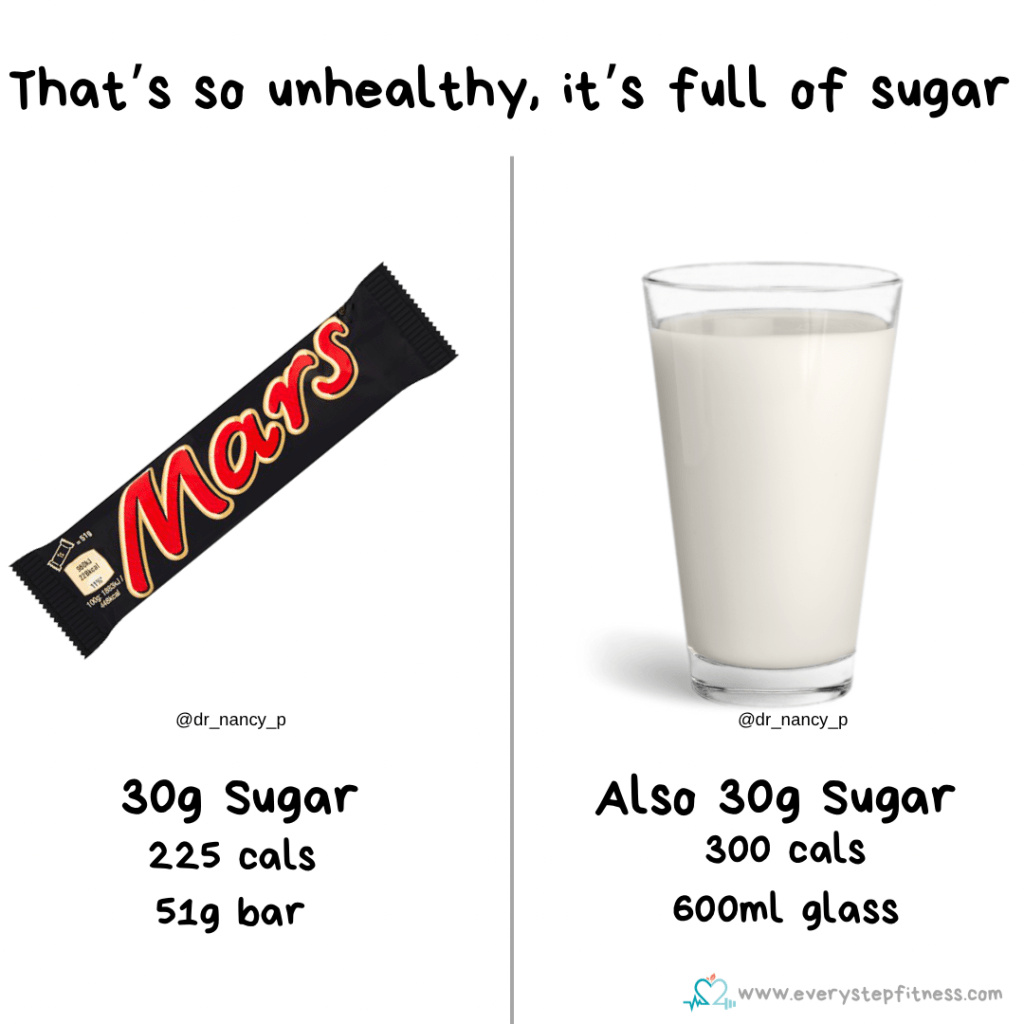
A mars bar contains around 30g sugar and a 600ml glass of milk also contains 30g sugar. However people will demonise the chocolate bar on the basis of its sugar content but will say milk is the ‘healthier’ choice, despite the sugar content? Why? Because the sugar in milk is ‘natural’ so it must be better, right?

Not exactly. Sugar is sugar. Whether it’s added to a chocolate bar or naturally found in milk as lactose, your body processes it the same way. What matters more is the context: how much you’re consuming, how filling it is, and whether it fits into your overall diet.

In this example the Mars bar contains around 225 cals and 30g sugar, whilst the milk contains around 300cals and 30g sugar. That’s the same amount of sugar and more calories in the milk. But most people wouldn’t blink at drinking a big glass of milk with breakfast, while feeling guilty over snacking on Mars bar.

Now obviously the milk has other benefits in terms of more protein and other micronutrients but in the context of the argument around sugar it’s no better than a mars bar. It’s not about “natural vs added” sugar, it’s about your whole diet. If you’re having a load of whole foods and protein in other meals then the Mars bar isn’t an issue if you can fit it within your calories. If however you’re eating 4 of them and your meals are also high in calories and low in micronutrients then it probably isn’t a great idea. The milk might be a better ‘snack’ but it still contains a significant number of calories so that needs to be accounted for.


We need to stop demonizing sugar based on its source and start looking at the bigger picture: calories, satiety, and how everything fits into your goals.

Both milk and Mars bars can have a place in a balanced diet, if you manage portions and priorities.

🤗

Xx
Tuesday Tip

Tuesday Tip: You won’t get ‘bulky’

Tuesday Tip: You won’t get ‘bulky’ 💪🏼

There’s a common fear, especially among women, that lifting weights will lead to getting “too bulky.” But is that really a justified concern?

Very few people naturally build extreme amounts of muscle and building visible muscle mass takes serious consistency, effort, and time. You don’t “accidentally” bulk up. It takes hours and hours in the gym every week. Building muscle does a lot for you (and getting bulky isn’t part of that!)

Here’s what the research says:

• Increased muscle mass improves metabolic health, even if you don’t lose fat. That means better blood sugar regulation, insulin sensitivity, and overall energy.

• Muscle slightly increases resting metabolism, but more importantly, it improves your body’s ability to train harder, recover better, and burn more energy overall.

• Resistance training reshapes your body – more definition, better posture, improved strength- regardless of the number on the scale

• While women may gain less absolute muscle than men due to hormonal and structural differences, they can build just as much relative muscle when training is consistent.

• Muscle doesn’t ‘turn into fat’ if you stop training, you just lose the stimulus and may retain water or gain fat if your diet doesn’t change.

Most people aren’t muscular enough to

‘accidentally’ look too big. In fact, building muscle gives you:

⁃ More shape

⁃ Better definition

⁃ Improved body composition

⁃ More freedom with food (because your body burns more!)

⁃ Long-term health benefits, including better aging and resilience

So if you’re still stuck in the mindset of always trying to get smaller, it’s time to think again. Think about building—not just muscle, but confidence, capability, and freedom. Muscle isn’t just about aesthetics. It’s protective. It’s empowering. And it’s one of the most underrated tools for aging well and living fully. And it definitely won’t result in you looking bulky!

Your future self will thank you.

Happy Tuesday! 🤗xx

Nutrition and Calorie Tips

‘It’s only a little sauce on the side, and a bit of oil for cooking – I don’t need to track that…’

‘It’s only a little sauce on the side, and a bit of oil for cooking – I don’t need to track that…’ 🤔

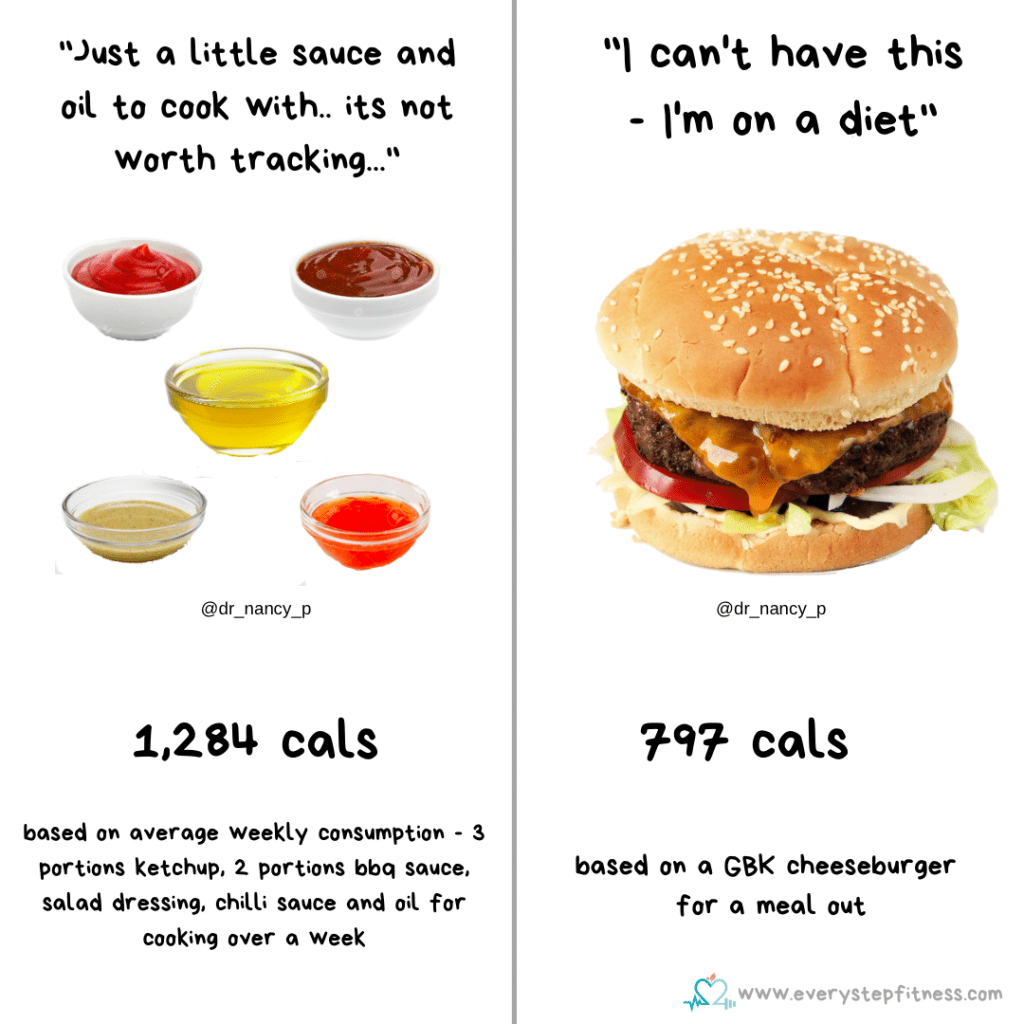
If you’re hoping to lose fat in a sustainable way you need to be aiming for a deficit of around 200-300 cals a day. Most people are pretty good at tracking the big stuff – the sandwich, the packet of crisps, the porridge for breakfast etc but how often do we overlook the little stuff. That little bit of ketchup on the side, that chilli sauce on your rice, that dash of oil in the pan…. And how often when you’re trying to lose fat do you deny yourself something you really want simply because you’re ‘on a diet’.

A cheeseburger comes in at around 797 cals – this is something you may not feel you can have whilst on your ‘diet’ and yet you probably don’t even think twice about the 1,284 cals you might rack up in sauces and oil (and tbh that’s a conservative estimate on the oil!). In one week that’s your whole deficit gone and you may not even realise it.

I always tell my clients to track everything – right down to the oil they’re cooking with as that can be the difference. So if you’re tracking cals and hoping to lose fat make sure you include these, and if you’re just trying to cut some cals maybe they’re a good place to start being more mindful too?

Oh and if you fancy a cheeseburger – just factor it in to your calories and have it! 🤗

Remember – calories count! 🤗xx

Tuesday Tip

Tuesday Tip: Muscle power vs strength

Tuesday Tip: Muscle power vs strength 🏋🏻‍♀️

There’s a lot of talk online about lifting heavy, and while strength training is definitely valuable, it’s important to consider something even more important as we age: muscle power.

What’s the difference? Strength is about how much force your muscles can produce. Power is how fast they can do it. And when it comes to staying independent, functional, and to living longer muscle power matters more.

Research shows that declines in muscle power are more strongly linked to things like early death, difficulty climbing stairs, or even just getting up from a chair. One study found that for adults aged 45–75, lack of lower leg power was linked to a 35% higher mortality risk, compared to just 18% for strength. Another review of thousands of older adults showed that power explained more of the ability to perform everyday tasks than strength did. Even gentle, regular movement (like standing up quickly from a chair) is more closely linked to leg power than leg strength.

So what does this mean for your training? It means that if you’re only doing slow, heavy lifts and skipping speed or light, explosive movements you might be missing a trick. Power declines faster with age than strength does, and we need to train it to keep it.

Here are some simple ways to start:

⁃ Try timed sit-to-stands or fast (but controlled) bodyweight squats

⁃ Add light, high-speed movements to your workouts (medicine ball throws, step-ups with speed)

⁃ Break up long periods of sitting with quick bursts of activity

You don’t need a gym or fancy equipment, just a little intention and consistency. That’s not to say you shouldn’t be lifting heavier weights as well to help prevent muscle loss and preserve strength but maybe skip the “lift heavy or go home” mindset and try thinking about training for your future self. The one who wants to run for the bus at 70, play with grand children at 80, or get off the toilet without help at 90.

Invest in power now, your older body will thank you for it.

Happy Tuesday! 🤗xx

Nutrition and Calorie Tips

‘Just a drizzle…..’

‘Just a drizzle…..’ 🍳

If you’re trying to lose fat and are working on reducing calories then you’re probably going to be recording your cals somehow. But are you really recording everything? It’s very easy to overlook some things because they seem so insignificant.

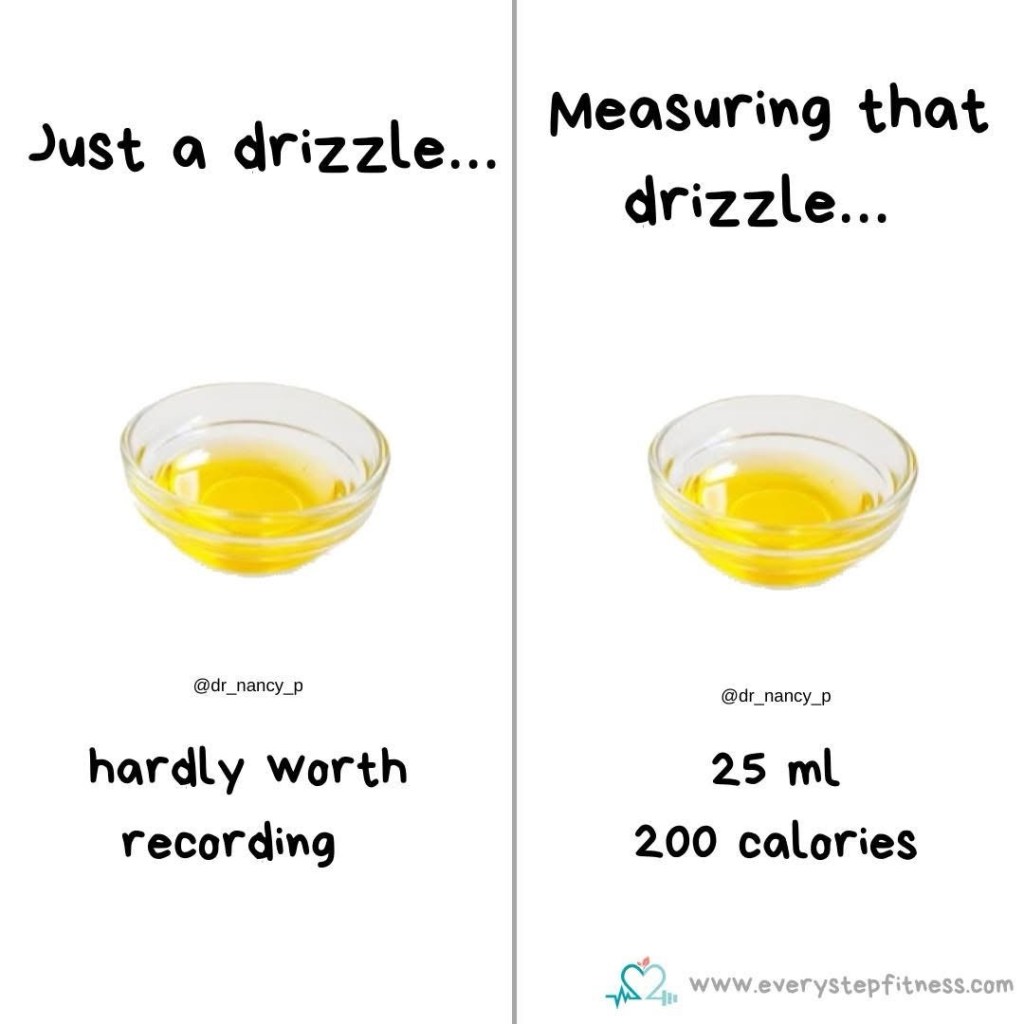
Oil used in cooking is a great example. So many of my clients will say they’ve just used a ‘drizzle’ of oil when cooking, so it’s not much. As a result they perhaps don’t measure it and don’t factor in those calories. Now aside from the fact that one person’s ‘drizzle’ could be another person’s ‘pour’ there’s actually a pretty good chance that you’re adding 100-200 cals a day to your meals with that ‘dash’.

That ‘drizzle’ of oil in the pan is probably around 25 ml, which depending on the type of olive oil will be at least 200 cals… But hey, that’s not worth recording right? Wrong! A sensible calorie deficit for fat loss is around 200 – 300 cals per day. So you’ve already eaten into your deficit with that one drizzle and turned a potentially low calorie meal like a stir fry etc into one that takes you over your allowance, for minimal satisfaction. You won’t notice those extra calories, and you’ll consume them without them really affecting how full you feel but they can really add up. If you’re cooking once a day that’s 1400 extra calories a week.

Now I’m not suggesting you shouldn’t use oil – if you want to then go for it! But if you are trying to lose fat, or your fat (weight) loss has stalled perhaps go back to basics and double check whether the amount you’re using could be more than you realise. And be a bit more mindful of this, or simply record it and have it within your daily calories. If you want to reduce the calories from cooking with oil then invest in a one calorie oil spray (you can get olive oil ones so you still get the health benefits if those monounsaturated fats) – 20 sprays will only be 20 calories, rather than the 200 plus cals from the ‘dash’ of oil

🤗 Xx