Nutrition and Calorie Tips

What happens when you eat carbs at night?

What happens when you eat carbs at night?🥔

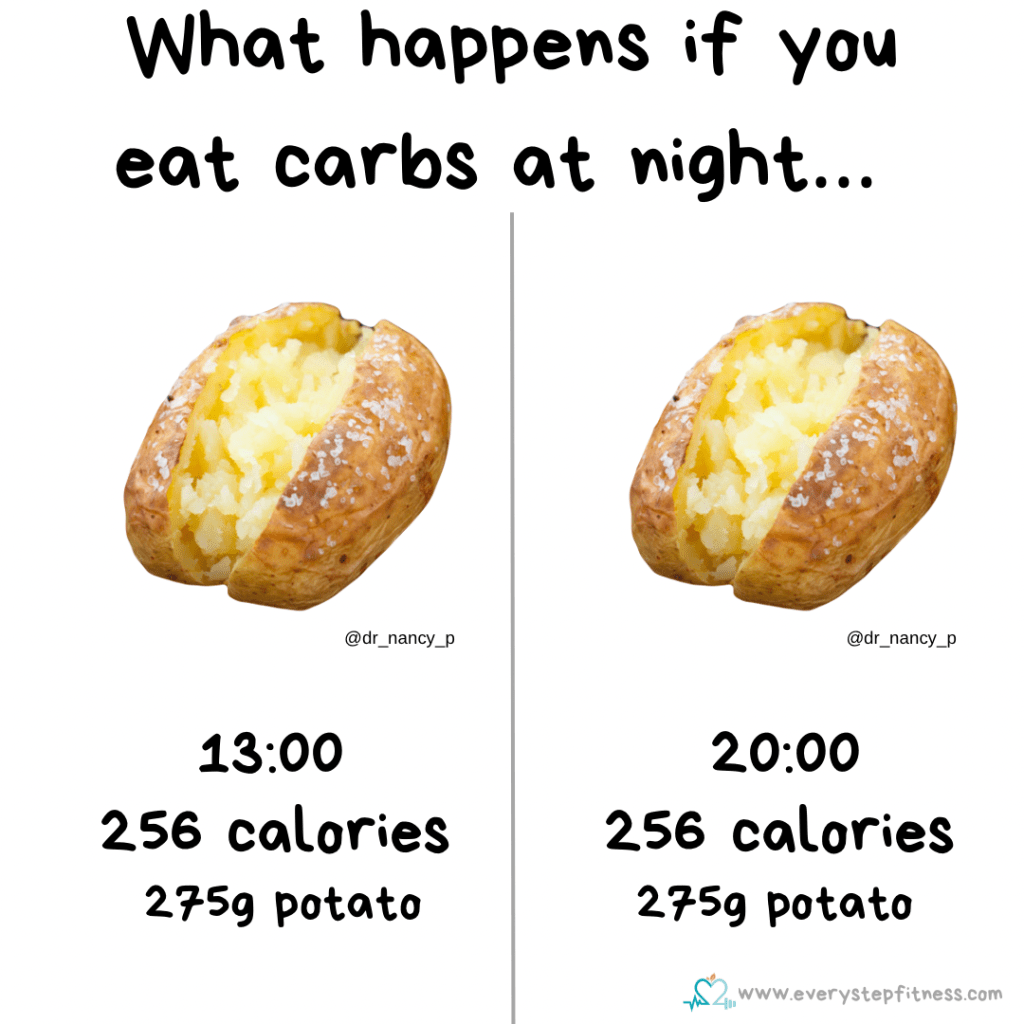
Some people have suggested that eating carbs at night, before you sleep should be avoided because you are more likely to store fat since you are sleeping shortly after the last meal, so you won’t have a chance to ‘burn it off.’ Is there any truth to this?

Nope. This isn’t how your metabolism works. Your metabolism doesn’t shut off just because you’re asleep, you’re still metabolising nutrients and creating fuel while you sleep. It’s also not how body fat is gained or lost – it doesn’t occur at specific times of the day. When you eat it’s likely that you will store some fatty acids in adipose tissue. But they can be mobilized again as we go through periods of ‘fasting’ and ‘feeding’ during the day. For example, if you only ate one really large meal per day, you would store a significant amount of fatty acids in adipose tissue, since the meal would likely be quite calorie-dense. However, after several hours, you would likely begin mobilizing much of that energy during the long ‘fasting’ window since you only ate a single meal. If on the other hand you ate 8 meals per day (totalling the same number of calories overall) you would store fewer fatty acids after each meal, but you also have a much shorter fasting window. The overall result though would be the same – you’d end up storing / metabolising the same amount of fatty acids.

Now people tend to focus on carbs as they’re often seen as the devil and also tend to be more calorie dense (especially when you include things like cakes, biscuits, pizza, etc that technically are a combination of carbs and fat) but studies show that it makes no difference to fat storage whether your calories are from carbs or other macros. So regardless of the content of the meal if you eat a big meal at night, then yes you will probably store more fatty acids overnight as it is a high calorie meal. But as you then have a long ‘fasting’ window while you sleep you will metabolise some of them. And as long as the meals you have earlier in the day don’t take you over your calorie goal it won’t result in actual body fat gains.

So, eating (anything) at night is not going to make you store more fat, and this is supported by research. At the end of the day, the most important factor for success is hitting your calorie target consistently. Eat in a pattern that allows you to be most consistent at hitting your calories.

🤗

Xx
Tuesday Tip

Tuesday Tip: Two weeks off won’t matter

Tuesday Tip: Two weeks off won’t matter 👌🏼

Will a few weeks lost to holiday, sickness or injury spoil all your hard-earned progress?

Only if you let it!

A couple weeks off is only a small fraction of your life and your fitness journey. It’s highly unlikely you’ll gain much fat or lose muscle over a few weeks.

Try to stop the “all-or-nothing” mentality and shift your perspective – you didn’t achieve all your progress in a week or two, and you certainly won’t lose it that quickly.

With the right mindset and approach, a brief break is simply a blip that need not hamper your progress and goals.

So if you’re injured, modify workouts to avoid aggravating your injury. For example, if you can’t train your upper body, focus on your lower body instead. If your injury is more severe, consider walks and lighter movement to stay active. And when you eventually get back to training, ease yourself in to prevent re-injury. Obviously also consult a physio for specific advice.

If you’re sick then just try to adhere to your current lifestyle and diet as much as possible. So keep tracking your food to maintain the habit. Eat a balanced diet if your appetite allows. Stay hydrated and prioritise recovery and sleep.

Reduce training intensity or stop altogether, depending on the severity of the illness.

If you’re on holiday then again try to do as much as you can – keep tracking to keep the habit going (if you don’t like going ‘over’ your cals then up your goal for the time you’re away), stay as active as you can – walk, swim etc and just try not to eat and drink for the sake of it. Focus on the other experiences of the holiday – not just what goes in your mouth.

Even if you stray from your diet, it’s unlikely that you’ll gain much fat over two weeks unless you really go off the rails. And research shows that 2 weeks off training results in little-to-no muscle loss. If you take an extended period off due to surgery etc then you may lose a little muscle but it still isn’t the end of the world. “Muscle memory” is a real phenomenon that enables you to rebuild lost muscle mass more quickly the second time around.

Happy Tuesday 🤗xx

Nutrition and Calorie Tips

Good snack?…..

Good snack?….. 🍫

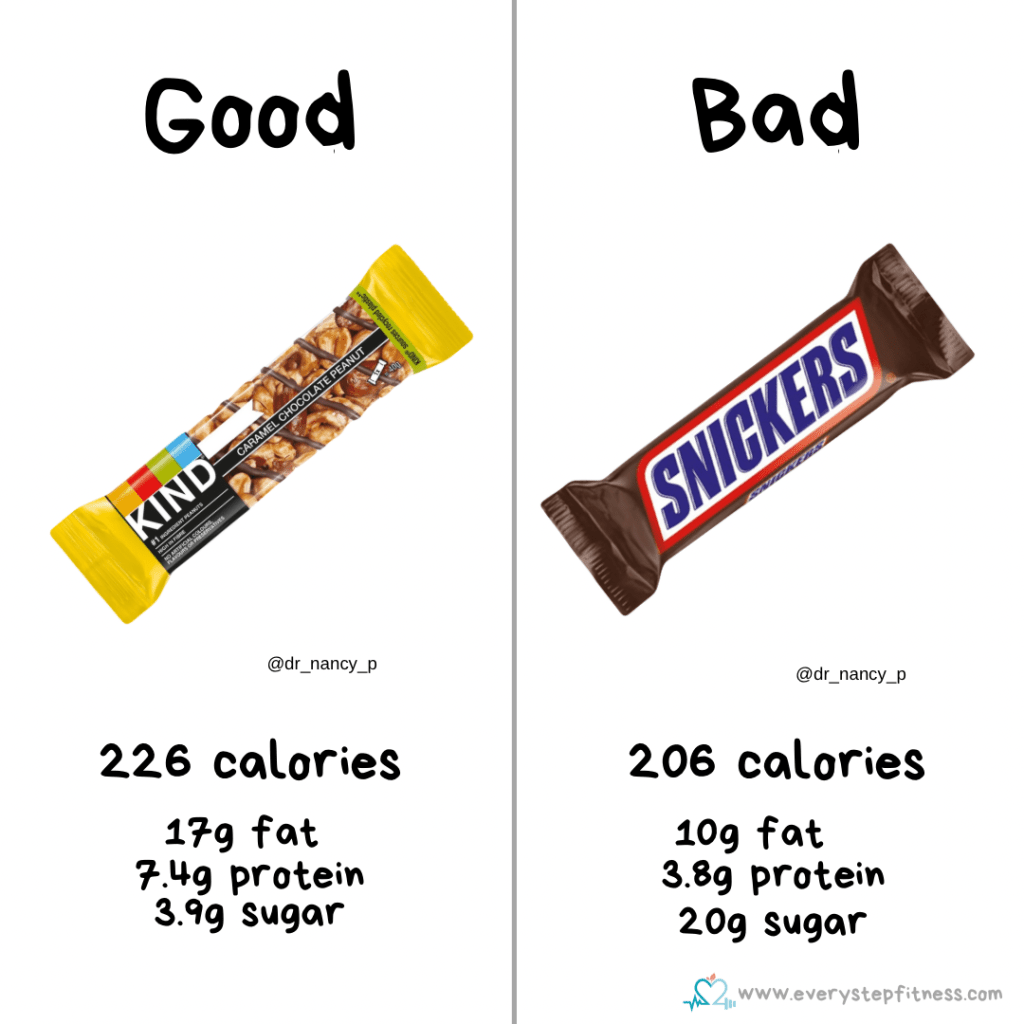
I often talk about this idea of foods being described as ‘good’ or ‘bad’ and I often hear people telling me they need to choose “better”snacks, or that they’ve swapped their usual chocolate for “good” snacks. So something like this caramel chocolate peanut KIND bar is often perceived to be a “good” snack, whilst Snickers is considered to be a “bad” snack.

The key to being in control of your weight management is really understanding that there is no such thing as a “bad” or “good” snack – they’re just different. There are nutritional differences between the chocolate and the KIND bar of course but not quite as many as we think ,and of course we don’t just choose food on the basis of its nutritional breakdown.

The 40g KIND bar is a great option for a snack – it’s got a bit more protein (though still not ‘high’ protein per se) and other micronutrients and less sugar (not that sugar is bad!). The combo of slightly more protein and fat may keep you fuller for longer.

The 41g Snickers bar however actually has fewer overall calories, a reasonable amount of protein and less fat. It provides you with energy, mainly in the form of sugar. For many people the chocolate can give an emotional boost as well as an energy one.

Overall the calorie difference between the two is only 20 cals but the Snickers is lower. So if you’re choosing the KIND bar in an effort to lose weight, then think again. If you’re choosing it because you like them then brilliant – keep having it. If you fancy some chocolate, then have that! Don’t be swayed by “healthy” marketing tactics. Just because a product is labeled as better for you or comes with a higher price tag, doesn’t guarantee it’s truly beneficial!

There are no good or bad foods – all foods can be accommodated within a balanced diet. Being aware of the calories in different foods empowers you to make that choice.

🤗

Xx

Tuesday Tip

Tuesday Tip: Menopause Marketing

Tuesday Tip: Menopause Marketing 🤔

Joe wicks recently caused a bit of a stir (again) for posting two ‘menopause’

Workouts. Before I start let me just say that whatever your views on Joe wicks there’s no denying a lot of his content has got adults and children exercising and losing weight and that’s great! But… this latest workout highlights a really common issue at the moment. ‘Menopause’/ ‘peri menopause’

is the new buzz word in health and fitness and every Tom, Dick and Harry (*Joe) is jumping on the bandwagon and marketing their products for menopausal Women.

No one is denying that there are a variety of menopausal symptoms that can make losing weight or exercising harder. No one is denying that these symptoms have historically been overlooked. But… the truth is (and multiple studies confirm) that there are no fundamental differences when it comes to what you need to lose weight in peri menopause/menopause. You need a calorie deficit and you need to be strength training alongside other cardiovascular exercise. Just as you do throughout your entire life – as a woman or man.

The symptoms that make it harder are a completely separate issue and need addressing – by medical experts and endocrinologists- not social media fitness professionals. There’s too much to include in one caption but NONE of the processes of menopause actually affect the basic biological principles and laws of thermodynamics. Yes you store fat in different locations, yes you’ll lose some muscle mass, yes your protein requirement goes up (a little) , yes tiredness and brain fog will make it harder to stick to a calorie deficit and exercise but it doesn’t change the basics.

You do not need a specific workout and certainly not a specifically low impact’ one. Midlife women aren’t ill or in need of low impact workouts anymore then any other person. They definitely don’t need ‘special’ workouts or diets. I work with countless menopausal women, many of whom have never been stronger or fitter in their lives. And the reality is I would give the same workout to a woman in her 20s or 30s as I would do a woman in her 40s or 50s! The exercises are all the same. Of course we may have to modify workouts but this is the case for ALL women of any age. It’s not menopause specific. Yes we may want to prioritise strength workouts but again that applies to all women (and men!).

I’m so sick of people trying to make money out of menopause just because it’s trendy. So instead of spending your money on menopause diets/workouts/plans/ supplements if you really want to spend money on it then use that money to see a private consultant endocrinologist/medical expert in menopause who is actually qualified to help you. Not someone who isn’t qualified making money out of it.

Happy Tuesday 🤗 xx

Nutrition and Calorie Tips

Stop eliminating and start modifying …

Stop eliminating and start modifying … 🍝

When we are trying to lose weight it’s common to feel like we need to cut out certain foods / meals. You may choose to cut some foods of course but you’re eliminating foods you actually really enjoy then your chances of long term success are far lower. So rather than thinking about never having a certain dish again, instead think of ways you can modify it to fit your goals.

In this example the spaghetti bolognese on the left is made using 20% fat beef mince and comes in at around 661 calories. The one on the right is made using the identical recipe but using 3% mince. The result is a significant reduction in calorie content –

487 cals.

The reality is the taste and satisfaction of that meal will be broadly similar for both dishes. You’d probably barely notice the difference. If you’d chosen to use a meat-substitute mince then you would have saved a further 30 /40 calories. You could of course leave the meat/meat substitute out all together and just use vegetables – that would reduce it even further by another 100 or so calories (using lentils instead would come out somewhere in between). However you’d probably find it wasn’t as satiating due to the lower protein and fat content and it certainly wouldn’t be as indistinguishable from the 20% beef mince option.

Of course there’s also the option to swap the spaghetti itself out for a lower calorie pasta or even courgetti etc if you like that, reducing the calories even further.

So it’s up to you – there are multiple ways to modify meals but still tick the box on taste and satisfaction. Start thinking about how you can modify things you enjoy and still accommodate them in your diet to achieve your goals.

🤗

Xx