Tuesday Tip

Tuesday Tip: Fat loss for small women

Tuesday Tip: Fat loss for small women 🙋🏼‍♀️

If you’re a smaller woman who has always found fat loss frustrating, you’re not imagining it. There are real reasons why being smaller can make the process tougher.

# You burn fewer calories

Smaller people naturally have a lower basal metabolic rate. That means your body needs fewer calories to function and you burn fewer calories when doing physical activity/exercise.

# Food is everywhere!

We live in an environment where high-calorie foods are everywhere and movement is optional. For someone with lower energy needs, this mismatch is even harder. If you’re not aware this it’s very easy to overeat and under-move.

# Hunger doesn’t scale down

Needing fewer calories doesn’t mean you’ll feel less hungry. Appetite signals don’t always adjust to body size, and when tempting foods are around, it can feel unfairly difficult to stick to lower cals.

# Eating out is tough

The average UK restaurant meal is ~1200 calories. For a small woman that is almost the whole day’s allowance, leaving only a few hundred calories for everything else.

# One-size-fits-all advice doesn’t work

You may be told to just eat 1800 calories etc, but that number might suit someone bigger or more active. Energy deficits are relative, and some people will need to go much lower to make progress.

# Modern convenience works against you

It takes almost no effort to access calorie-dense food via delivery apps, snacks, coffee shop cakes etc. Combine this with less movement, and the surplus adds up quickly.

# Partners can complicate things

If your partner is someone with higher energy needs (often men), they can eat more freely without gaining weight. Sharing meals can make your lower calorie needs feel even more restrictive.

None of this means fat loss is impossible. It just means smaller people need more awareness and precision. Your calorie needs are unique, and success comes from working with them, not against them.

Happy Tuesday 🤗xx

Nutrition and Calorie Tips

‘I’m being good and choosing the avocado ….’

‘I’m being good and choosing the avocado ….’ 🥑

Subway have released a range of new loaded jacket potatoes. They are great option for lunch on the go and they’re going to keep you full and satisfied. There are a few different options and most people would assume that the one with guacamole is a more virtuous choice than the tuna mayonnaise one as it’s vegetarian and includes avocado (a ‘super’ food).

There is often an assumption that vegetarian or vegan options are healthier and therefore automatically lower calorie. Avocado has also had very good PR and is assumed to be a healthy choice.

In reality the tuna mayonnaise and cheese option is actually fewer calories – 558 compared to 605 cals. It also has more protein and less fat.

In reality both are great options – but if you were trying to eat in a calorie deficit and had assumed without checking you might find the avocado option takes you over your calories. There are also plenty of other options too which come in lower.

So don’t automatically assume that vegetarian options or ‘super’ foods are always the better option. Sometimes they’re the same or worse than other choices. If you enjoy them then definitely have them, but if you’re only having them because you think they’re ‘good’ then think again.

Read the labels and look at the calories and then make your choice. If you’re trying to lose weight then go for the lowest calorie option, that you actually want to eat!

🤗xx

Tuesday Tip

Tuesday Tip: Post dinner cravings

Tuesday Tip: Post dinner cravings 🍫🍟🍦

We’ve all been there, you’ve had a balanced, filling meal, you’re not hungry and yet, chocolate, crisps, or ice cream start calling your name.

Post dinner cravings aren’t just about hunger. They’re a mix of psychology, biology, and environment and understanding that makes them more manageable.


High sugar, high fat foods stimulate the brain’s dopamine system. They trigger reward pathways that make you want more, even when your body doesn’t need extra fuel. Stress and emotions also have an impact. Food is a quick comfort, so cravings increase when you’re tired, overwhelmed, or anxious.

The other important factor is restriction. Studies consistently find that strict ‘no treats’ rules backfire. In fact, studies show that people who practice flexible eating (allowing treats in moderation) report fewer and less intense cravings than those who follow rigid diets.

So how can you prevent and manage these cravings?

⁃ Stop demonising foods. Labelling foods ‘bad’ often makes them more tempting. Instead, allow higher calorie foods in moderation and enjoy them mindfully.

⁃ Pair ‘junk’ food with foods higher in nutrients (protein, fibre, vitamins etc) e.g. strawberries, Greek yogurt, and some chocolate

⁃ Plan ahead – having balanced, high-protein meals and snacks on hand makes it easier to resist impulsive choices.

⁃ Thirst is often mistaken for hunger, so start with a glass of water before reaching for the snack cupboard.

Remember cravings don’t mean you’ve failed or lost control. They’re simply normal signal. And with the right strategy, you can acknowledge them without derailing your progress.

So next time the ice cream tub calls your name after dinner, pause. Ask yourself: is this hunger, emotion, or just habit? Then decide mindfully.

Happy Tuesday 🤗xx

Nutrition and Calorie Tips

‘What you think you had…..’

‘What you think you had…..’ 😬

We all know that to lose weight/fat you need to be eating and drinking at a calorie deficit. Often the problem though is our awareness and perception of what we are actually consuming. Portion control is a massive part of this – specifically underestimating serving sizes and what you’ve consumed.

Studies repeatedly show that almost everyone, even those who are trained dieticians and nutritionists (and therefore should be ‘experts’ on portion sizes etc) significantly underestimate what they’ve consumed. This is even more so when recording in hindsight. We forget things, we underestimate what we’ve had, we don’t even know we’re doing it.

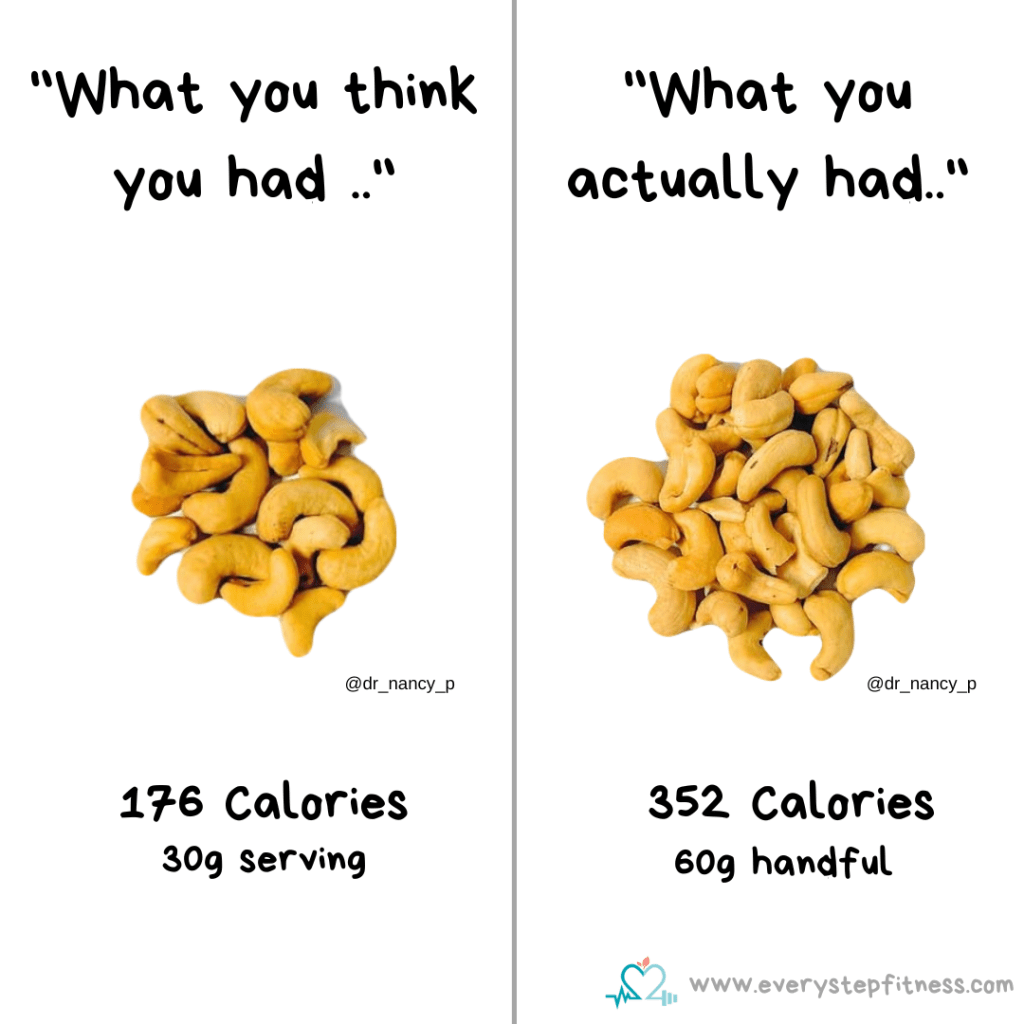
For example, having some

cashews for a snack. You may think you’ve has a portion (30g) of cashews – that would be approx 176 cals. That’s not bad and can be easily factored into your daily cals. In reality though you probably had a

handful that was closer to 60g which comes in at 352 cals! That’s not as easy to fit in, and you probably barely noticed the extra cashews.

So if you’re struggling to lose weight and can’t work out why, try being totally honest with yourself and see if you may actually be underestimating things. The best way to do this is you get out the kitchen scales, weigh the portion and track the calories – before you eat them! You definitely do not need to cut things out completely – that’s totally counter productive and unsustainable long term. So instead work on becoming more aware of the actual quantities you’re eating / drinking and fit them into your diet accordingly. Knowledge is power!

Enjoy 🤗 xx

Tuesday Tip

Tuesday Tip: Tracking calories, not losing weight?

Tuesday Tip: Tracking calories, not losing weight? 🔍

If you’re tracking your calories and not losing weight, you’re not tracking accurately. I know you may think you are, and I’m not suggesting you’re consciously under tracking but the reality it’s hard to be totally accurate.

Research shows that even the most careful trackers often underestimate their intake, and the gap is bigger than most people realize. If you’re

1,500 calories a day, studies suggest in reality, you may be consuming closer to 1,700 calories if you’re very accurate, and closer to 2,000 (or more) if you’re not. That’s hundreds of calories each day slipping through unnoticed.

In one study, adults underreported their daily calories by as much as 700 calories. That’s the equivalent of a burger and fries missing from their food diary. Even more telling, when participants were offered a financial incentive for accuracy, they still couldn’t reliably track what they ate. So this isn’t about dishonesty; it’s about the inherent difficulty of calorie tracking.

Think about it: portion sizes are hard to estimate, labels can be misleading, restaurant meals hide oils and dressings, and a quick handful of snacks often goes uncounted. Even small mistakes add up quickly. That spoonful of peanut butter you logged? If it’s actually two, you’ve just underestimated by nearly over 100 calories. Repeat that a few times a day, and it’s easy to see how the numbers add up.

So what does this mean? Is tracking pointless then? No but you have to be really honest with yourself and be open to the fact that you’re probably not tracking perfectly- no one is. So if you’re not losing weight it doesn’t necessarily mean your body is broken or your metabolism is damaged. It likely means your intake is a little higher than you think, and that’s normal. You either need to double down on the tracking and check you’re being as accurate as possible or lower your calorie goal. Track as best you can, stay mindful of hidden calories, and adjust based on results over time.

Happy Tuesday 🤗
Xx