Tuesday Tip

Tuesday Tip: How to Stop Late Night Snacking

Tuesday Tip: How to Stop Late Night Snacking 🍪

Late-night snacking is a tricky habit many struggle with, often derailing weight loss efforts. So why do we do it, and how can we break the cycle?

There are several reasons for after-dinner snacking, and it’s key to figure out the cause. Identifying the cause is the first step in finding a solution.

#1 Skipping Meals

If you’re not eating enough during the day, your body craves energy at night. Try meal prepping or keeping easy options on hand (ready meals etc). If you’re too busy, schedule meals like meetings to create a routine.

#2 Grazing All Day

Snacking throughout the day can leave you unsatisfied, leading to overeating at night. Have balanced meals every 3-5 hours instead of grazing, helping to regulate hunger and reduce cravings.

#3 Not Enough Protein

Protein is the most filling macronutrient. Without enough, you might feel unsatisfied, leading to late-night cravings. Include protein in each meal or snack, but not at the expense of carbs too.

#4 Unbalanced Meals

Meals lacking fibre or healthy fats can leave you reaching for snacks later. Use the balanced plate method; combine protein, carbs, healthy fats, and fibre-rich fruits or veggies to stay full longer.

#5 Uneven Calorie Distribution

Not spreading your calories evenly throughout the day can cause hunger at night. Spread your calorie intake across meals to avoid nighttime cravings.

#6 Mindless Eating

Boredom, stress, or emotions can trigger overeating. Practice mindful eating by focusing on the taste and texture of your food, and stop when you’re satisfied, not stuffed.

Late night snacking doesn’t have to derail you. By identifying the cause and making simple adjustments like consistent meals, balanced plates, and mindful eating, you can take charge of your habits.

Happy Tuesday! 🤗

Xx

Nutrition and Calorie Tips

‘Weight loss’ meals vs ‘normal’ meals….

‘Weight loss’ meals vs ‘normal’ meals….🥘

Once again this highlights a really important issue – marketing! Ready meals can be a really useful thing to have in your freezer/fridge for quick meals when you’re busy. They’re also handy if you’re trying to stick to your calories and want something with pre calculated calories too. Most people would assume that the slimming world or weight watchers (or other weight loss brand foods) are automatically a more virtuous choice of ready meal . Whilst the ‘normal’ supermarket ones may be assumed to be higher calories.

In reality the Slimming world and the weight watchers ones are actually significantly higher in calories at 440 and 424 cals vs 372 and 363 cals for supermarket examples. That’s quite a large difference! The weight loss branded ones are also more expensive – up to £4.40 vs £1.85.

So don’t automatically assume these weight loss branded foods are always the better option. Sometimes they’re the same or worse than other brands. And very often pricier! If you enjoy them then definitely have them, but if you’re only having them because you think they’re better and lower calorie then think again.

Read the labels and look at the calories and then make your choice. If you’re trying to lose weight then go for the lowest calorie option, that you actually want to eat!

🤗xx

Tuesday Tip

Tuesday Tip: Should You Skip Breakfast?

Tuesday Tip: Should You Skip Breakfast? 🍳

Lately, there’s been a lot of talk about skipping breakfast for longevity. Some social media and celebrity ‘experts’ claim you should eating around 12-2 PM every day if you want to live longer. Sounds simple, right? But does the science agree?

Well… not quite.

A recent large-scale study followed 62,746 people over and found that those who skipped breakfast, or only ate breakfast 1-2 times per week, had a higher risk of developing gastrointestinal cancers (including esophageal, gastric, colorectal, liver, and gallbladder cancer) compared to those who ate breakfast daily.

And no, this wasn’t just about weight, lifestyle, or socioeconomic factors. The link between skipping breakfast and cancer risk remained even when adjusting for other variables. In fact, multiple previous studies have supported these findings.

Why might this be happening? There are a few possible explanations:

– Inflammation: Skipping breakfast is linked to higher levels of C-reactive protein, a marker of inflammation. Chronic low-grade inflammation plays a role in tumor growth by promoting oxidation, mutation, and DNA changes.

– Circadian Rhythm Disruption:Eating late may mess with your body’s internal clock, affecting metabolism and cellular function.

So, should you be eating breakfast?

The evidence suggests yes, not just for energy and satiety, but for long-term health. This doesn’t mean breakfast is magical, but skipping it could have unintended consequences beyond just hunger. It also raises general concerns about fasting for periods of time and the impact that can have on gastrointestinal health.

Moral of the story? Don’t believe every health trend you see on social media. Always question the claims and check what the science actually says.

Happy Tuesday! 🤗

Xx

Nutrition and Calorie Tips

A snack or loads of snacks…

A snack or loads of snacks… 🍫

There are lots of strategies you can use when trying to stick to your calorie deficit to lose weight/fat. Being aware of the calories in the foods you choose to consume and swapping to lower calorie foods which you also enjoy is an obvious option. As well as the calories though it’s worth considering the quantity and volume of the food you’re choosing.

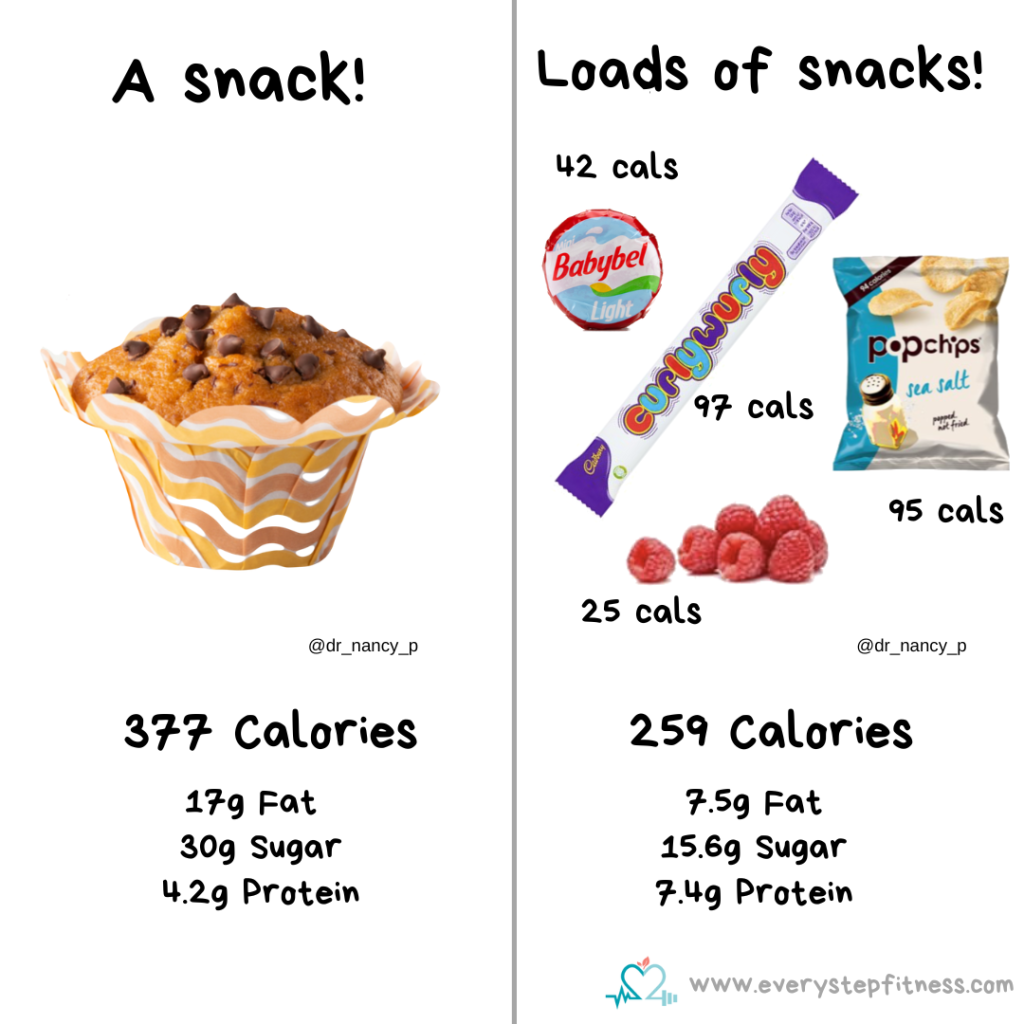
Snacking is a common problem and an easy way to extra calories to sneak in. If you were to snack on a banana and chocolate muffin you’re looking at a substantial 377 calories of food. That’s quite a lot for a snack, and it will be gone in a few bites. However for only 259 calories you could have a curly wurly, a light babybel, some raspberries and a packet of popchips. This combination not only has the advantage of fewer calories overall, but also higher protein overall which will help to keep you fuller for longer, and they contain more fibre (mainly from the raspberries) and other micronutrients which will also help. But an often overlooked aspect is that there is also a greater volume of food in the lower calorie option. It will take you longer to eat the 4 snacks than the muffin, which will also increase feelings of satisfaction. You may also even find you don’t even need to eat all 4 snacks.

Obviously if you fancy the muffin and can fit it into your calories then go for it but this is just another strategy to add to your toolkit to help you stick to those calories.

Enjoy 🤗

Xx

Tuesday Tip

Tuesday Tip: Is a calorie just a calorie?

Tuesday Tip: Is a calorie just a calorie?🍫

This is a common debate when discussing calorie deficits and food choices. People often say, “A calorie isn’t just a calorie—some are better than others.” For example, they argue that 100 calories of nuts aren’t the same as 100 calories of chocolate.

So, is that true? Well, technically—no. A calorie is simply a unit of measurement for energy. In that sense, 100 calories of nuts provide the same energy as 100 calories of chocolate.

However, the type of food matters. Different foods have different metabolic effects. Some require more energy to digest (this is the thermic effect of food), but the difference is small and unlikely to impact overall calorie burn significantly.

Foods with low-calorie density (like fruits, vegetables, and lean proteins) allow you to eat a larger volume for the same calories. For example, you’d need to eat 10 punnets of raspberries (250 calories) to match the calories in one Snickers bar.

Satiety also varies. High-fibre, protein, and fat-rich foods keep you fuller for longer. Solid and thicker foods provide more satiety than liquids. Some foods are hyperpalatable (aka delicious!), making them easier to overeat, while others naturally regulate appetite.

Food also has emotional and psychological effects. While nuts may be more filling, sometimes no amount of nuts will satisfy a chocolate craving, and that’s okay! In those moments, you’re better off having the chocolate and moving on, rather than overeating other foods while still wanting the chocolate.

Ultimately it’s about balancing all of these things in a way that lets you stick to your calorie goals. So sometimes that will mean going for the more filling option of nuts and sometimes it will mean going for the chocolate you actually want, but being aware that you may feel more hungry later and being prepared for that.

So yes, a calorie is just a calorie—but food is more than just food!

Happy Tuesday!🤗

Xx