Tuesday Tip

Tuesday Tip: Muscle power vs strength

Tuesday Tip: Muscle power vs strength 🏋🏻‍♀️

There’s a lot of talk online about lifting heavy, and while strength training is definitely valuable, it’s important to consider something even more important as we age: muscle power.

What’s the difference? Strength is about how much force your muscles can produce. Power is how fast they can do it. And when it comes to staying independent, functional, and to living longer muscle power matters more.

Research shows that declines in muscle power are more strongly linked to things like early death, difficulty climbing stairs, or even just getting up from a chair. One study found that for adults aged 45–75, lack of lower leg power was linked to a 35% higher mortality risk, compared to just 18% for strength. Another review of thousands of older adults showed that power explained more of the ability to perform everyday tasks than strength did. Even gentle, regular movement (like standing up quickly from a chair) is more closely linked to leg power than leg strength.

So what does this mean for your training? It means that if you’re only doing slow, heavy lifts and skipping speed or light, explosive movements you might be missing a trick. Power declines faster with age than strength does, and we need to train it to keep it.

Here are some simple ways to start:

⁃ Try timed sit-to-stands or fast (but controlled) bodyweight squats

⁃ Add light, high-speed movements to your workouts (medicine ball throws, step-ups with speed)

⁃ Break up long periods of sitting with quick bursts of activity

You don’t need a gym or fancy equipment, just a little intention and consistency. That’s not to say you shouldn’t be lifting heavier weights as well to help prevent muscle loss and preserve strength but maybe skip the “lift heavy or go home” mindset and try thinking about training for your future self. The one who wants to run for the bus at 70, play with grand children at 80, or get off the toilet without help at 90.

Invest in power now, your older body will thank you for it.

Happy Tuesday! 🤗xx

Nutrition and Calorie Tips

‘Just a drizzle…..’

‘Just a drizzle…..’ 🍳

If you’re trying to lose fat and are working on reducing calories then you’re probably going to be recording your cals somehow. But are you really recording everything? It’s very easy to overlook some things because they seem so insignificant.

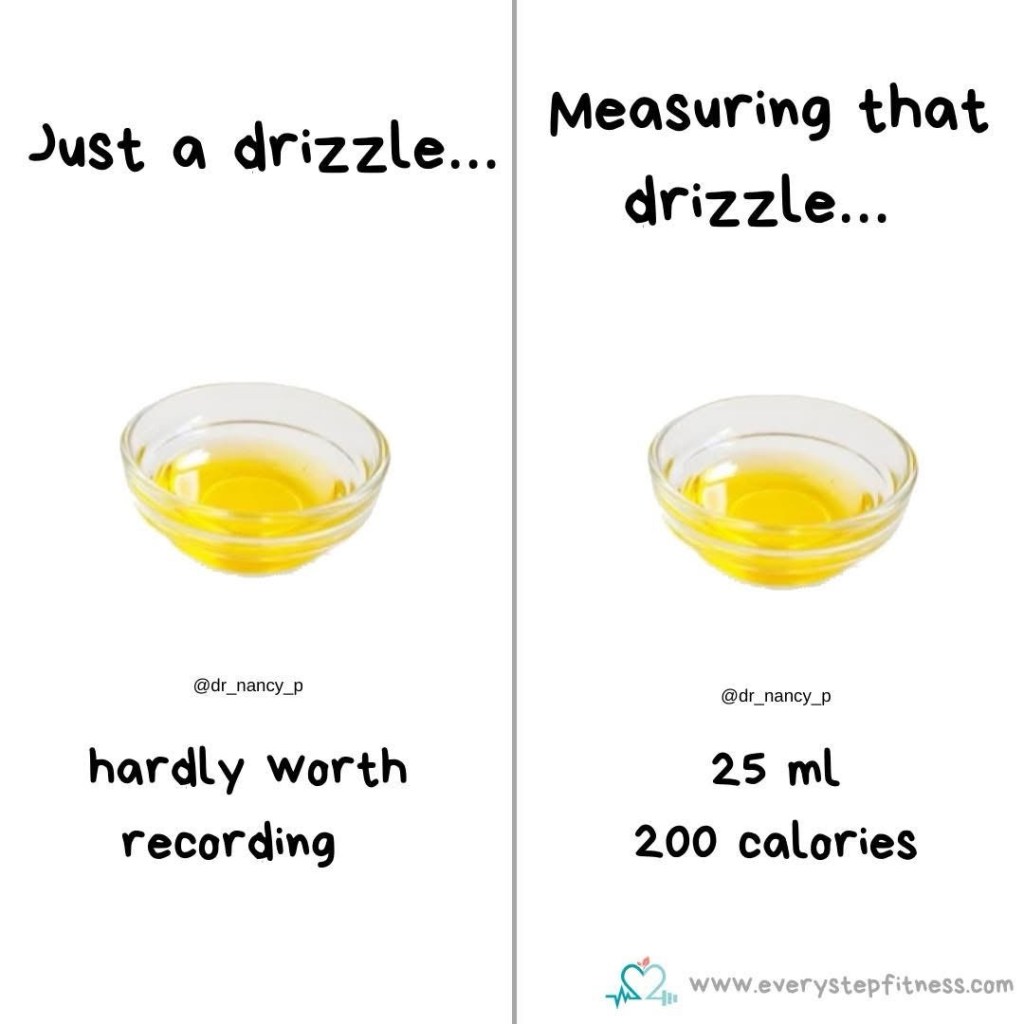
Oil used in cooking is a great example. So many of my clients will say they’ve just used a ‘drizzle’ of oil when cooking, so it’s not much. As a result they perhaps don’t measure it and don’t factor in those calories. Now aside from the fact that one person’s ‘drizzle’ could be another person’s ‘pour’ there’s actually a pretty good chance that you’re adding 100-200 cals a day to your meals with that ‘dash’.

That ‘drizzle’ of oil in the pan is probably around 25 ml, which depending on the type of olive oil will be at least 200 cals… But hey, that’s not worth recording right? Wrong! A sensible calorie deficit for fat loss is around 200 – 300 cals per day. So you’ve already eaten into your deficit with that one drizzle and turned a potentially low calorie meal like a stir fry etc into one that takes you over your allowance, for minimal satisfaction. You won’t notice those extra calories, and you’ll consume them without them really affecting how full you feel but they can really add up. If you’re cooking once a day that’s 1400 extra calories a week.

Now I’m not suggesting you shouldn’t use oil – if you want to then go for it! But if you are trying to lose fat, or your fat (weight) loss has stalled perhaps go back to basics and double check whether the amount you’re using could be more than you realise. And be a bit more mindful of this, or simply record it and have it within your daily calories. If you want to reduce the calories from cooking with oil then invest in a one calorie oil spray (you can get olive oil ones so you still get the health benefits if those monounsaturated fats) – 20 sprays will only be 20 calories, rather than the 200 plus cals from the ‘dash’ of oil

🤗 Xx

Tuesday Tip

Tuesday Tip: Training for a Summer body?

Tuesday Tip: Training for a Summer body? 👙

As we head towards summer there’s a lot of social media posts around talking about exercising to get your bikini or summer body. Now aside from the fact that, generally speaking, fat loss (which tends to be the real goal) is almost impossible to achieve from exercise (you need a calorie deficit) it’s also not an ideal goal.

The issue with training for a ‘summer body’
is that it’s merely a goal to be constantly slim or lean without any other performance goals attached. The standards are arbitrary and the likely result is that you’ll never feel slim enough. It’s hard to escape this desire to slim down for summer as it’s so pervasive in our society and we start buying into it from a very young age. Now that’s not to say that wanting to lose fat for summer is necessarily a bad thing or something you shouldn’t do – ultimately it’s your body and you can choose what you want to do with it. But if it’s a pressure you are trying to avoid then perhaps it’s worth considering replacing that summer body goal with more stable goals that will serve you all year round, not just for the summer.

Ultimately the exercise routine and diet that you can do consistently, over the entire year, is the best one for you. Not the one that you can only manage for 4-8 weeks at a time because it’s unsustainable for you and your lifestyle. Try repositioning your goals – for example goals of longer life, better quality of life, strong bones, quicker recovery from illness etc. Train for your old man/woman body – you want dense bones, strong muscles, good balance, a healthy heart and functional independence. When you’re 80 you want to be able to carry your shopping, lift your grandchildren, reach to put things away on the top shelf, get up from your chair unaided, stop yourself falling etc. If you try to focus on these sorts of goals you may find you are able to exercise and eat in a way that isn’t overly restrictive (on the food side) or inconsistent (e.g. sudden bursts of over exercising then weeks of months of no exercise). It also won’t feel like punishment.

Think about the long term and think about what will serve to keep you healthy and functioning for longer. Starving yourself, drinking ‘detox’ juices, cutting carbs, hours of cardio etc won’t – eating a reasonable amount of calories from all food types and working to include cardio and resistance training for strong muscles, heart and lungs will!

Happy Tuesday 🤗xx

Nutrition and Calorie Tips

Weekdays vs Weekends

Weekdays vs Weekends 😇

This is an extremely common pattern I see in my clients, and myself. Weekdays are often “ok” calorie wise or even good, and then weekends it goes a bit off track.

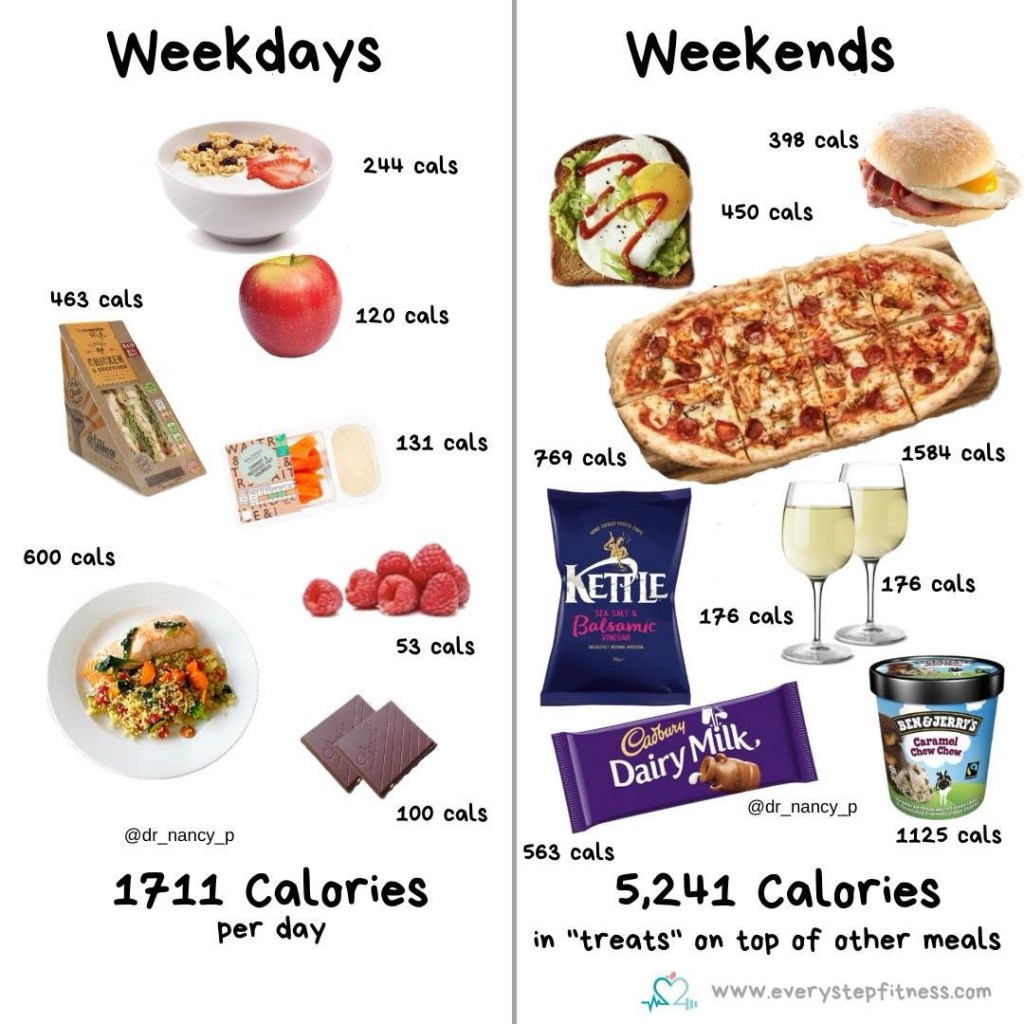
You may think that if you stick to your fat-loss calorie target for most of the time (5 days a week) that it’s ok to just relax at the weekend. Now sometimes this can work, but it rather depends how much you relax lol! In this example I’ve assumed a daily calorie goal of 1,800 cals for fat loss, or 12,600 calories per week. So Monday to Friday you hit those calories, or perhaps are even a little under (8,555 cals during the week in this example). Then on Saturday and Sunday you “relax” and have a few “treats”, because it’s the weekend right? You’ve been good all week so it’s fine… In this example I’ve included two weekend breakfasts, a pizza one night, a couple of glasses of wine, some crisps in front of a movie, sunday evening ice cream and chocolate etc. That’s 5,241 calories and doesn’t even include a full weekend of eating and drinking (especially if you start on Friday evening.. or even Thursday). Just those treats on top of the weekday calories take you to 13,796 calories for the week. So you’re already over by nearly 1,200 cals.

That extra 1,200 cals (or more) is why you won’t be losing fat. It’s very easy for that to happen. The things I’ve described for weekend treats aren’t crazy or particularly over indulgent. I’m sure we’ve all had weekends like that right? Now I’m definitely not suggesting you don’t enjoy some of these foods from time to time, but if you really want to lose fat then its worth getting away from the idea of weekends being focused on food and drink “treats”. Have the things you enjoy but in moderation and within your overall weekly calorie target.

Ways to do this include, reducing your weekday calories a little to give you a buffer for the weekend (be cautious with this though as if you take them too low you will find you tend to binge at the weekend which is counter productive so only aim to save 100-150 cals per day max). Also try going for smaller options of the weekend treats, a small bar of chocolate, a single portion bag of crisps, low cal ice cream etc. Pick one meal you want to let your hair down with rather than the entire weekend and keep tracking over the weekend so you can see where the extra cals are creeping in.

OR decide that life’s too short and you don’t want to restrict your calories over the weekend but then accept that you won’t be able to lose fat (which is absolutely fine too! You don’t need to lose fat – no one does).

🤗

Xx

Tuesday Tip

Tuesday Tip: Don’t go too low

Tuesday Tip: Don’t go too low 📉

It’s tempting when you start trying to lose weight to panic and cut calories drastically – because surely a bigger deficit means quicker results right? To a degree yes but…. It never really works and this is why.

Our bodies are designed and have evolved to essentially make losing weight and fat hard. Fat loss goes entirely against our main drive to survive so conserving energy and maximising fat storage is a good evolutionary strategy. If energy consumption (calories) are reduced drastically the body will adjust processes to ‘fit’ the calories you consume. Now this doesn’t mean you can put on weight if you eat too little – that’s just a myth. What it does mean though is that the body compensates for a lower energy intake by reducing energy expenditure.

It does this in two ways. Firstly it reduces NEAT (non-exercise activity thermogenesis), – these are the subconscious incidental movements and processes in your body e.g. your heart rate may slow, body temperature may change, and hormones such as leptin, T3 and T4 adjust to reduce energy expenditure. As a result your BMR may decrease.

In addition you will subconsciously move or fidget less than you usually would. So you may find you don’t stand up or tap your feet etc as much, you may be less inclined to take the stairs and take the lift instead, you may find you drive instead of walking places as much, you might not get up to go get things you’ve left in other rooms (e.g. not going upstairs to get the hoodie you want to wear and grabbing whatever is handy downstairs instead), not getting up to get a glass of water if you’re thirsty, feeling generally low motivation to exercise/walk etc. You probably won’t even notice you’re doing any of this.

So as you’ll be expending fewer calories the deficit you think you have becomes smaller. In addition you’ll feel low, hungry, tired and tend to obsess over food. This means the tendency to binge/overeat either when you have a ‘cheat’ day or when the diet ends is high. This is why you often find any weight you’ve lost will come back quite quickly.

So rather than heading straight in to an aggressive 800-1000 calories a day diet (for the umpteenth time in the past few years) try aiming for a higher number of calories with a smaller deficit. A smaller deficit allows you to thrive and stick to the newly acquired habits you need to stick to, consistently, to move towards your goals. Work more on delayed gratification. Something that takes longer but feels easier is far more likely to work out the way you want it to.

If this resonates but overwhelms you at the same time, that is also completely normal. We are designed to want instant gratification and results so it’s ok if it feels counterintuitive to start with. But trust me, stick with it and you’ll reap the benefits – play the long game!

Happy Tuesday 🤗xx