Nutrition and Calorie Tips

A healthy snack of dried fruit…

A healthy snack of dried fruit… 🍇

Fruit makes a great healthy snack and we’re encouraged to swap chocolate and biscuits for fruit instead… but be careful about the fruit you’re actually having.

Many people will happily snack on dried fruit thinking it’s a great way to lose weight. Now whilst there’s nothing wrong with dried fruit at all, as it’s full of fibre and vitamins, it’s also much higher in calories (mostly from sugar) than fresh fruit. And you’re far more likely to over eat it. It’s easy to eat a whole packet of raisins for example but you’re a lot less likely to eat an entire bunch of grapes (and in fact you could eat 4 bunches and still be consuming fewer calories.

The reason the raisins are so much higher in calories is because they’ve lost 95 percent of their water content leaving mostly sugar and fibre, in a much smaller package. This ramps up the sugar and calorie content, so 100g of dried fruit can be more than 4 times more calories than fresh fruit, and less filling.

So if fat loss is your goal consider the type of fruit you’re snacking on, and be mindful of how much dried fruit you’re consuming and don’t be afraid of fresh fruit.

🤗

Xx

Tuesday Tip

Tuesday Tip: Re-train your brain

Tuesday Tip: Re-train your brain 🧠

One trap many of us fall in to is treating food as a reward, and exercise as punishment; “i’ve had a really good week, I deserve a dessert” or “I’ve had such a bad weekend I need to really work hard at the gym tomorrow”. This cycle is self-defeating and creates a negative relationship with food and exercise. The key is trying to view both food and exercise as ways to fuel and care for your body, so you can sustain a healthy lifestyle long term. Here are some tips to help:

#1 Non-food rewards:

Instead of food, reward yourself with other things that are calming/relaxing or fun e.g. massage, manicure, new smellies, a bath, a walk, time reading your book, watching your favourite show etc. Or try things that encourage the healthy habits -new workout clothes, a new experience (e.g. rock climbing) or recipe books. Having nice things to go along with a behaviour makes that behaviour more fun, so your reward motivates you to do better

#2 Try not to justify food:

When you think, “I can have this because I’ve been good all week” etc then pause and remind yourself that your behaviour doesn’t determine what you can eat e.g. don’t reward yourself with cake because you went to the gym. Think about what food you want and decide why you want it e.g. you want cake because it tastes good – that’s fine. Re-train your mind to disassociate food from your behaviour. Have cake because you like it, not because you “deserve” it.

#3 Find fun workouts:

If the workout you’re doing isn’t enjoyable then change it. Try something new – if you usually run on the treadmill try doing a class, if you do classes have a swim etc – find something you actually like doing.

#4 Remember the good times:

Recent research in the journal “memory” has shown that recalling times when you had fun working out can help you look forward to future workouts. So reminisce about a workout you really enjoyed – it could be a fun class, or a race you took part in, or a game of football with your friends, or a walk or cycle outside – anything!

Happy Tuesday 🤗

xx

Nutrition and Calorie Tips

Swaps to save calories….

Swaps to save calories…. 🥤🍟 🍫

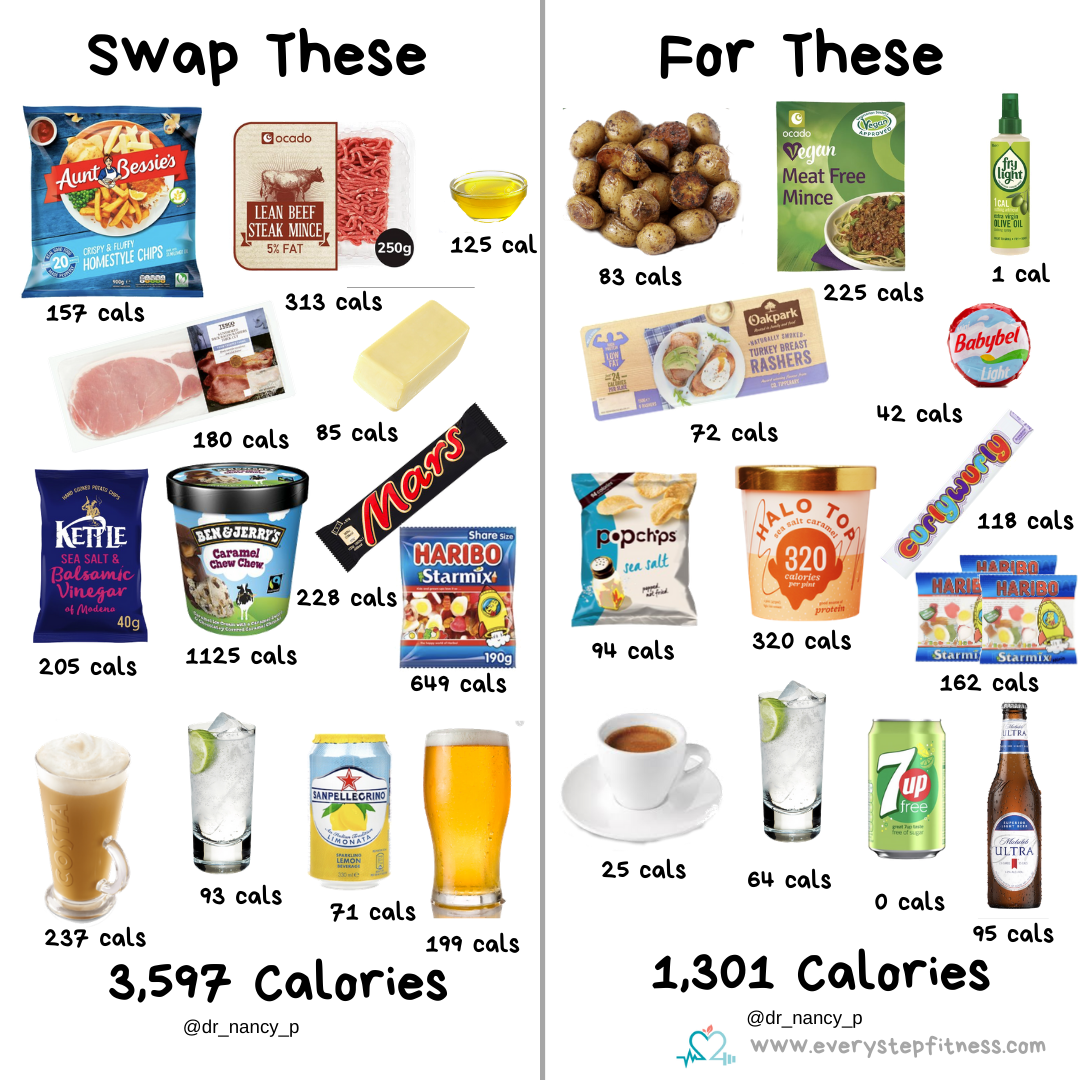
When I’m working with clients for sustainable fat and weight loss one of the big things I try to encourage is making some ‘easy’ swaps that they can incorporate into their diet. to save calories. It’s not about replacing something you love with something you hate (that will never work and will make you feel like you’re deprived) but there are some swaps you can make which you may not even really notice. Or they may be compromises which you’re willing to make.

This is a selection of some of the common ones and although individually some of the calorie savings may seem small it’s amazing how they all add up. Some involve similar tasting but lower calorie products, others are a portion size thing too. Obviously there are loads more – but I have tried to present a few of the main ones that my clients have used and enjoyed. Let me know about your own swaps too!

Here’s the list:

⁃ Oven chips (100g) 157cals vs 100g potatoes and oil spray (ten sprays) 83 cals

⁃ Lean beef mince (250g) 313 cals vs meat free mince (250g) 225 cals

⁃ 15ml olive oil 125 cals vs fry light olive oil spray 1 cal per spray (so even using 25 sprays is still a massive saving)

⁃ Bacon rashers (3) 180 cals vs Turkey Rashers (3) 72 cals

⁃ Cheddar cheese (20g) 85 cals vs babybel light (20g) 42 cals

⁃ Kettle Chips Small bag 205 cals vs pop chips 94 cals

⁃ Ben and Jerrys tub 1125 cals vs halo top tub 320 cals

⁃ Mars bar 228 cals vs curly wurly 118 cals

⁃ Grab bag Haribo 649 cals vs 3 mini bags 162 cals

⁃ Medium whole milk latte 237 cals vs skinny Americano 25 cals

⁃ Gin and tonic (single) 93 cals vs Gin and slimline tonic 64 cals

⁃ San pellegrino Lemonade drink 71 cals vs 7up zero lemonade drink 0 cals

⁃ Pint of London Pride Ale 199 cals vs Michelob Ultra 95 cals

Remember as part of a balanced diet it’s not a problem including some lower calorie options, especially if they mean you actually stick to it! If you want any help with making swaps just shout!

🤗

Xx

Tuesday Tip

Tuesday Tip: Vitamin D and COVID-19

Tuesday Tip: Vitamin D and COVID-19 🦠

There are mixed messages in the media about the link between Covid 19 and Vitamin D so I thought it was worth a quick overview.

Vitamin D is a fat soluble steroid hormone and is important for bone health, and regulation of the immune system. Vitamin D deficiency has been linked to numerous health problems including muscle weakness, various cancers, MS, Asthma, TB, heart disease, type I and II diabetes, depression, Alzheimers etc. Very few foods naturally contain vitamin D, so sun exposure is the main way that we obtain this vitamin. Even before the pandemic the recommendation was that people should consider taking vitamin D supplements between October and March (darker months) as there is a high rate of deficiency in the UK.

Many studies have shown that vitamin D can reduce the risk of getting acute viral respiratory tract infections and pneumonia, and can help with common colds and flu. So what about COVID-19? Studies are limited but a recent study found that 82.2% of patients hospitalized with COVID-19 were deficient in vitamin D. This was compared to the healthy control group of people without COVID-19, where 47.2% of people were vitamin D deficient. Studies have shown a correlation between lower vitamin D levels and higher levels of COVID-19 cases in the population. Some studies have also shown a correlation between vitamin D deficiency and COVID-19 severity and mortality. There are now 30 or so studies showing that optimal blood levels of vitamin D reduces the risk of covid-19 risk of infection, risk of severe disease and risk of dying. Many researchers now regard the evidence as ‘overwhelming’.

More research is needed, but there is little to be lost in supplementing with Vitamin D. Vitamin D supplements are inexpensive and have low risk of toxicity but do bring significant benefits, not just in relation to COVID-19, but to overall health and well being. So what dosage should you take? You need a minimum of 10 micrograms a day (or 400 IU (international Units)), and the maximum daily safe dose is 100 micrograms (4000 IU), so something in between is a good place to aim for.

Happy Tuesday 🤗

Xx

Nutrition and Calorie Tips

Just a walk…

Just a walk… 🚶🏼‍♀️

I shared this back in the summer but as this second lockdown progresses I’ve noticed a lot of my clients are beating themselves up over not doing “enough exercise”. In many cases they’ve been trying to work from home again, and run the household etc. Some days they’re managing to fit in a workout, others they’re not and they’re feeling guilty about it, and worrying about the loss of those activity calories they “should” be burning.

During this time one thing most people are can manage is to walk more, making the most of the allowed outdoor exercise. This is often not viewed as something which contributes to those activity calories, but it’s actually doing more good.

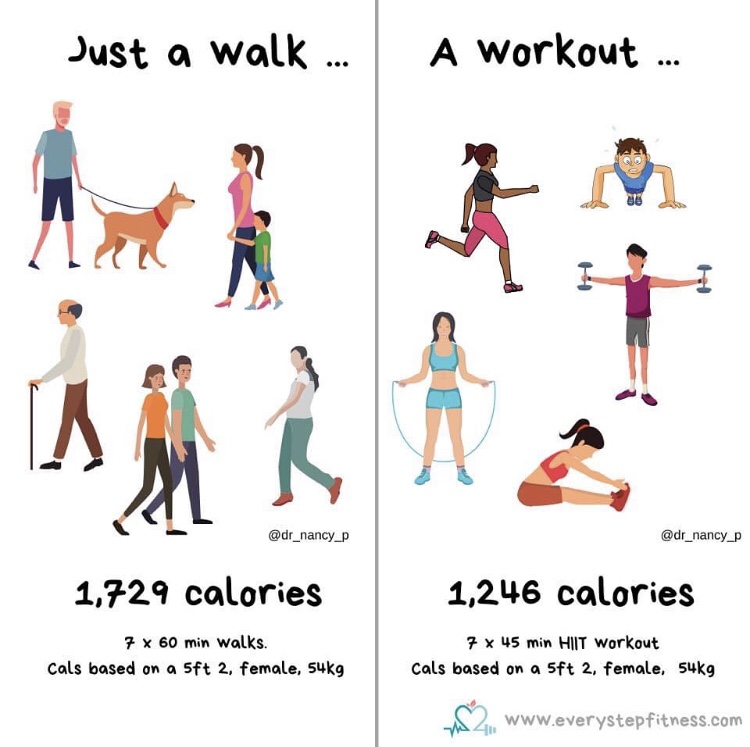
It’s natural to associate cardio workouts with burning loads of calories; you feel sweaty and breathless so you feel like you’re working hard. A 45 min HIIT for example is very tough and regardless how hard you’re working you’re going to be feeling it. However, it may be hard to motivate yourself to commit to a 45 min session at home when there are so many other things shouting for your attention (children (literally!), work, house chores etc). In contrast an hour’s walk doesn’t feel particularly strenuous, it may be something you do anyway to walk the dog, get the shopping or get out the house for bit, and it in fact burns more calories than the workouts.

I did this experiment on myself back in the summer so the numbers will vary according to your age, height, weight and fitness levels but the principal is the same (independent studies show this too). A one hour walk a day will burn significantly more calories than a 45 min HIIT workout. So if you’re not managing a workout every day – don’t stress, especially if you’re managing to go for a walk. In addition 7 days of HIIT workouts is actually NOT a good idea – studies have shown these workouts impact negatively on sleep if you’re doing too many a week. Obviously there are cardiovascular and health benefits to the HIIT workouts which are equally as important as calories burnt so don’t ditch them completely but my point is that you shouldn’t feel guilty if all you manage is a walk on some days.

🤗

Xx