Recipes

Trick or treat? ..

Trick or treat? ..🎃🍫

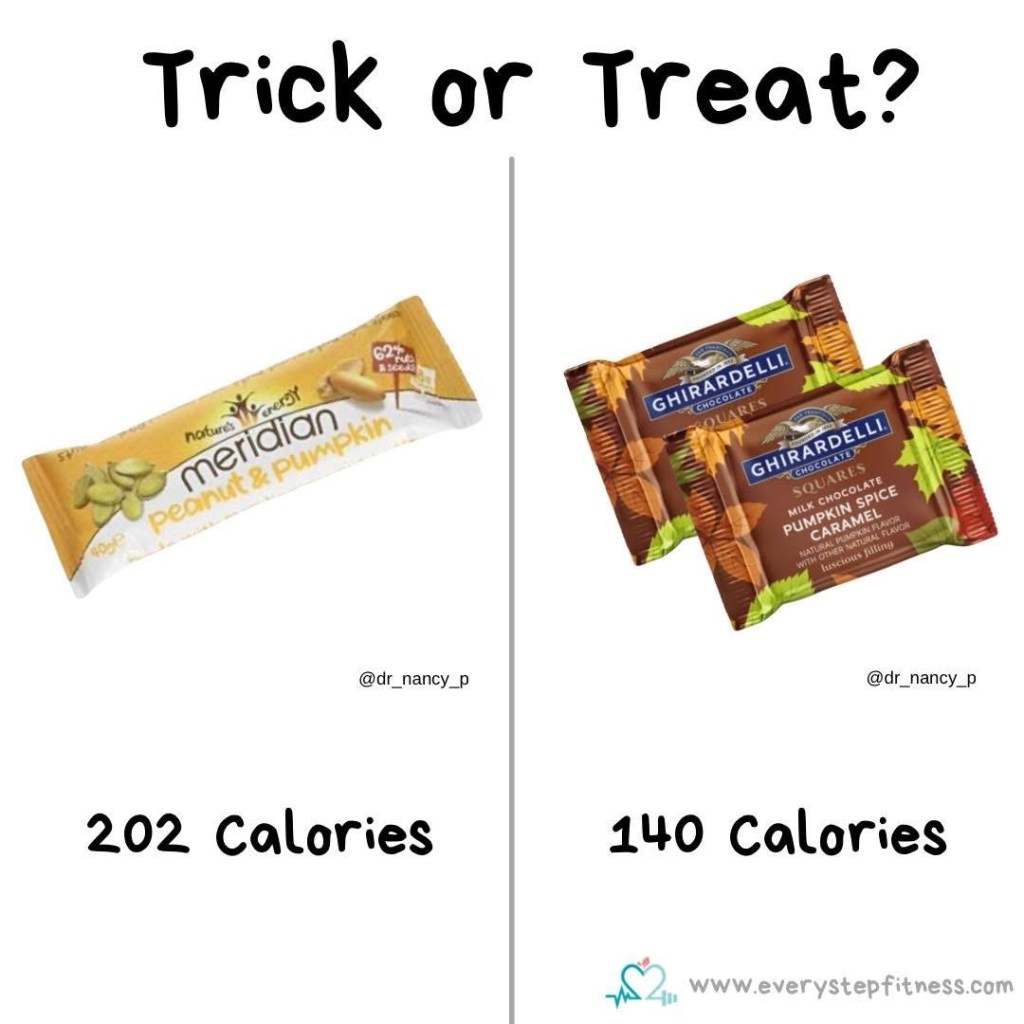
It’s pumpkin season and there’s a multitude of pumpkin spice snacks out there. Pumpkin is often promoted as a health food (pumpkin itself does indeed have many health benefits) and there are lots of snack bars out there that are marketed to imply that they are a “healthy” choice. This is a perfect example – this bar definitely looks like it’s a healthy choice. It’s got nuts and pumpkin seeds in it – great for good fats, vitamin A, and a host of other benefits.

So you might decide to reach for this rather than reaching for a pumpkin spice caramel chocolate square thinking it was a better choice. Well that may not always be the case.

It does contain a good range of nutrients (and fat and sugar) and is definitely a good snack to give you energy and keep you full and will cost you 202 cals. But you could actually have 2 of these chocolate caramel squares for fewer calories. So if you were trying to lose fat/weight and looking for a snack, then rather than reaching for a “healthy” snack bar when you don’t fancy it, you’d be better off just going for a snack you actually want – like the chocolates if that’s what you fancy. And if you do want the ‘healthy’ bars then be sure to read the labels carefully as some are extremely high in calories.

Ultimately, if you’re trying to lose fat or weight, it comes down to calories. So enjoy a balanced diet overall and just be mindful of the calories in what you’re having.

Happy Hallowe’en 🤗
xxx
Tuesday Tip

Tuesday Tip: Pilates to build muscle?

Tuesday Tip: Pilates to build muscle? 💪

Pilates is elegant, challenging, and amazing for mobility and core control but can it replace traditional strength training for muscle growth and strength? Social media says yes but let’s see what the evidence says.

#1 How Pilates Builds Strength

Pilates uses bodyweight, springs, and controlled movement to improve balance, stability, and endurance. You’ll definitely feel it especially in your core and smaller stabilizing muscles. But feeling the burn doesn’t always equal muscle growth. Research shows Pilates improves functional strength and posture, but not maximal strength (how much weight you can lift). Without heavier resistance or progressive overload, the larger muscle groups (glutes, quads, lats) don’t get the same challenge.

#2 What About Muscle Growth (Hypertrophy)?

To build muscle, your body needs enough tension and load to trigger adaptation. Traditional resistance training (using weights, bands, or machines) creates that through progressive overload (gradually lifting more over time). Pilates, while great for endurance, doesn’t generate the same muscle stimulus. You might see small changes if you’re new to exercise, but not the same growth or metabolic boost that comes from lifting. When we look at research on strength, lean muscle gain, cardiovascular improvements, and bone density, Pilates falls short compared to traditional resistance training and conditioning.

#3 The Best of Both Worlds

Does that mean ditch Pilates? Not at all. Think of Pilates as the side salad, not the main course. It’s perfect for improving mobility, posture, core control which are all vital. But if your goals include muscle gain, bone strength, or boosting metabolism (and these should be everyone’s goals to age well)make resistance training your foundation and let Pilates complement it.

Pilates is fantastic for core strength and movement quality but for real gains in muscle and strength, weights still win. So don’t listen to social media and think you can rely solely on Pilates. If you love Pilates then combine both, and you’ll have a balanced, powerful body for life.

Happy Tuesday 🤗xx

Nutrition and Calorie Tips

‘I’m trying to lose weight so I’m avoiding carbs ….’

‘I’m trying to lose weight so I’m avoiding carbs ….’ 🍞

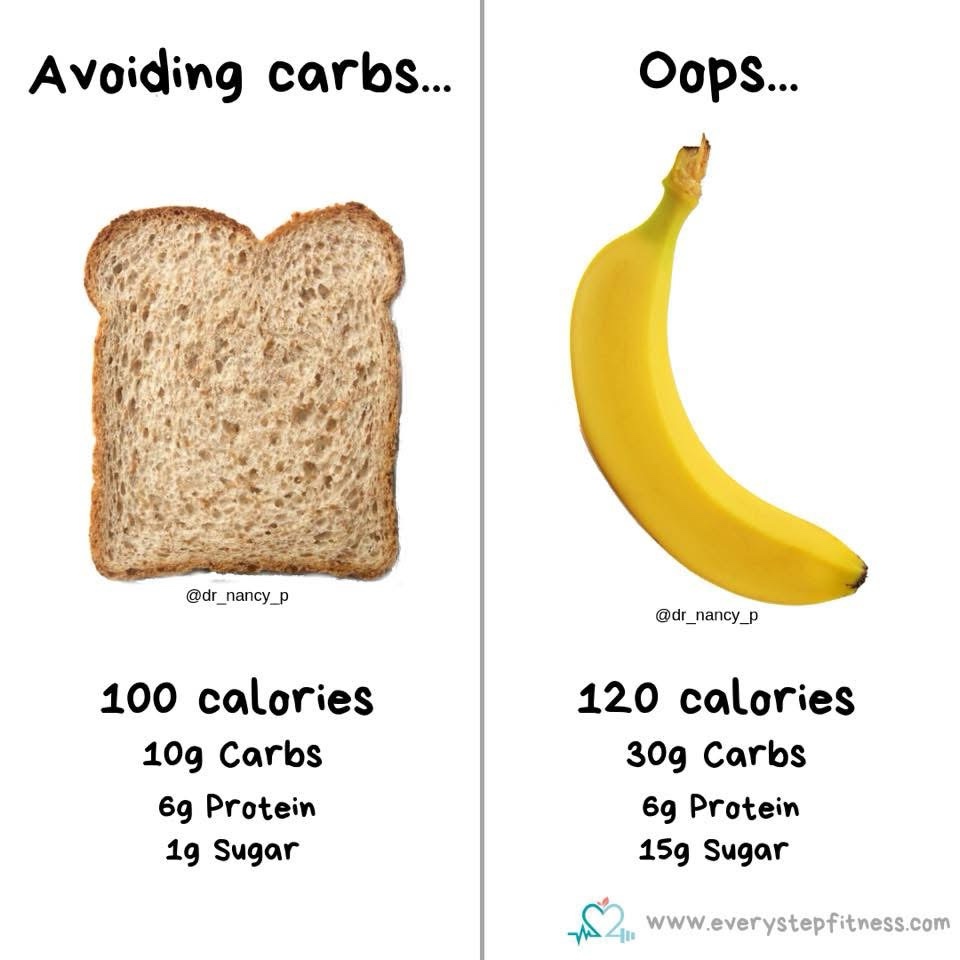
There is a common misconception that carbs are inherently ‘bad’ and that in order to lose weight you need to cut them out or avoid them completely. This usually means people cut out bread, pasta, rice, potatoes etc.

However they continue to eat fruit and veg without thinking twice when many actually contain more carbs. For example compared to a slice of bread a small Banana contains more calories, 3 times as many carbs and 15 times as much sugar! Now that doesn’t make the banana bad either – but why would you avoid the bread if you like it, yet happily eat the banana if you’re trying to avoid carbs?

In reality there is no reason at all to cut carbs from your diet. You can lose weight with or without carbs – it’s all about calories. Now obviously some people have medical reasons to avoid things like bread (coeliacs etc) but for the majority of people these foods are fine. The reason you may see weight loss when cutting these sorts of carbs is simply because you’re reducing your overall calorie intake. However unless you never want to eat carbs again then you’re not really setting yourself up for sustainable, long term weight management.

Obviously different carbs have different pros and cons – complex carbs will keep you fuller longer, whilst simple carbs (fruits mostly) will provide a faster hit of energy, you’ll get different nutrients from the different types too.

It’s important to have a balanced diet – including a range of carbs from bread to fruit. What works for you may not work for someone else and you may prefer to reduce consumption of carbs, but it’s important to be informed about what’s actually in the food you’re eating before you make that choice. Cutting out whole food groups is never a sensible or sustainable approach though.

Personally I enjoy all sorts of carbs – from bread, to fruit, to pasta, to potatoes – to doughnuts! Eat the carbs you like and enjoy and just be mindful of the calories! 🤗
Xx

Tuesday Tip

Tuesday Tip: Are Seed Oils Really Toxic?

Tuesday Tip: Are Seed Oils Really Toxic? 🌻

You may have seen social media wellness influencers decrying the evils of seed oils (canola, corn, cottonseed, grapeseed, rice bran, soybean, sunflower, and safflower oils), calling them inflammatory or toxic. But what does the actual evidence say?

The main argument is that seed oils are high in omega-6 fatty acids, which supposedly cause inflammation and chronic disease. It sounds scary, but it’s not that simple.

#1 What Omega-6s Actually Do
Omega-6 fats, like linoleic acid, are essential, our bodies need them for cell structure and function. Most people get about 6% of their calories from them, and research shows this intake is linked with lower risk of heart disease, not higher. When people replace saturated fats (like butter or coconut oil) with seed oils, LDL (“bad”) cholesterol tends to drop.

#2 The Inflammation Myth
Yes, linoleic acid can be metabolised into arachidonic acid, a compound involved in inflammation, but only a tiny fraction (0.3–0.6%) actually does. Large studies show no link between omega-6 intake and inflammation, heart disease, or cancer. Inflammation is a complex process driven by stress, sleep, illness, smoking, and environment, not by a drizzle of oil.

#3 Processing and ‘Toxins’
Seed oils are refined with a solvent called hexane. That sounds alarming, but residual amounts are negligible and far below safety limits. Refining actually makes oils more stable, less rancid, and more affordable.

#4 The Bigger Picture
Health isn’t just about one ingredient. Social media fearmongering about seed oils distracts from real issues such as limited access to fresh food, chronic stress, inequities in healthcare, and disordered eating habits which cause far more harm.

So, can you have seed oils?
Yes, they’re safe, evidence-based, and heart-healthy when used instead of saturated fats. So instead of cutting them out, focus on adding more omega-3s (salmon, flaxseed, walnuts) for balance.

Don’t let fear-based social media nutrition trends dictate your diet. Eat a variety of foods, that you enjoy, and remember balance always wins.

Happy Tuesday 🤗xx

Nutrition and Calorie Tips

Movie Snacks…

Movie Snacks… 📺

We all love a snack with a movie, and I’m sure if you’re a chocolate lover like me you could easily chomp down through a large bar of chocolate without even thinking about it. A 180g bar of chocolate isn’t even that large really so you might even have more. That bar is 961 calories though!

Why waste 961 calories on a chocolate bar when instead you could have:

  • 150g raspberries
  • A mini bag of buttons
  • A curly wurly
  • A substantial chocolate protein mousse
  • A snack bag of popcorn
    All for the just over half the calories, but with approx 25g of protein.

You could deceive yourself that you’ll only eat a few squares of the large bar or you may end up eating it all without even thinking about it. However instead you could opt for smaller chocolate bars paired with nutrient-dense foods that provide more nutritional benefits and protein, keeping you fuller for longer and making you significantly more likely to maintain your calorie deficit whilst still satisfying your sweet tooth.

There’s nothing wrong with enjoying some snacks with a movie but maybe try a few swaps to reduce the cals without reducing the enjoyment.
Enjoy!
🤗
Xx