Nutrition and Calorie Tips

Shift your focus away from the gym …

Shift your focus away from the gym …👀 🏋🏼‍♂️

Whilst it’s obviously important to be active and to exercise for lots of reasons – not least of which is health and well being, too many people are too focused on the gym and what workout’s they’re doing when it comes to weight loss. So often I hear people frustrated that they’re ‘been to the gym every day’ but haven’t lost any weight.

The fact is you it’s very hard to create a meaningful calorie deficit via exercise and activity alone. You have to work extremely hard to burn more than a few hundred calories in a workout. Studies show we usually over estimate cals burnt and how active we are.

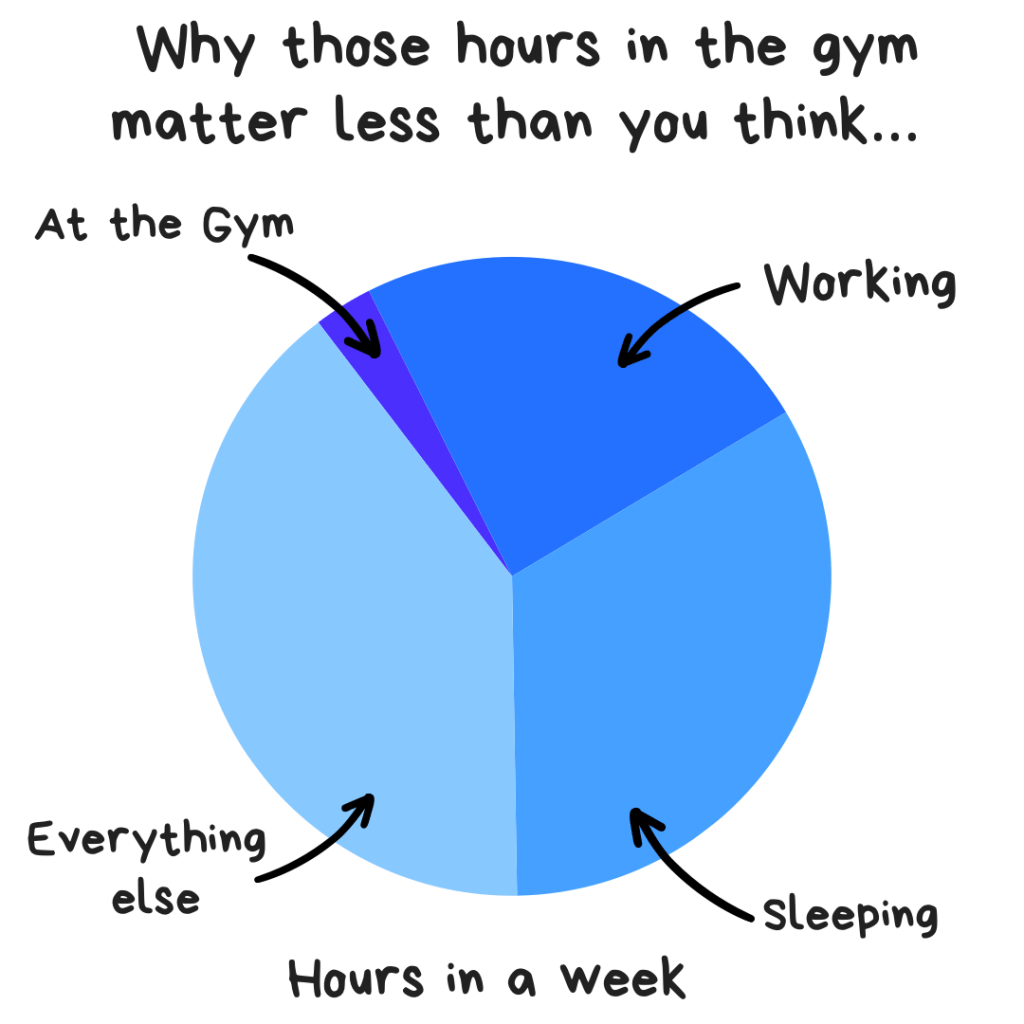
If you workout 5 days a week, for an hour a time (which is a substantial amount of exercise) you may feel you should be seeing some weight or fat loss. But that’s 5 hrs out of an entire week… for the average person working a 5 day week they’ll spend 40hrs working, assuming 8hrs sleep a night that’s 56hrs asleep, leaving another 67 hours or so of time when you’re doing everything else. So when you look at it like that those 5 hrs aren’t nearly as important as the other 107 hours (excluding sleep ).

So where do you think the focus should be? On those other hours! Yes the workouts are important for health and well being but they’re not the priority when it comes to fat loss. What you do for the rest of the day and what you eat is. You can’t out-exercise what you eat and diet is king when it comes to fat loss but general activity does help.

We always perceive a workout as burning more calories than it actually does (many studies have proved this). There’s also a tendency after a tough workout to eat more- either because we reward ourselves for the perceived effort or because we’re hungry. There’s also a tendency to be generally less active too if you’re exhausting yourself in workouts. If you spend your working day sat down, and then your evenings watching TV and your weekends fairly sedentary too then that’s what you need to focus on.

The end result is that by being focused on workouts as the only source of calorie expenditure we can end up moving less generally and eating more.

So shift your focus and as think beyond the gym. The calories you burn in a 1 hr workout will be considerably fewer than what you burn being generally active for the rest of the day. So think about how you spend the rest of your day. Do you find yourself sitting more than perhaps you need to? Do you amble instead of walking with purpose? Do you take the lift instead of the stairs? Think beyond the gym and focus instead on making yourself more active – get up, stand instead of sit, walk faster, walk more!

Also don’t be tempted to eat exercise calories back – just treat them as bonus cals rather than something to eat back.

🤗

Xx
Tuesday Tip

Tuesday Tip: The best weights workout

Tuesday Tip: The best weights workout 🏋🏼‍♂️

You’ll see lots of people on social media touting their workout as THE best weight training workout. So what really is the best weight training program?

Well, it doesn’t exist. Whilst a lot of people may claim to have the best workout regime for you, if you want to grow muscle tissue or get stronger, there is no clear evidence that any particular workout regime is better than any other and certainly there isn’t one that stands out as the ‘best’.

A recent study presented a review of the largest analysis of resistance training variables. It looked at whether low reps high weight, or higher reps and lower weights etc are better for building muscle strength. It concluded that whilst heavier loads are important for strength, and multiple sets are important for muscle growth, the actual differences between a lot of variables were very small.

Essentially if you’re lifting a reasonably heavy (challenging) weight, for multiple
sets, 2-3 times a week you don’t really need to obsess about the details. It doesn’t matter whether you have push and pull days, or whether you work on the whole body each time, or whether you do 8-12 reps or 15-20 etc. There’s really no need to complicate it. Yes , obviously if you’re a body builder or focused on a very specific weight lifting goal then of course you can fine tune and tweak your program and get into the finer details. But most people don’t lift weights at all and everybody should because it’s important for so many health and well being reasons. And many people shy away from weights because it can seem complicated, scary or overwhelming.

So let’s keep it simple – as long as you’re lifting weights regularly and you find what you’re doing challenging – you’ll be doing just fine! Whether you choose to do it in a gym environment or a class environment (e.g. Bodypump) you’ll reap the benefits.

🤗
Xx

Nutrition and Calorie Tips

The best diet… ..

The best diet… .. 🥗

There are lots of diets out there that claim to be better than any other. But what do ALL these diets have in common? And why do they work?

It’s nothing to do with any special properties of specific diets. For ANY diet to work it has to result in a calorie deficit. For some people certain diets will enable them to achieve this more easily and therefore that diet will work for them. But behind these diets are the simple maths of calories in vs out. However the issue with many diets is that they don’t educate you on the mechanism behind them and are therefore short term fixes.

Keto / low carb : omits or reduces carbs, which may reduce calories.

5:2 : limits calorie intake for 2 days a week, which may create a calorie deficit on average.

Intermittent fasting/ 16:8 : restricts the window of time you can eat in, which MAY reduce calories.

Diet clubs : assign points or values to certain foods and restrict food types, so MAY reduce calories

Shakes / Supplements : replaces meals or promotes excessive bowel movements etc which result in water loss, and a possible calorie deficit from meal replacement.

Juice cleanse/ detox : replaces whole foods with juices, resulting in fewer calories and rapid initial water loss.

Body type/blood type diet : restricts foods based on blood or body type, which may result in a calorie deficit

Spot the similarities? Many involve omitting food groups which will result in a calorie deficit. Calories can’t tell the time so methods involving not eating on certain days/times only work if you don’t overeat on others. Diet clubs help with accountability (regular weigh ins and rewards) but hide calories behind points or labels which lock you in to their method.

All of these diets can result in fat loss, but how many of them are sustainable long term, educate you on managing energy intake or build new habits? Some are actually damaging; laxative supplements and fasting can cause bowel damage, kidney damage and development of silent acid reflux etc, as well as promoting disordered eating. The best ‘diet’ in my opinion , is one that requires the least amount of restriction and “rules” as possible.That’s why I like tracking calories.

It’s focused less on restriction and more on having restraint.

But it doesn’t matter which ‘diet’ you choose, as long as it works for you – but make sure you understand WHY it works 🙂

xx

Tuesday Tip

Tuesday Tip: Overeating ‘Junk’?

Tuesday Tip: Overeating ‘Junk’? 🍬

Can’t stop eating sweets / ‘junk’?

Sometimes all it takes is a bit of awareness around what might be behind your eating habits to make small changes that have long lasting changes.

If you’re finding yourself overeating these types of foods consider some of these possible reasons.

# Lack of sleep affects our appetite. Sleep deprivation can increase hunger levels and appetite for those delicious high sugar, high fat, high salt foods. Prioritise sleep where you can

# Make sure you’re eating enough during the day. Don’t make the mistake of trying to eat very small portions in an attempt for weight loss, only to come home and eat the whole fridge. Fuel your day adequately with healthy, nourishing choices so you that you won’t feel incredibly hungry at night leading to overeating.

# Stay hydrated! It’s not about ‘just drinking water’ whenever you’re hungry but staying hydrated can impact your appetite and make you feel more alert and energised – potentially helping your to make better food choices throughout the day.

# Have a good source of protein at every meal. It’s the most satiating macronutrient and paired with lots of fibre from whole grains and veggies will create a very satisfying and filling meal.

# Reflect on how you feel when you make less desirable food choices. Sometimes it is absolutely ok to choose those delicious foods but sometimes it’s emotions or boredom driving it. Recognising the source can be a great help.

# Are you being too strict? Sometimes this can intensify our craving for a food if we are constantly trying to ban ourselves from eating it. Allow yourself to enjoy them sometimes in moderation, rather than going cold turkey.

🤗

Xx

Nutrition and Calorie Tips

Fasted vs non-fasted Exercise…

Fasted vs non-fasted Exercise… 🏃🏼‍♂️

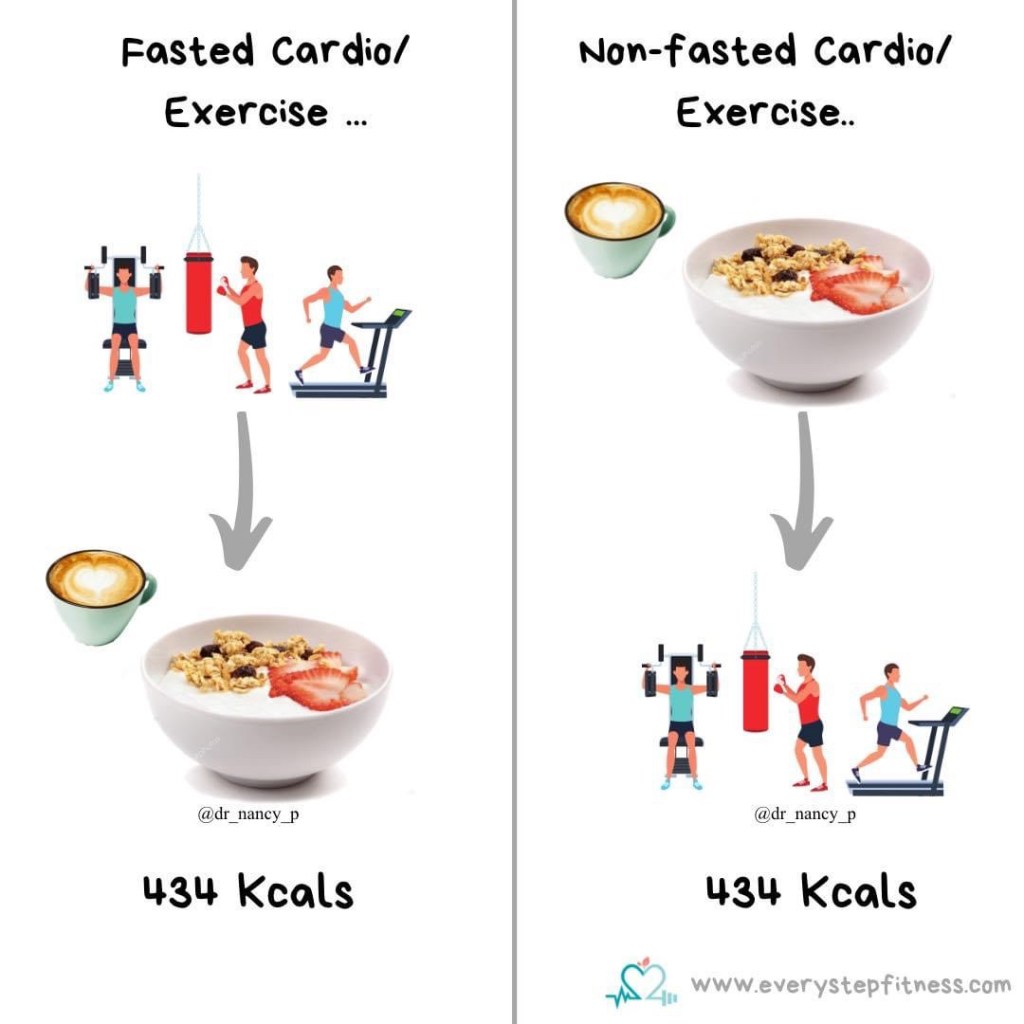
There’s a fair amount of confusion out there about whether you’re better off exercising fasted (on an empty stomach) or after you’ve eaten something (non-fasted) and whether one is better or worse for fat loss.

The confusion arises because people often talk about how exercising on an empty stomach increases fat oxidation. This then gets conflated with fat loss. Fat oxidation is the process of using fat for energy in the body. When you eat something the body secretes insulin to aid in the processing and metabolism of the food for energy and storage. Insulin reduces fat oxidation, so less fat is used for energy. So the argument is that if you haven’t eaten anything yet that day then you won’t have secreted any insulin and therefore fat will be oxidised and used for energy.

Whilst this is true – you will have more fat oxidation, it doesn’t actually mean more fat loss. Fat loss is dependant on overall calories consumed, on average, over the day/week/month etc. Even if you exercise before eating, you still need to have a calorie deficit for that day otherwise any excess calories will still be stored as fat. So It makes NO difference to fat loss whether you choose to eat before or after exercise.

For some people they prefer to exercise on an empty stomach, but for others they need some food in their system to workout. From a workout perspective if you haven’t eaten yet then you may find you fatigue faster and aren’t able to work as hard, so you may end up burning fewer calories. So it’s very much personal preference!

However bear in mind that doing too much intense fasted cardio does impact hormone production. Firstly, it causes stress hormones like cortisol to rise, thyroid activity to be depressed, and in women decreases the production of kisspeptin (disrupting the release of estrogen and progesterone) which isn’t great!

🤗

xxx