Tuesday Tip

Tuesday Tip: How to age well!

Tuesday Tip: How to age well! 👵🏻

Ageing is something we all experience but perhaps we feel like it’s out of our control. In reality up to 80 percent of how we age is directly influenced by your lifestyle choices.

Movement, exercise, good nutrition, and sleep can make significant differences to how you age.

Regular physical activity can significantly slow the aging process in joints. Studies have shown that inactive individuals experience a rapid deterioration of joint health, leading to increased pain, stiffness and reduced mobility.

Regular exercise not only helps maintain muscle mass, but it also plays a crucial role in preventing age-related muscle loss. In contrast, a lack of physical activity is associated with muscle wasting, weakness, and frailty. It also helps with proprioception and balance. Proprioception is the body’s ability to sense movement, action, and location. It’s present in every muscle movement you have. Without proprioception, you wouldn’t be able to move without thinking about your next step. Proprioception allows you to walk without consciously thinking about where to place your foot next. As you age this becomes even more important and helps you to stop yourself falling. Preserving muscle mass also means you can get back up if you do fall. All this enables longer independence

People who regularly do some form of aerobic exercise, experience significant improvements in cognitive function and a decreased risk of age-related cognitive decline. Meanwhile, sedentary individuals have been shown to be prone to memory loss, reduced mental sharpness and at greater risk of neurodegenerative diseases

A diet abundant in fruits, vegetables, whole grains, and lean proteins provides essential vitamins, antioxidants, and minerals that combat oxidative stress, protects against age-related diseases, and promotes cellular health.

Lack of sleep disrupts vital processes, which can lead to some signs of aging, such as fine lines, dull skin, and impaired cognitive function. During deep sleep, the body engages in critical repair and rejuvenation activities, promoting cellular regeneration and optimising brain function.

So take some control back and prioritise some of these habits and prioritise your nutrition, exercise and sleep to ensure you age as well as possible!

Happy Tuesday 🤗xx

Nutrition and Calorie Tips

Stop exercising to burn calories…

Stop exercising to burn calories… 🏃🏼‍♂️

Whenever someone wants to lose weight inevitably they place a huge focus on exercising to burn more calories. Exercise appears to be the holy grail of weight loss behaviours. Exercising to burn calories becomes the main goal. And yes, of course it’s important to exercise and yes of course it does increase your energy output but, as I’ve discussed before, you will never ever be able to out-exercise food.

So whilst I wholeheartedly support people exercising more (I’m an instructor so obviously I do!) it’s not with the sole purpose of burning calories. That’s last on my list of reasons for anyone to partake in exercise and it should be last on yours too!

Instead, move your body to improve your mental and physical well being. There are so many reasons to exercise that go beyond burning calories.

• Exercise improves muscle mass and joint health and keeps you functioning independently into old age.

• Whilst excess exercise can down-regulate immune function, regular exercise serves to improve the resiliency and expression/activity of immune cells and mediators so it improves immune function and helps protect against disease.

• It makes you feel stronger and more empowered

• It improves mood, can reduce anxiety and some symptoms of depression and relieves stress.

• It improves cardiovascular health and reduce disease risk

• It increases self confidence

Above all – exercise to celebrate that you can! Not to burn calories!

🤗xx

Tuesday Tip

Tuesday Tip: Common mistakes that prevent weight loss

Tuesday Tip: Common mistakes that prevent weight loss 🤔

Here are some of the common mistakes I see people make with their diet/nutrition that may be preventing them from losing weight/fat.

#1 Thinking that there is a “perfect” diet.

There Is no ideal diet that you can follow to lose weight. You have to learn about calories and nutrition, go through some trial and error and figure out what works best for you.

#2 Trying to do too much too quickly

Many people try to completely overhaul their diet overnight. Small, simple, step by step changes that can be sustained over time often lead to better long term results.

#3 Eating too little

Now just to clarify – I do not mean that you can ‘hold on to fat’ if you under-eat. If you’re in a calorie deficit you will lose weight/fat (consider the extreme case of some eating disorders etc). But you can hinder your progress by eating too little because most people can only under eat for so long before the mind and body fight back and they binge. A lot of people are stuck in a cycle of bingeing and restricting because they are eating too little instead of properly nourishing themselves. So it’s about finding a sustainable calorie deficit.

#4 Not being willing to make sacrifices.

Sorry but if you aren’t happy at the weight you are, eating and drinking as you are, then you are going to have to make changes and that may mean sacrificing some of the things you currently enjoy consuming.

#5 Too much variety

Finding a few go-to meal options and sticking them consistently helps simplify your nutrition choices and make grocery shopping and food prep easier. Variety is great, but don’t overdo it to the point that eating at home becomes a huge chore.

#6 Expecting results too quickly

You can’t expect to change your diet and see see changes In a week or a month. It took longer than that to gain the weight and it will take longer to lose it. Changes take time so be patient.

#7 Inconsistency

It may be boring but consistency is key. You can’t expect results if every weekend you have a massive blowout. You need to find a happy medium if you want to reach your goals.

Happy Tuesday 🤗xx

Nutrition and Calorie Tips

Anyone for ice cream?.

Anyone for ice cream?.. 🍦

It’s warmed up a bit now so definitely time to crack open the ice cream! I don’t know about you but once I start on a tub it’s gone before I even realise it!

Whilst there’s no problem with including any ice cream you like in your diet, if you are trying to lose weight/fat you may find that fitting a whole tub into your calories quite tricky. So you have two options – either limit the amount you have, or swap from a calorie dense type of ice cream to something that’s similar tasting, but lower calorie. There are the obvious swaps to the low calorie brands like oppo or halo top etc but another option is to switch to something else entirely.

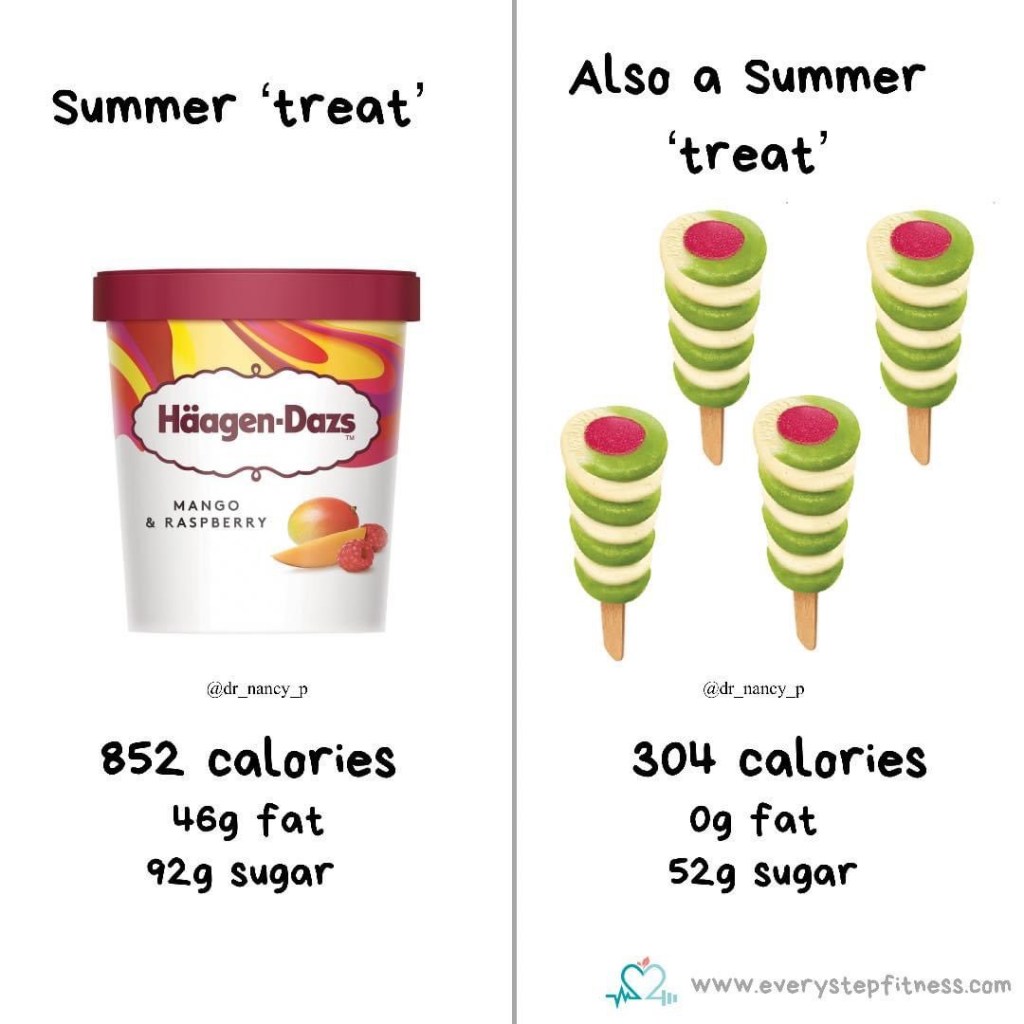
In this example switching from the Häagen-Dazs mango and raspberry ice cream to twisters makes a massive calorie saving. You could have 4 twisters for almost a third of the calories of the Häagen-Dazs. As an added bonus the chances of you eating 4 twisters in a row is considerably less than working your way through a tub anyway. Psychologically it’s much easier to work your way through an open tub than help yourself to 4 lollies in a row.

So if you do want to enjoy some

Ice cream but save some cals try going for the lower cal, higher volume option if you can.

🤗xx

Tuesday Tip

Tuesday Tip: Dealing with stress eating

Tuesday Tip: Dealing with stress eating 🍫

I think many of us struggle to make healthy decisions when we’re feeling stressed or overwhelmed. Heightened emotions can drive you to engage in self-destructive coping strategies which range from eating too much, not eating enough, overthinking, isolating yourself, procrastinating, overworking etc. These are just some ways in we learn to cope, but these strategies often come with a cost. If stress eating is one of your coping strategies then the cost could be that you don’t stick to your plan, and then over eat and feel guilty etc which further adds to the feeling of stress and overwhelm.

So how do you prevent this? The problem is these behaviours are often instinctive. You do them mindlessly. If you want to change them then you have to actually remember that at the time when you’re feeling overwhelmed. It helps to anticipate these situations in advance – identify which situations tend to leave you feeling overwhelmed. Then the key is to take ‘REST’ – relax, evaluate, set an intention, take action – R E S T!

A good indicator that you need a REST is when you feel an intense emotion, or have a desire to act impulsively, even if you don’t know why. These are moments of choice.

You can either do what you normally do – react impulsively and potentially cause more distress for yourself. Or you can relax, evaluate, set an intention, and take action using a healthier coping skill.

RELAX – Pause. Take a breath. Step away from the situation to get a different perspective.

EVALUATE – Observe what is happening for you physically, emotionally, and mentally.

How do I feel? What’s happening? What are the facts?

SET AN INTENTION – Ask yourself, ‘What do I need right now?’ Coping, problem solving, self-soothing, communication.

TAKE ACTION – Put your plan into motion (call a loved one, go for a walk, distract yourself with a hobby etc).

Proceed mindfully, moving ahead slowly and with awareness of what you’re doing.

So instead of the old approach which was to feel stressed, act impulsively and eat, then feel guilty, instead you pause, notice the overwhelm, breathe,use your plan (talk to a loved one etc), feel better hopefully.

This can take some time to put into practice. But it’s a skill well worth learning.

Happy Tuesday 🤗xx