Tuesday Tip

Tuesday Tip: Overeating ‘Junk’?

Tuesday Tip: Overeating ‘Junk’? 🍬

Can’t stop eating sweets / ‘junk’?

Sometimes all it takes is a bit of awareness around what might be behind your eating habits to make small changes that have long lasting changes.

If you’re finding yourself overeating these types of foods consider some of these possible reasons.

# Lack of sleep affects our appetite. Sleep deprivation can increase hunger levels and appetite for those delicious high sugar, high fat, high salt foods. Prioritise sleep where you can

# Make sure you’re eating enough during the day. Don’t make the mistake of trying to eat very small portions in an attempt for weight loss, only to come home and eat the whole fridge. Fuel your day adequately with healthy, nourishing choices so you that you won’t feel incredibly hungry at night leading to overeating.

# Stay hydrated! It’s not about ‘just drinking water’ whenever you’re hungry but staying hydrated can impact your appetite and make you feel more alert and energised – potentially helping your to make better food choices throughout the day.

# Have a good source of protein at every meal. It’s the most satiating macronutrient and paired with lots of fibre from whole grains and veggies will create a very satisfying and filling meal.

# Reflect on how you feel when you make less desirable food choices. Sometimes it is absolutely ok to choose those delicious foods but sometimes it’s emotions or boredom driving it. Recognising the source can be a great help.

# Are you being too strict? Sometimes this can intensify our craving for a food if we are constantly trying to ban ourselves from eating it. Allow yourself to enjoy them sometimes in moderation, rather than going cold turkey.

🤗

Xx
Nutrition and Calorie Tips

Fasted vs non-fasted Exercise…

Fasted vs non-fasted Exercise… 🏃🏼‍♂️

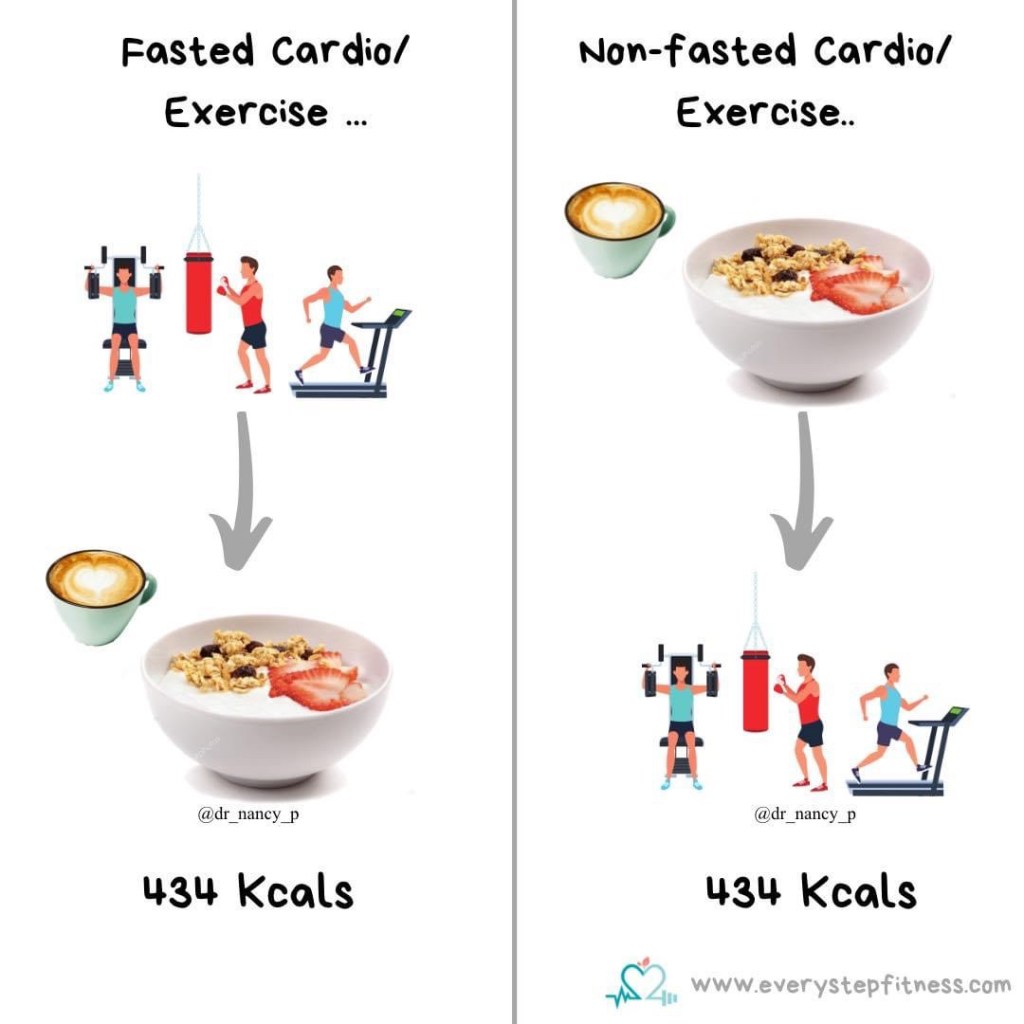
There’s a fair amount of confusion out there about whether you’re better off exercising fasted (on an empty stomach) or after you’ve eaten something (non-fasted) and whether one is better or worse for fat loss.

The confusion arises because people often talk about how exercising on an empty stomach increases fat oxidation. This then gets conflated with fat loss. Fat oxidation is the process of using fat for energy in the body. When you eat something the body secretes insulin to aid in the processing and metabolism of the food for energy and storage. Insulin reduces fat oxidation, so less fat is used for energy. So the argument is that if you haven’t eaten anything yet that day then you won’t have secreted any insulin and therefore fat will be oxidised and used for energy.

Whilst this is true – you will have more fat oxidation, it doesn’t actually mean more fat loss. Fat loss is dependant on overall calories consumed, on average, over the day/week/month etc. Even if you exercise before eating, you still need to have a calorie deficit for that day otherwise any excess calories will still be stored as fat. So It makes NO difference to fat loss whether you choose to eat before or after exercise.

For some people they prefer to exercise on an empty stomach, but for others they need some food in their system to workout. From a workout perspective if you haven’t eaten yet then you may find you fatigue faster and aren’t able to work as hard, so you may end up burning fewer calories. So it’s very much personal preference!

However bear in mind that doing too much intense fasted cardio does impact hormone production. Firstly, it causes stress hormones like cortisol to rise, thyroid activity to be depressed, and in women decreases the production of kisspeptin (disrupting the release of estrogen and progesterone) which isn’t great!

🤗

xxx

Nutrition and Calorie Tips

Tuesday Tip: Beat the Autumn Blues

Tuesday Tip: Beat the Autumn Blues 🍂

So Autumn is well and truly here; cooler, darker evenings and mornings. For me, and many of my clients and class members this is a tough transition. It’s hard to find motivation to continue regular exercise, and we crave warming, comfort foods. I’ve posted this before but it’s always a useful reminder at this time of year.

Low energy, low mood and low motivation makes us want to hibernate rather than work out. So how can you keep that summer mojo going? Focus on shorter workouts if you’re struggling to find motivation for long sessions. In an ideal world you’d aim for 30-45 mins of high intensity exercise 3 x week: a class, a home hiit workout, or a cycle or run. But anything is better than nothing so if you can only do 10-15 mins then that’s fine! Don’t forget all the other ways you can exercise too like gardening, walking, jogging, swimming etc

Find a gym buddy; it’s harder to skip that workout when you’re doing it with someone else. Join a colleague for a lunchtime run, or meet up with a friend at the gym or at a class. The social side of fitness plays a massive role in keeping you on track.

Try to sneak exercise in whenever you can: park further away, take the stairs, walk over to speak to colleagues in the office rather than phoning or try a walking meeting with colleagues. If you’re watching the kids play sport then walk the sideline instead of standing still.

Exercise isn’t about losing weight, it’s great for stress relief and at this time of year when things can be a bit manic it’s a great release. The endorphins will lift your mood and help energise you. Make the most of those bright autumnal days and go for a walk outside.

Focus on warming, filling foods like soups and casseroles. I also like to stew up a load of fruit (apples, pears, plums, berries – whatever!) and use it as a snack or pud. Warm it up, sprinkle some oats or a little cereal on it and a dollop of Greek yoghurt – a great comforting dish!

Oh and just because it’s not baking hot you still need to be drinking plenty of water. It’s even more important to ensure you’re properly hydrated at this time of year as it’s when most of us forget – so get sipping while you workout!

Don’t let the changing seasons get you down – embrace it – enjoy it and have some fun this Autumn 🍁

Happy Tuesday 🤗

Xx

Nutrition and Calorie Tips

‘Healthy’ snacks… 🤔

‘Healthy’ snacks… 🤔

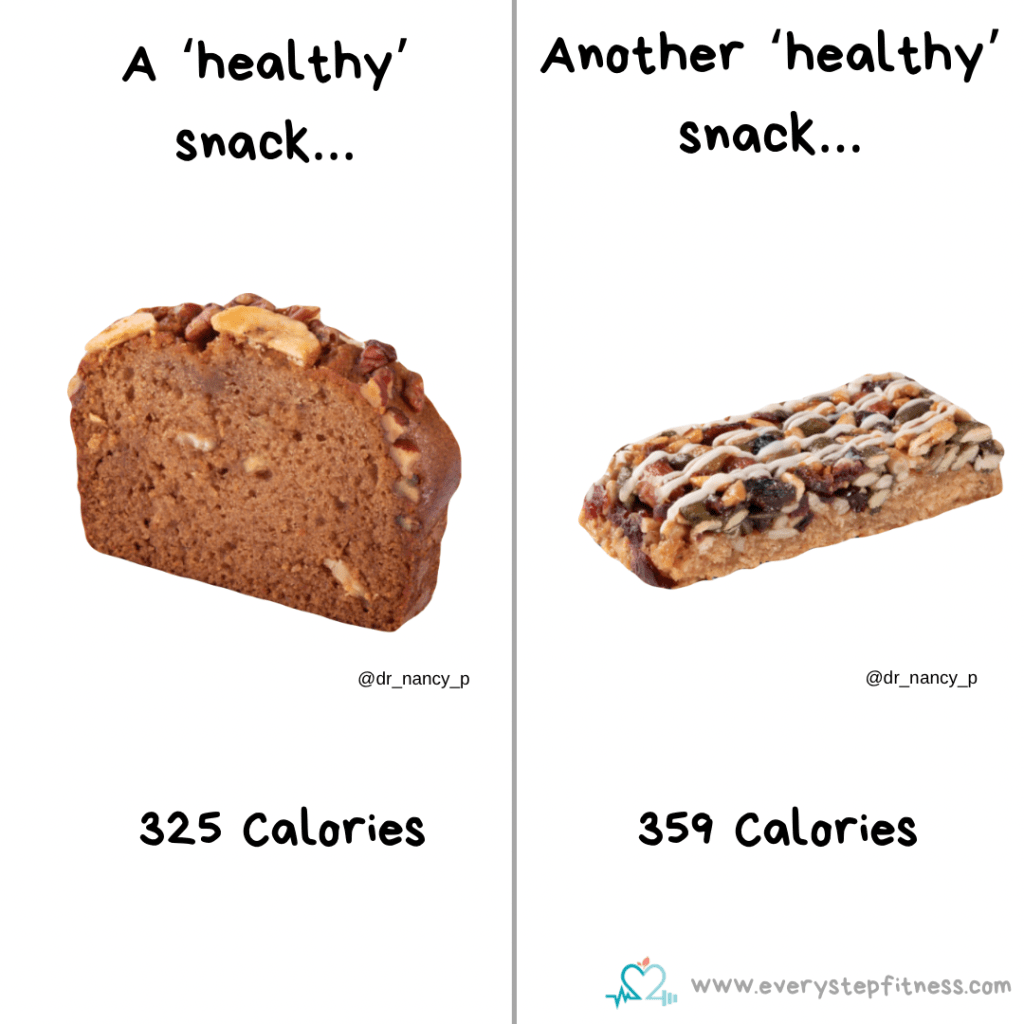
So todays post has come about after recent chats with a few of my clients. Our perceptions of what is ‘healthy’ and therefore equated to being low calorie in many cases is heavily influenced by marketing and social media. Often what we expect to be the healthy or low calorie option isn’t actually as low as we think.

This particular comparison is an interesting one. Both these snacks (banana bread and a flapjack) have been described to me as a ‘healthy’ or low calorie option when grabbing a sweet treat at a cafe. Now some of those people have said they would choose the banana bread as the only other option was a flapjack which was ‘bad’ and others have said the opposite. In reality as you can see there’s really not much in it. Both these snacks are close to 350 cals, both are high fat and sugar and both contain a variety of micronutrients. So both of these are actually a hefty snack and should both be treated as such. They’re essentially just the same as a small slice of cake. There’s nothing wrong with that at all but it’s just worth remembering when choosing to have them.

In some cases other choices may even be fewer calories so no matter how ‘sure’ you are about which option you think is lower in calories it’s always worth checking (assuming weight loss / controlling calorie intake is your goal of course). As I always say – knowledge is power so being aware of the calorie content of things, and also of our own perceptions of the things we consume is always a good thing. Make an educated choice!
🤗

Xx

Tuesday Tip

Tuesday Tip: Pump(kin) it up!

Tuesday Tip: Pump(kin) it up! 🎃

Well it is Hallowe’en today so I kinda had to focus on the most famous (and only?) of hallowe’en vegetables! The pumpkin!

So they’re not just great for carving cool spooky lanterns, in fact their nutritional benefits are so good – they’re scary!

Not only is pumpkin really low calorie (only 26kcals in 100g), it also contains no saturated fats or cholesterol, and is rich in fibre, anti-oxidants and B vitamin. They are super high in vitamin A – a single serving giving you over 4 times your daily recommended amount of this vital vitamin. It’s great for eye health and for essential immune function – great to ward off those seasonal colds at this time of year.

It’s particularly good for helping you recover from your workouts. Pumpkins are high in vitamin C – which as well as boosting your immune system also helps the body produce collagen. This is vital for maintaining the structure of your bones and keeping them strong! It’s full of beta-carotene which is a fantastic natural anti-inflammatory, which will help reduce your post-workout recovery time! On top of that it’s also rich in potassium (it has more potassium than bananas). This helps to restore the body’s electrolyte balance after a heavy workout which means you will recover faster and keep those muscles functioning properly.

It doesn’t end with the flesh – the seeds are also brilliant too. They are also full of anti-inflammatory compounds and rich in healthy fats, protein and fibre and recent evidence suggests they can help with pelvic floor issues (having an impact via anabolic action on pelvic floor muscles and relaxing the bladder muscles and bladder overactivity. So sprinkle them over your brekkie or grab a handful for an on the go snack!

It’s such a versatile veg – you can use it in casseroles or stews, make a yummy soup, oven roast it, throw it in a curry, and you can use it in baking too – it makes a great egg or butter replacer in muffins and loaf cakes, and you can even make a pumpkin butter!🤗

The pumpkins sold for carving aren’t the best for cooking as they’re grown to have less ‘meat’. So if you’re buying purely to eat it’s worth going for other pumpkins or squashes, but the carving ones are still perfectly edible. So as you’re carving those pumpkins today save a bit of the flesh and try roasting it or throwing it in a casserole etc.

Happy Hallowe’en guys!

🎃👻

Xx