Nutrition and Calorie Tips

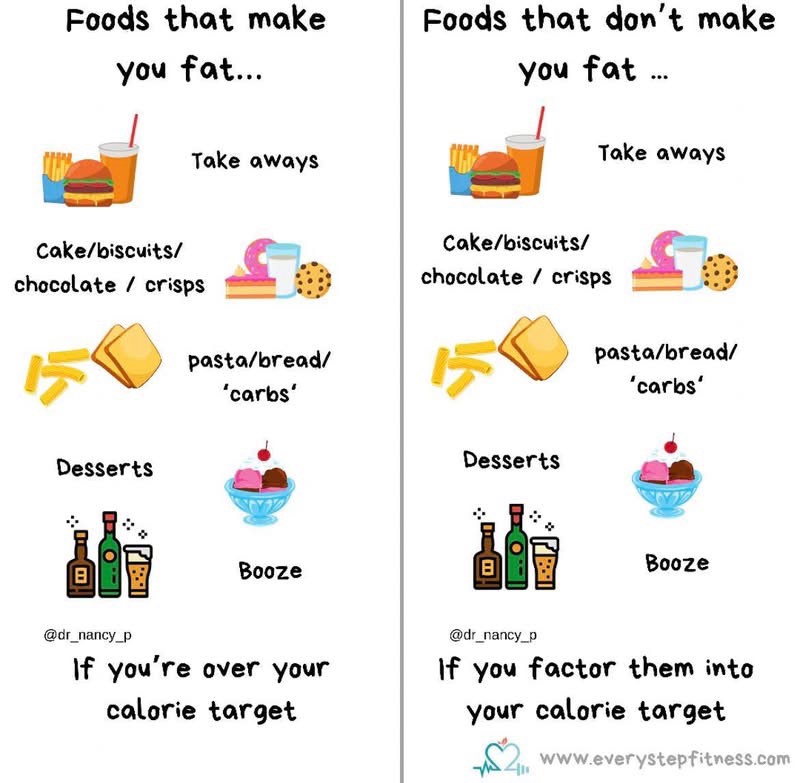
Foods that make you fat…

Foods that make you fat… 🍕

Remember no one food makes you fat, and no one food makes you lose fat. Every day I hear people freaking out because they’ve eaten something that isn’t ‘healthy’. Usually they mean they’ve eaten something that isn’t a whole food (fruit, vegetables, whole
grains) or foods that are perceived as ‘good’
E.g. nuts, avocados, salads, hummus etc.

So yes the majority of your diet should ideally come from ‘healthy’ foods e.g. fruits, vegetables, lean protein, good quality carbohydrates, fibre etc. Ideally around 80% of your diet should be from these food, but that still leaves room for all the other foods you enjoy.

You can and should include foods you perceive as ‘bad’ like cookies, cakes, take aways, alcohol, ‘bad’ carbs etc in your diet in moderation. It doesn’t mean you’ve ‘fallen off the wagon’, or gone off your diet, that you’re a failure, or ‘can’t stick to anything’, or need to ‘start over’. No one can stick to a diet that excludes everything they love all the time – it’s not sustainable. So try to forget this all or nothing attitude, as it’s only setting you up for failure and it’s really not being very nice to yourself!

So don’t freak out if you have some chocolate or a glass of wine. It won’t make you fat, it won’t ‘ruin’ your diet. Quitting because you think you’ve failed will though. So just accommodate the fun foods into your calories. Try to aim for no more than 20 percent ‘fun’ foods (just to ensure you’re getting the right vitamins and minerals etc) but equally don’t over think it – and remember its your diet over time that matters – over months and years, not hours and days. So if you’re over calories today, just be under for the next few days to accommodate it!

Enjoy 🤗
xx
Tuesday Tip

Tuesday Tip: Under-reporting food

Tuesday Tip: Under-reporting food 📝

The sad truth is that people are terrible at accurately reporting how many calories they’re eating and multiple studies demonstrate this time and time again. For example in a couple of recent studies participants were convinced they were eating 1200 cals or less a day but on average they were eating over 2200 cals! In other studies it’s been shown people under-report by an average of 1500 cals.

It’s not that surprising – if you’ve never tracked your food intake, why would you have any idea how much you’re actually eating? This is even harder when we are surrounded by calorie dense, easily accessible foods which are easy to over eat.

It’s quite fashionable at the moment to disparage calorie tracking (ironically often by those social media ‘experts’ who’ve spent years tracking their own food) but it’s still something that’s actually really important. Aside from providing a reality check on how much you’re eating it also helps as it gives you a better idea of not only calorie content but also other nutrients. You learn what actual portion sizes look like and how many calories some of those restaurant meals actually contain but equally you may find other things you’ve avoided through ‘fear’ are actually fewer cals than you thought. It also dispels the marketing myths around foods and the assumption that ‘heathy’ foods are naturally low calorie etc.

Tracking isn’t so much about tracking but more about increasing knowledge and awareness about your diet and habits and then how you can make positive changes. Not everybody has to track, but most people could benefit from tracking for a short period of time.

Happy Tuesday 🤗xx

Uncategorized

‘I’m pretty good at estimating my calories….. ‘

‘I’m pretty good at estimating my calories….. ‘ 🥑

I’m always telling my clients to try to be as accurate as possible when they’re tracking their food and calories. This means actually weighing things – particularly anything that is calorie dense.

Very often people tell me that they’re “pretty good” at estimating the amounts they’re having, that they have the same thing each day so they know what it looks like now, that they can estimate pretty well etc. I’m sure some can, but I know I can’t. I can at first but then often amounts creep up without you even realising it.

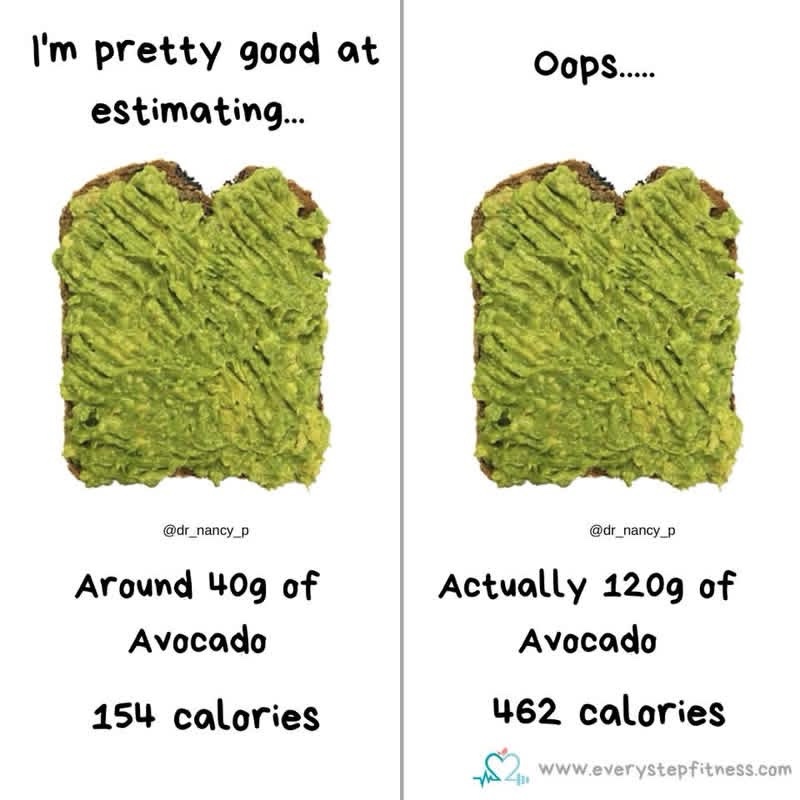
In this example on the left is an amount that was estimated at around 40g avocado by a number of people I asked, (calories excluding the toast), on the right is the actual amount – 120g! Now I don’t know about you but I wouldn’t have thought it was that much but look at what a difference it makes in calories. 40g can look very similar to 120g when layered on toast and you may not even realise how much you’re having. The same goes for nut butters, spreads, cheese etc – anything high calorie. With less calorie dense foods it won’t matter as much but with these calorie dense foods when you get it wrong you’re adding a large number of calories. This is also why measure like “a small avocado” are no good – what’s small? my small may not be your small… etc

So if you are trying to lose fat/watching your calories maybe it’s time to go back and get those scales out and double check those estimates and see if you really are as good as you think you are.
🤗
Xx

Tuesday Tip

Tuesday Tip: How to get back on the wagon

Tuesday Tip: How to get back on the wagon 🍟🍔🍕

After the summer holidays and a bank holiday weekend, you may feel as though you’ve overindulged and completely fallen off the wagon. So, what now? Should you throw in the towel and write the whole week off? Absolutely not! Before you beat yourself up or get stuck in a cycle of overeating, try these tips to get back on track.

1. Chin up

Stay positive. So you’ve eaten or drunk more than planned? One weekend or calorie splurge isn’t the end of the world. Refocus on why you want to lose weight or feel healthier. There will always be peaks and troughs—the overall journey can still be heading in the right direction, even with a few bumps along the way.

2. Make your next meal healthy

Don’t wait until tomorrow, Monday or when the children go back to school. Make your next meal a healthy one. You’ll feel better for it and immediately start getting yourself back on track.

3. Bank a few calories

Don’t starve yourself or severely restrict your calories after a blip. You’ll only end up ravenous and more likely to overeat again. However, you could eat around 100–200 Cals less for the next few days. You’ll barely notice the reduction, but it can help buffer some of the extra calories.

4. Get active

You can’t out-exercise a consistently poor diet, but being active can burn a few extra calories and help you feel better. Go for a walk, cycle, swim, take a class or grab a skipping rope—anything that gets you moving!

5. Think!

Consider what led to the splurge. There’s no need to beat yourself up, but it’s useful to understand why it happened. Were you away from your normal routine? Surrounded by tempting food? Bored, hungry or emotional? Did friends persuade you to have another drink?

Once you recognise the reason, you can plan for it next time. Most importantly, don’t let one indulgent weekend turn into an indulgent week. Draw a line under it and move on!

Happy Tuesday 🤗xx

Nutrition and Calorie Tips

Carbs make you fat….

Carbs make you fat…. 🥔 🍞

I actually lose count of the number of times people tell me it’s carbs that are making them fat, or stopping them losing weight, or that they just need to cut carbs and they’ll lose weight….

The rhetoric is usually something along the lines of – to lose fat/weight you need to cut or reduce carbs and focus on more protein and fat based foods (nuts are a prime example). Many new clients I meet have either tried eliminating carbs from their diet or that they intend to, by which they usually mean cutting out potatoes, bread, pasta etc. Many social media ‘experts’ have suggested that carbs are ‘bad’ and to be avoided – but this is based on very little actual evidence. In fact many studies have supported the fact that eliminating carbs has no significant impact when it comes to weight loss – it’s the total calories that have the impact.

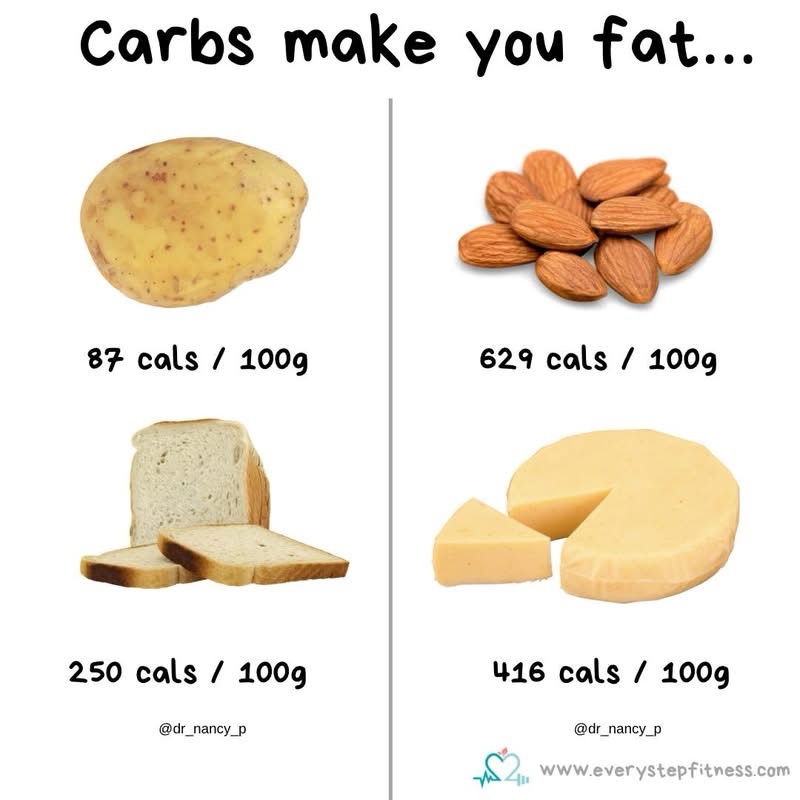
No food or macro is inherently fattening. It all comes down to calories. Carbs do not make you fat – as you can see in this example – those high carb foods are actually far lower in calories per 100g than those high fat foods. Now eating fat-heavy foods won’t make you fat either – but this just illustrates the point re carbs quite nicely.
From a fat loss standpoint, fats are more calorie dense than carbs or protein. Fats contain 9 calories per gram, carbs contain 4 calories per gram and so does protein. Therefore, fat as a macronutrient is more than TWICE the amount of calories compared to carbohydrates or protein. This doesn’t mean fat is ‘bad’ it just means foods that are high in fat are also high in calories, so be mindful mindful of your portions! Often it’s what you’re putting on the carbs that make them higher in calorie – like cheese, butter, nut butter etc.

You CAN eat carbs and still lose weight when you are able to achieve a energy deficit. So stop believing that carbs are responsible for your weight gain. They’re not – whether intentional or not you were just eating more calories than you needed.

🤗
Xx