Nutrition and Calorie Tips

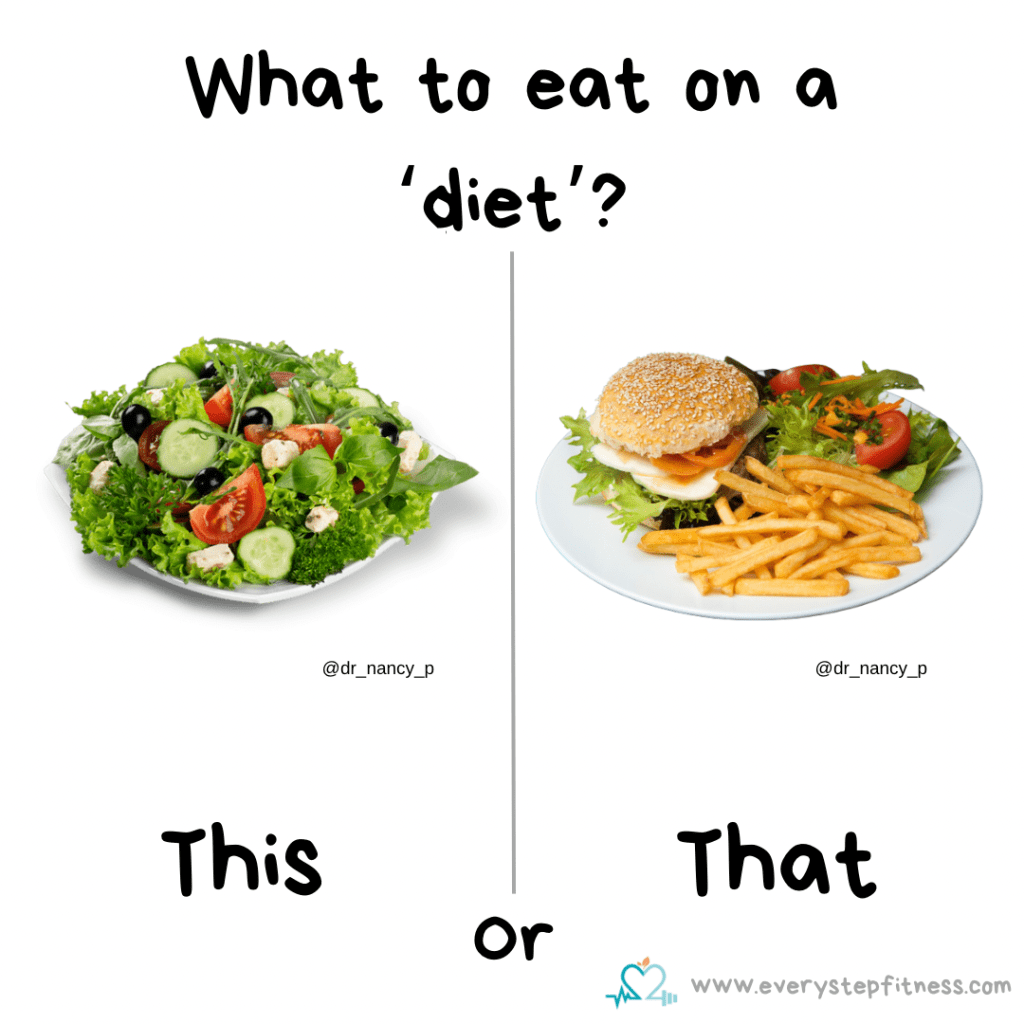
What ‘should’ you eat on a ‘diet’?

What ‘should’ you eat on a ‘diet’? 🥗

People often say to me ‘I know what I ‘should’ eat, but I just don’t’ . There’s a whole load of guilt and shame in that statement. And it’s often this guilt and shame that leads to feelings of resentment and deprivation and ultimately leads to unsuccessful weight loss attempts.

I do talk about this a lot but it’s so important. What if there are no good or bad foods? Just foods that serve a purpose in that moment. When you remove the stigma around certain foods you enjoy, you can also remove the fixation on them which may naturally lead to a more balanced approach to our diets.The more you (or social media) tells you that a food is bad and you can’t have it or that you’re ‘bad’ for indulging in it – the more you are likely to focus on it. Those thoughts circulate in your head until you can’t hold out any longer, binge on those foods and then feel embarrassed or ashamed or angry with yourself. This can lead to you just saying ‘f*ck it’ and throwing in the towel , then just indulging continuously until you decide to ‘be good’ again. The classic yo-yo dieting approach we are all so familiar with.

Instead just allow all foods to be a regular part of your life. Instead of demonising and banning foods just give yourself some guidelines – staying within a calorie target, ensuring you’re getting your 5 a day in, making sure you’re including some protein in your main meals etc Then fill the rest of your diet with the foods you’d traditionally attempt restrict and avoid.

It doesn’t need to be this salad or that burger… it should be this AND that.

🤗xx
Tuesday Tip

Tuesday Tip : Calorie Counting Doesn’t Work…

Tuesday Tip : Calorie Counting Doesn’t Work… 🤔

I hear this a lot – people tell me that calorie counting didn’t work for them and that despite only eating 1000 cals (or whatever value it is) they just didn’t lose weight.

If the goal is to lose weight/fat then the only way to do this is to be in a energy (calorie) deficit. This is a fact and hundreds of studies support this. The means by which you achieve that deficit can obviously vary. It doesn’t mean you HAVE to count calories. But if calorie counting didn’t work for you that means you weren’t in a calorie deficit.

If you thought you were only eating 1000 calories then something is definitely going awry as anyone on that level of calories WILL lose weight.

So if calorie counting doesn’t work for you then these are probably the reasons why.

# 1 Measuring inaccurately

This is the most common issue – not weighing food accurately. If you’re just using MyFitnessPal and finding a rough estimate that you ‘think’ is right then it’s not going to cut it. If you’re guessing weights then you’ll almost certainly be under estimating – again hundreds of studies show this to be the case – even in experienced ‘trackers’. Eyeballing amounts accurately is incredibly hard and unreliable. So get the kitchen scales out – measure in grams and millilitres (not cups and tbsp) and then you’ll have a better level of accuracy.

# 2 Lack of consistency

You feel like you’ve been on track consistently for weeks but in reality those weekends, nights out, or those days when you’ve emotionally eaten have taken you over etc. We’re very good at ‘forgetting’ (unintentionally) all the times we actually don’t stick to the plan. So if you haven’t lost then perhaps it’s because you haven’t been consistent enough?

# 3 Not enough time

Maybe you’ve been trying for a couple of weeks but aren’t seeing the results you want yet. Well that’s probably because you need to do it for longer! It takes weeks and months – not days to see sustainable losses. Remember you didn’t put the weight on in a few days, it’s not going to come off in a few days either. You need consistency over 7 days a week, for weeks and months.

Happy Tuesday 🤗xx

Nutrition and Calorie Tips

What actually happens when you lose weight fast…

What actually happens when you lose weight fast… 📉

We seem to be conditioned into expecting extremely rapid weight loss when we start a new diet or exercise regime. Social media is also full of promises of diets that will help you ‘lose 5kg in a week’. I can see why it’s tempting and I can also see why it’s nice to lose large amounts of scale weight when you start a new diet, and why it’s easy to feel disheartened if you don’t.

First things first, remember weight loss is not the same as fat loss. You’ll see lots of diets promising x kg loss in a week etc. What these diets – be they juice cleanses, ‘detoxes’, 7 day challenges, fasting, keep etc , don’t explain is that if you did indeed see that amount of loss in a week then it wouldn’t be fat loss. The harsh reality is that most of that weight loss is actually water weight, stomach contents, and a fraction of that is also muscle , and only a little bit of actual fat. Plus if it’s a particularly restrictive diet or is using pseudoscience to back it up it can also mess up your relationship with food and mental health.

Weight loss and fat loss are not the same thing. It’s quite easy to manipulate water weight by consuming fewer carbs (as 1g carbs binds approx 3g water), reducing salt intake or using diuretics (which increase the amount of water and salt excreted in the form of urine). This is how some athletes cut a few kg in the week before a competition.

So what should you do?

Do not crash diet – please! Instead try to make sustainable longer term changes to your calorie intake. A moderate calorie deficit will allow you to lose sustainably and steadily (an average of <1% body weight/ week). Shift your expectations away from big scale losses as a measure of success each week and instead look at long term trends and changes in things like clothes size, or measurements or progress photos rather than the scales.

🤗xx

Tuesday Tip

Tuesday tip: Balancing hormones

Tuesday tip: Balancing hormones 🚩 🤔

You will often see fitness or wellness coaches talking about you needing to ‘balance your hormones’ or promising that certain products can do this. This is a huge red flag. Fitness coaches, personal trainers, wellness coaches, life coaches etc should not be talking about hormones in this respect – it falls outside their scope of practice and I’m afraid in most cases they don’t know what they’re talking about. The wellness world is full of this sort or marketing quackery that preys on people – right now the main target is peri menopausal and menopausal women, though often it targets other groups too.

The only person qualified to tell you that you need to ‘balance’ your hormones is an endocrinologist. For example – balancing the levels of thyroid hormones, or the levels of oestrogen and progesterone has real and significant medical implications. Another example is cortisol production – if ‘imbalanced’ through chronic stress it causes oestrogen and androgens to be suppressed. These are facts, based on medical science, not conjecture based on the current social media hype that preys on vulnerable people.

Inevitably you’ll also see that these people talking about a need to balance hormones are also selling programs or supplements which will ‘balance your hormones’ …. Ta da! What a surprise…

There is so much fear and distrust for doctors and the medical community, and none whatsoever for non-regulated, unproven and untested products purchased over the counter or internet. If someone has a real hormone imbalance they need medical care – likely in the form of an endocrinologist but certainly not a collection of random supplements or diets.

Happy Tuesday 🤗

Xx

Nutrition and Calorie Tips

Reverse lent!

Reverse lent! 😇

We may be a week into Lent already but regardless of your beliefs or faith Lent has traditionally become a time when people give up various things they consider ‘bad’. Now whilst there’s absolutely nothing wrong with that at all sometimes it can become more of a negative rather than positive experience.

So how about instead of giving up things, you turned it around and tried taking something up or giving something to others?
You could do some voluntary work, or you could give things to charity. For example, try setting up a box and popping one item of clothing or something you don’t want anymore in it every day for each day of lent, then donate to charity at the end!
You could give your time to someone – it could be something simple like helping a friend or neighbour, or calling someone for a chat. Or you could take up a new hobby or challenge during Lent – try something new like gardening, knitting, drawing, or perhaps a fitness based challenge – trying new classes, walking every day, working out 3 times a week etc.

What do you say? 🤗
How about a reverse lent?
Xx