There are lots of brands out that that are using the marketing power of “protein” to sell their products. The unspoken idea is that protein = better or healthier etc. The reasoning behind this is the fact that increased protein can help with improved satiety (feelings of fullness) so CAN help to prevent overeating. Also those working out may want to focus on protein to help with muscle building. For most people a balanced diet will contain enough protein so you don’t need to go out of your way to take in extra protein unless you’re a bodybuilder or professional athlete. However you may still wish to focus on higher protein foods and snacks to help keep you feeling full.
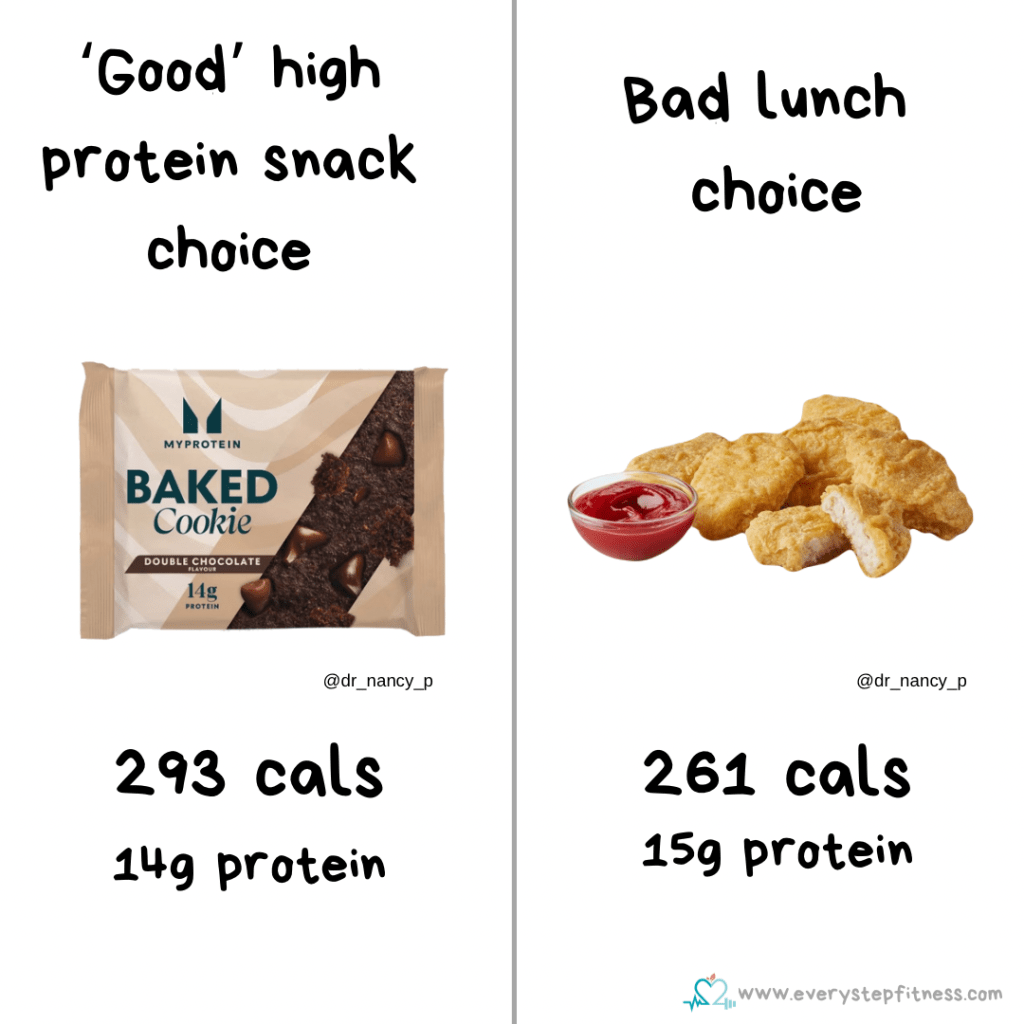
So you may well see this protein cookie and think it’s a good option. It does have a reasonable amount of protein – 14g, though that’s not that high for the calories and it’s quite a lot of calories for a snack. In contrast 6 nuggets might be perceived as a ‘bad’ lunch option, definitely not a snack, because it’s junk food isn’t it…? Yet the nuggets contain more protein (15g ) for fewer calories.
In terms of weight loss both will probably do the same basic job -they provide a decent amount of protein for under 300 cals. But don’t be fooled into thinking the protein cookie is a ‘better’ option for weight loss than any other snack. Don’t be swayed by the “protein” label – actually check the nutritional info and then choose the snack you want!
If you’re trying to lose weight here are a few prices of key information which should help.
# ANY diet that causes you to lose weight over an extended time frame does so by decreasing calorie intake. Whether it does it under the guise of some other mechanism or not it all ultimately comes down to a calorie deficit. Keto, intermittent fasting, weight loss clubs, etc – they all only work if they result in a calorie deficit.
# Despite what you see online calories in vs calories out is not a myth. It has the largest influence over what we weigh and our bodyfat. Thousands of studies support this.
# While calories matter, food quality still matters. Eating fewer calories will undoubtedly cause you to lose weight but if you also want to feel good and be healthy then it’s worth ensuring you’re still including nutrient dense foods too.
# 1kg of body fat is made up of approx 7,700kcal. Of your weight changes quickly within a day or so then it’s simply not possible that it’s all body fat.
Large changes in weight in short time frames (whether up or down) are mostly due to changes in weight from water, glycogen and food rather than actual body fat.
# Eating more protein doesn’t directly help weight loss. However it does increase feelings of fullness and satiety, can help ensure muscle mass is preserved when you do lose weight (assuming you’re also working out too) and does very marginally increase calorie burn.
# Consistency is key. Trying to eat
“perfectly” 100% of the time is unlikely to work. Having some degree of flexibility can help improve consistency over the longer term.
# You need to find what works for YOU.
Energy balance applies for everybody – it’s always about a calorie deficit. But how you achieve that calorie deficit and what works best for you and feels good long term varies from person to person.
Why it’s generally harder for women to lose weight than men 👫
I encounter this a lot with my clients, especially couples. A man appears to change very little in their diet and loses 3kg in a week, whilst a woman cuts carbs, cuts booze, workouts tonnes and gets a stomach bug and puts on 2 kg! Now obviously this is just a humorous example but it’s not actually that far from the truth. Men really do tend to respond faster than women when it comes to weight loss, so why is this?
Generally, men will burn more calories at rest than women due to them being taller, heavier and naturally more muscular. This means they will need to consume more calories to maintain their weight. It also means they can consume considerably more calories and still be in a calorie deficit. For example a 6ft man, weighing 95kg needs around 2,600 cals to maintain so anything below that is a deficit. In contrast a 5ft 6inch woman, weighing 67 kg needs approx 1800 cals to maintain and less to lose weight. That’s almost a 1000 cals difference and makes a huge difference when trying to accommodate your meals, snacks and then social stuff on top.
This is even harder if you’re a couple as you may be likely to eat similar things/portions so if you’re both eating around 1600 cals then the man will be at an even greater deficit so will lose weight much more rapidly.
Whilst it’s not possible to out exercise diet obviously there is also some impact from the amount of calories burnt and men will naturally burn more calories than women due to their height, weight and muscle mass.
Women may see higher fluctuations in weight too (which makes the process harder) as they can be more susceptible to fluid retention in response to stress and other hormones. In addition there are psychological reasons it’s harder for women. ‘Diet culture’ is so prevalent and affects women from a very young age. Most of my female clients have been on and off diets since they were teenagers to some degree. These repeated attempts at trying to find dietary success can completely fracture anyone’s mindset around their bodies and food. Whilst men do also face these struggles it’s not usually to the same extent.
What you can do about it?
Women can increase their chances of weight loss success by increasing muscle mass (which increases your BMR so you burn more calories at rest).
And whilst it is indeed harder for women to lose weight that doesn’t mean the law of thermodynamics don’t apply. If you are in a calorie deficit you will lose body fat and you may still be losing fat even if the scale doesn’t necessarily show it. So make sure you’re tracking accurately so you know you’re eating in a calorie deficit.
Work on any habits, thoughts and behaviours that may have held you back due to diet culture (e.g. move away from overly restrictive dieting or cutting out food groups).
Overall don’t give up! Use objective measures to keep track of progress beyond the scales and don’t worry if your other half or men in your life seem to be ‘doing better’ – it’s not better – it’s just different!
One of the key tips I give my clients revolves around volume eating. If you’re trying to lose weight then volume eating can be really beneficial. Volume eating is all about consuming larger quantities of low-calorie, high-volume foods such as vegetables, fruits and whole grains. It allows you to eat more food and feel fuller while maintaining a lower calorie intake.
Foods like fruit (berries, grapes, pineapples etc), salad (tomatoes, cucumber, peppers, lettuce, mushrooms etc), and vegetables (pumpkin, leafy greens, broccoli etc) have high water and fibre content. It adds volume to our meals without adding many calories. Another advantage of volume eating is it can often increase the micronutrient content of the diet. Usually (but not always) these high volume foods are nutrient-dense, meaning they are rich in vitamins and minerals which is beneficial for overall health.
Volume eating can potentially help in developing sustainable eating habits too. Restrictive diets can lead to feelings of deprivation, but volume eating encourages incorporating varied food sources and decent portion sizes, so can reduce some of this restriction
Ways to do this include making sure that for your main meals 50% of the plate is made up with these high volume foods. Ensure you’re also having whole grain , unrefined carbs too as they aid in satiety, muscle recovery and training performance /energy levels (and they’re tasty!).
For snacks consider adding fruit or salad to your snacks. So rather than just having 2 biscuits, have 2 biscuits and a large portion of berries, or instead of having a packet of crisps have a lower calorie crisp option and have some cucumber and carrot sticks with it etc. Zero calorie drinks also help to add volume – especially to snacks.
It’s BBQ season! With lots of summer parties and BBQ’s it can be hard to stay on track with your goals. Here are some tips to help!
Eat before you go
If it’s more of a drinks and nibbles type event then eat before you go so you’re not starving and likely to stuff down whatever nibbles come your way. Equally if it’s a late afternoon BBQ don’t let yourself get too hungry before you go – have an early lunch or brunch so you are satiated and less likely to overeat later.
One piece of meat
There is no other meal really where you’d load up on chicken, burger, a sausage… maybe a lamb kebab … so why do we do it at BBQ’s? Treat it as a normal meal – one , maybe two pieces of meat max!
Watch the salads
Salads are great but if they’re loaded with dressing, sauces, avocado, potatoes, cheese etc then they’re also quite high calorie. That’s not a prob – but don’t kid yourself that they’re low cal!
Stay hydrated
Drinking water in between each alcoholic beverage can help keep you hydrated and save you some booze calories. Not getting too drunk will also help you make more sensible food choices too.
Don’t stand by the food table.
You are more likely to over eat if you’re hanging around the food table. Take your conversation and move it away so you’re not tempted to mindlessly snack.
Bank calories
As with any social event you can save some calories ahead of time. Don’t go too low in the preceding days but saving 100-200 cals for a few days will give you more to spend at the party.
Shift the focus
Instead of focusing on the food and drink focus on the company instead. You’ll remember the fun times with friends more than the burger you eat…
Have fun and don’t stress
If you do wake up the next day and you’re a little heavier don’t stress yourself out over it. Get right back on track. It’s most likely just water and a lot of glycogen. Stressing about it it’s just going to make things worse. Enjoy yourself.



 Every Step Fitness