Tuesday Tip

Tuesday Tip: Strength Training and Brain Health

Tuesday Tip: Strength Training and Brain Health 🧠

We often think of crosswords, Sudoku, or ‘brain training’ apps as the best way to protect our memory as we age. But recent research suggests strength training may do more for your brain than any puzzle ever could. In a 6-month study of older adults with mild cognitive impairment (a group at high risk for dementia) participants were assigned to one of four groups: resistance training, cognitive training, both, or a control group of nothing. Resistance training alone came produced the best results.

It was a simple strength training program of lifting at around 80% of their maximum strength, 3 sets of 8 reps, 2–3 times per week, focusing on major muscle groups. After six months, those who got stronger also got sharper. Improvements were seen in memory, executive function, processing speed, and attention. MRI scans even showed growth in the posterior cingulate cortex, a brain region tied to memory and one of the first hit by Alzheimer’s. The stronger participants became, the more this area grew. Interestingly adding cognitive training to resistance training actually reduced the benefits. Strength training alone not only improved cognition but maintained those gains for at least 18 months after the study ended, without continued exercise. Brain atrophy slowed, connectivity improved, and memory held steady.

Why? Building strength boosts brain-derived neurotrophic factor (BDNF), blood flow, and growth factors in both muscle and brain. In short, your muscles talk to your brain. So if you want to protect your mind, train your body. Two to three full-body sessions a week, working hard enough to challenge yourself, may be one of the simplest, most powerful ways to keep your brain resilient. Forget just training your brain, train your muscles. Your mind will thank you.

Happy Tuesday 🤗

Xx

Nutrition and Calorie Tips

‘I don’t eat much but I can’t lose weight…’

‘I don’t eat much but I can’t lose weight…’ 🤔

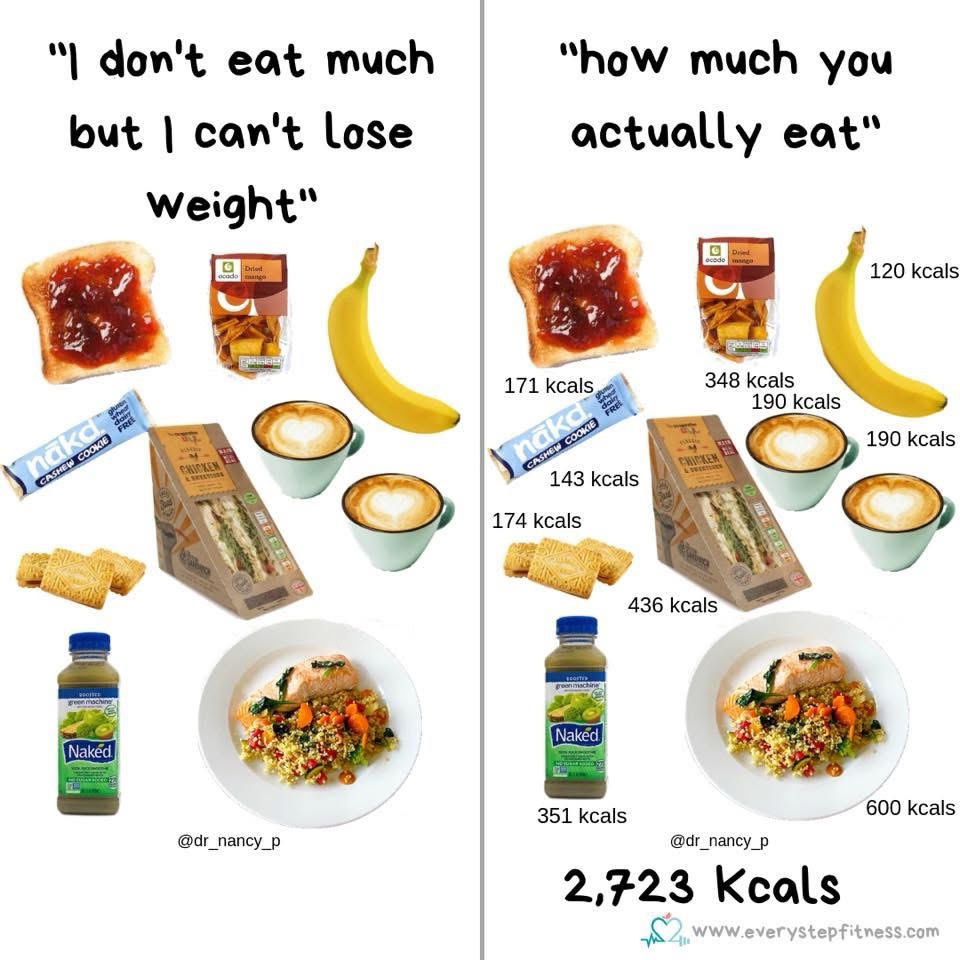
A piece of toast for brekkie, bit of fruit for a snack with coffee, healthy snack bar and a sandwich for lunch with a ‘healthy’ drink, and a ‘healthy’ dinner of fish and salad….. that’s not really much for a day?…right…… 🤔

Often we think we’re not eating much and can’t understand why we don’t lose weight. It’s not until you actually add it all up that you realise you’re probably eating a lot more than you realise. The coffees, the couple of biscuits you forget about, the dried fruit snack (it’s fruit – it’s fine right?), a ‘healthy’ dinner of fish and salad … it must be ok?

It is ok and there is nothing wrong with any of that, but when you actually add it all up you’re looking at over 2,700 calories… for a ‘good’ day! Now for most people trying to lose weight or fat that is going to be far too many calories to be in a deficit which would let you lose fat.

So if you feel you aren’t eating much but you’re not losing weight/fat then maybe it’s time to just write down everything you’re eating on those days and see how much you really are consuming 🤗.

Remember – calories count!

Xx

Tuesday Tip

Tuesday Tip: Cortisol and Belly Fat

Tuesday Tip: Cortisol and Belly Fat 😓

Cortisol makes you gain belly fat is a common myth. The idea is that the stress hormone causes stubborn belly fat and therefore we should avoid cortisol ‘spikes’ at all costs (which translates to suggestions to avoid certain workouts etc), but is that really the truth?

Cortisol is essential. It helps regulate energy, inflammation, and even fat metabolism. Levels naturally rise and fall throughout the day, with a large spike in the morning (part of your circadian rhythm) and smaller increases during activity or stress. Research shows these short-term rises are not harmful, they’re protective and necessary. Exercise, fasting, even drinking coffee trigger temporary cortisol increases, and that’s a good thing. These transient spikes mobilize stored fuel and support recovery. If cortisol alone caused belly fat, athletes and early risers would all struggle with weight gain, which clearly isn’t the case.

So where does the belly fat myth come from? Chronic stress or Long-term elevated cortisol has been linked to appetite changes, sleep disruption, and overeating. But importantly, cortisol doesn’t directly add fat to your stomach. Instead, chronic stress often leads to behaviors like late-night eating, less activity, poor sleep etc that add up over time. The hormone plays a role, but it’s not acting in isolation.

Some also claim exercise spikes cortisol and therefore makes fat loss harder. Acute exercise-induced cortisol is good – studies show that long-term training actually lowers resting cortisol levels and improves stress resilience. So workouts don’t make you fat, they make you fitter and more stress-tolerant.

Remember – cortisol spikes are normal and often beneficial. Chronic stress may influence weight, but mostly via the habits it can create, not hormones alone. Exercise helps regulate cortisol long-term. If you’re concerned about ongoing stress or health issues, consult your doctor—not social media.

Stressing about cortisol is more harmful than the hormone itself.

Happy Tuesday 🤗
xx

Nutrition and Calorie Tips

TV Snacks…

TV Snacks… 📺

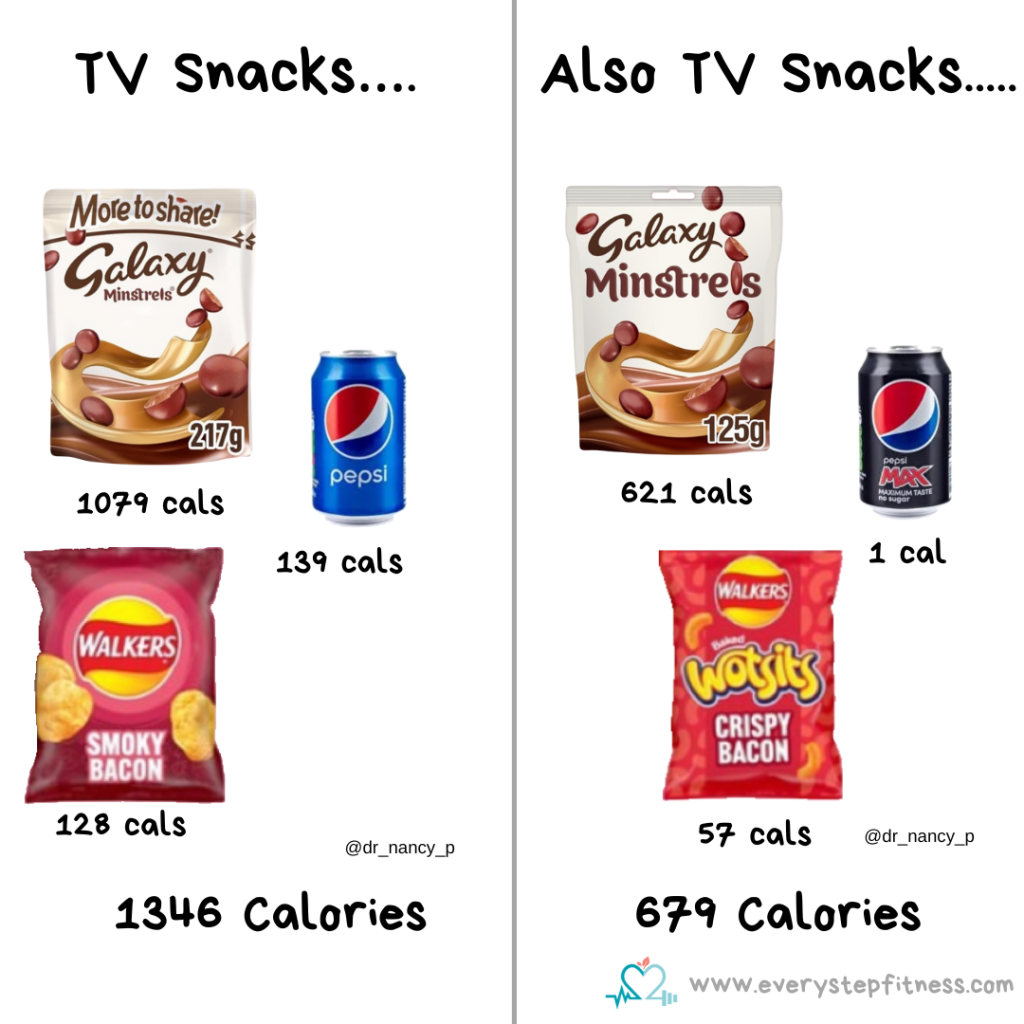
It’s Sunday evening , you’re about to settle down in front of a movie with some snacks. So you grab a packet of crisps, a bag of chocolate, and a drink. You know it’s not exactly low calorie but it doesn’t seem that bad… plus you won’t eat all the chocolate (except once that bag is open who are you kidding – they’re gone right?). This may sound like a lot but actually it’s pretty easy to stack up this sort of snacking without realising it and the calories really add up.

A packet of crisps (128 cals), sharing bag of minstrels (1079 cals) and a Pepsi (139 cals). That’s a whopping 1346 cals of snacks!

There’s nothing wrong with enjoying some snacks with a movie but maybe try a few swaps to reduce the cals without reducing the enjoyment . You could have a bag of wotsits (57 cals), a smaller grab bag of minstrels (621 cals) and a Pepsi Max… for only 679 cals. Which not only is still quite a lot of cals for a snack but is a lot of food full stop – you’d probably find you were satisfied with all that anyway and not miss the larger bags!

Enjoy!

🤗

Xx

Tuesday Tip

Tuesday Tip: How to be healthy

Tuesday Tip: How to be healthy 🥗

The health and wellness industry loves to sell you the idea that to be healthy you need cold plunges,infrared light, expensive trackers, trendy supplements etc . But the truth? You only need to nail a few basics to cover most of your health and fitness needs.

# Reduce bodyfat and build muscle

Too much body fat raises health risks, but you don’t need to be shredded. Research shows the lowest mortality risk is around 20- 22% body fat for men and 25-30% for women, which is quite attainable. Also vital is building and keeping muscle as it supports metabolic health and helps prevent age-related weakness.

# Move more
Sitting for 10+ hours a day can raise your risk of death by up to 192%. Even light movement, walking, household chores etc adds up. Around 7–9000 steps a day is a great target but it depends what your baseline is – something beats nothing.

# Eat mostly well
Eat a balanced diet including protein, carbs, fruit/veg and plenty of whole foods. Include healthy fats and enough fibre too (around 14g per 1000 calories). It’s fine to have sugar/junk food – just have it in moderation.

# Don’t overdo the booze
The idea that a little alcohol is healthy is false. Health risks rise with ANY consumption of alcohol. It’s one of the few actual carcinogens (cancer causing) foodstuffs. The less, the better.

# Prioritise sleep—especially regular sleep
Short sleep is linked to higher health risks, but this is often also linked to high stress and poor diet it’s hard to tease apart the biggest risks. Regular exercise can offset some harm of short sleep. Sleep regularity (consistent wake/bed times) may be more important than total hours.


You don’t need a magic hack to be healthy. Move your body, lift some weights, eat sensibly, keep alcohol low, and get consistent sleep. Do that, and you can safely ignore 90% of the wellness info online.

Happy Tuesday 🤗
Xx