Nutrition and Calorie Tips

‘That’s so unhealthy – it’s full of sugar’…

‘That’s so unhealthy – it’s full of sugar’… 🍫🥛

Let’s kill the sugar myth real quick…

There’s a pervasive myth that sugar is bad – particularly sugar in processed foods. However the view is that ‘natural sugar’ is absolutely fine?

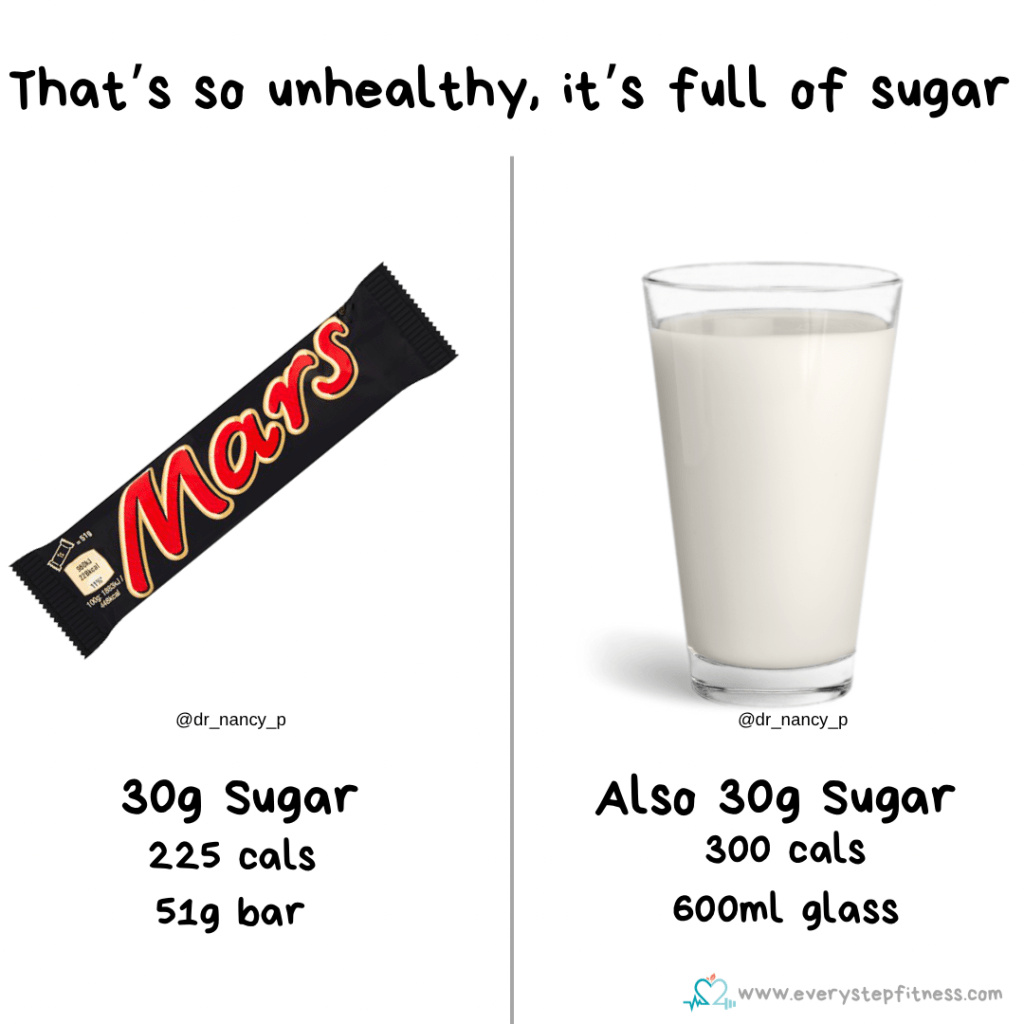
A mars bar contains around 30g sugar and a 600ml glass of milk also contains 30g sugar. However people will demonise the chocolate bar on the basis of its sugar content but will say milk is the ‘healthier’ choice, despite the sugar content? Why? Because the sugar in milk is ‘natural’ so it must be better, right?

Not exactly. Sugar is sugar. Whether it’s added to a chocolate bar or naturally found in milk as lactose, your body processes it the same way. What matters more is the context: how much you’re consuming, how filling it is, and whether it fits into your overall diet.

In this example the Mars bar contains around 225 cals and 30g sugar, whilst the milk contains around 300cals and 30g sugar. That’s the same amount of sugar and more calories in the milk. But most people wouldn’t blink at drinking a big glass of milk with breakfast, while feeling guilty over snacking on Mars bar.

Now obviously the milk has other benefits in terms of more protein and other micronutrients but in the context of the argument around sugar it’s no better than a mars bar. It’s not about “natural vs added” sugar, it’s about your whole diet. If you’re having a load of whole foods and protein in other meals then the Mars bar isn’t an issue if you can fit it within your calories. If however you’re eating 4 of them and your meals are also high in calories and low in micronutrients then it probably isn’t a great idea. The milk might be a better ‘snack’ but it still contains a significant number of calories so that needs to be accounted for.


We need to stop demonizing sugar based on its source and start looking at the bigger picture: calories, satiety, and how everything fits into your goals.

Both milk and Mars bars can have a place in a balanced diet, if you manage portions and priorities.

🤗

Xx
Nutrition and Calorie Tips

‘It’s only a little sauce on the side, and a bit of oil for cooking – I don’t need to track that…’

‘It’s only a little sauce on the side, and a bit of oil for cooking – I don’t need to track that…’ 🤔

If you’re hoping to lose fat in a sustainable way you need to be aiming for a deficit of around 200-300 cals a day. Most people are pretty good at tracking the big stuff – the sandwich, the packet of crisps, the porridge for breakfast etc but how often do we overlook the little stuff. That little bit of ketchup on the side, that chilli sauce on your rice, that dash of oil in the pan…. And how often when you’re trying to lose fat do you deny yourself something you really want simply because you’re ‘on a diet’.

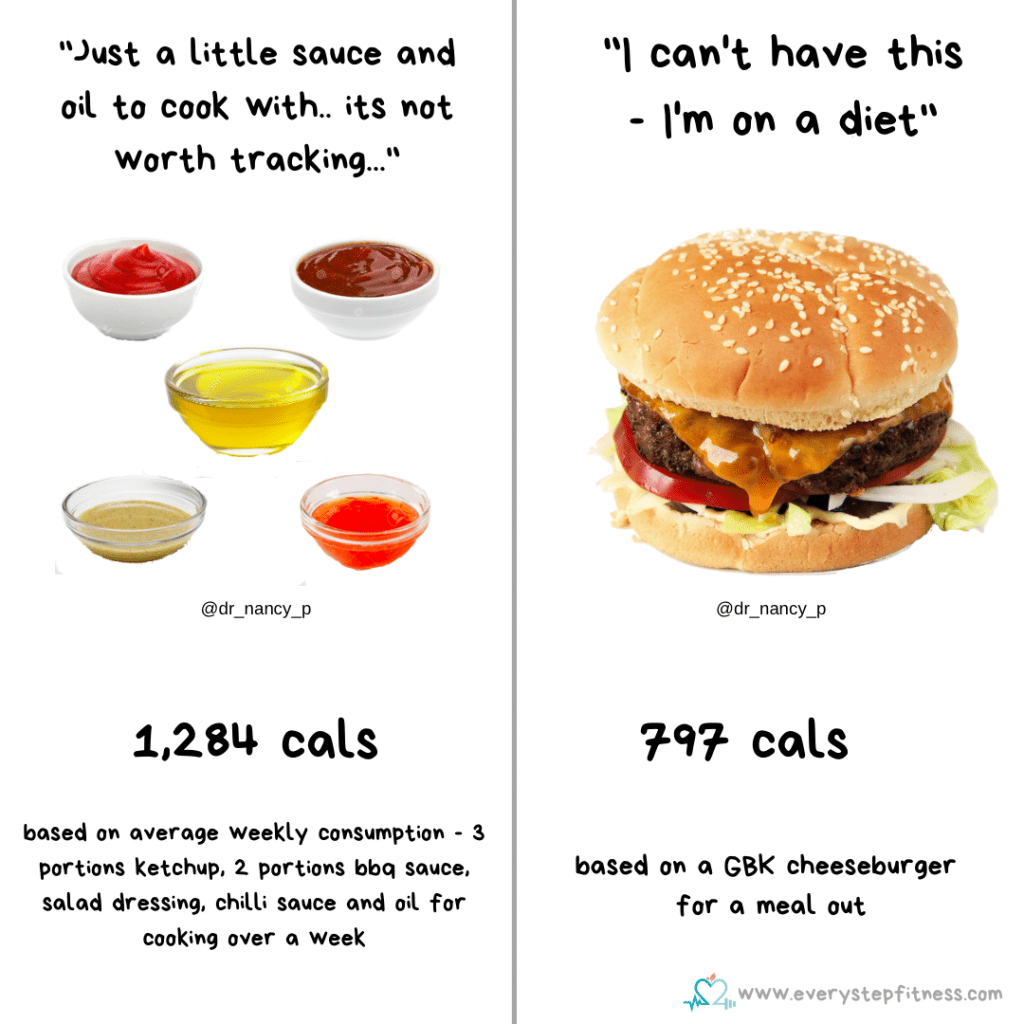
A cheeseburger comes in at around 797 cals – this is something you may not feel you can have whilst on your ‘diet’ and yet you probably don’t even think twice about the 1,284 cals you might rack up in sauces and oil (and tbh that’s a conservative estimate on the oil!). In one week that’s your whole deficit gone and you may not even realise it.

I always tell my clients to track everything – right down to the oil they’re cooking with as that can be the difference. So if you’re tracking cals and hoping to lose fat make sure you include these, and if you’re just trying to cut some cals maybe they’re a good place to start being more mindful too?

Oh and if you fancy a cheeseburger – just factor it in to your calories and have it! 🤗

Remember – calories count! 🤗xx

Nutrition and Calorie Tips

‘Just a drizzle…..’

‘Just a drizzle…..’ 🍳

If you’re trying to lose fat and are working on reducing calories then you’re probably going to be recording your cals somehow. But are you really recording everything? It’s very easy to overlook some things because they seem so insignificant.

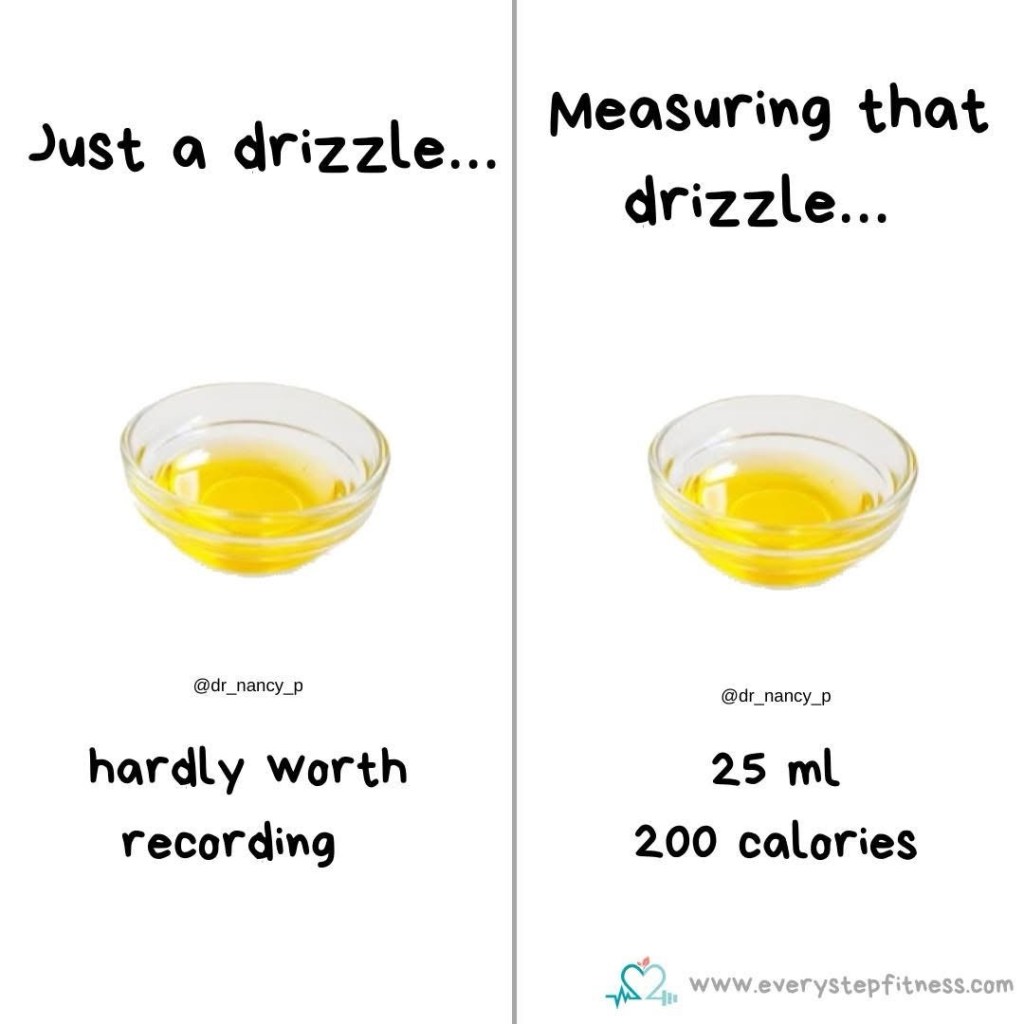
Oil used in cooking is a great example. So many of my clients will say they’ve just used a ‘drizzle’ of oil when cooking, so it’s not much. As a result they perhaps don’t measure it and don’t factor in those calories. Now aside from the fact that one person’s ‘drizzle’ could be another person’s ‘pour’ there’s actually a pretty good chance that you’re adding 100-200 cals a day to your meals with that ‘dash’.

That ‘drizzle’ of oil in the pan is probably around 25 ml, which depending on the type of olive oil will be at least 200 cals… But hey, that’s not worth recording right? Wrong! A sensible calorie deficit for fat loss is around 200 – 300 cals per day. So you’ve already eaten into your deficit with that one drizzle and turned a potentially low calorie meal like a stir fry etc into one that takes you over your allowance, for minimal satisfaction. You won’t notice those extra calories, and you’ll consume them without them really affecting how full you feel but they can really add up. If you’re cooking once a day that’s 1400 extra calories a week.

Now I’m not suggesting you shouldn’t use oil – if you want to then go for it! But if you are trying to lose fat, or your fat (weight) loss has stalled perhaps go back to basics and double check whether the amount you’re using could be more than you realise. And be a bit more mindful of this, or simply record it and have it within your daily calories. If you want to reduce the calories from cooking with oil then invest in a one calorie oil spray (you can get olive oil ones so you still get the health benefits if those monounsaturated fats) – 20 sprays will only be 20 calories, rather than the 200 plus cals from the ‘dash’ of oil

🤗 Xx

Nutrition and Calorie Tips

Weekdays vs Weekends

Weekdays vs Weekends 😇

This is an extremely common pattern I see in my clients, and myself. Weekdays are often “ok” calorie wise or even good, and then weekends it goes a bit off track.

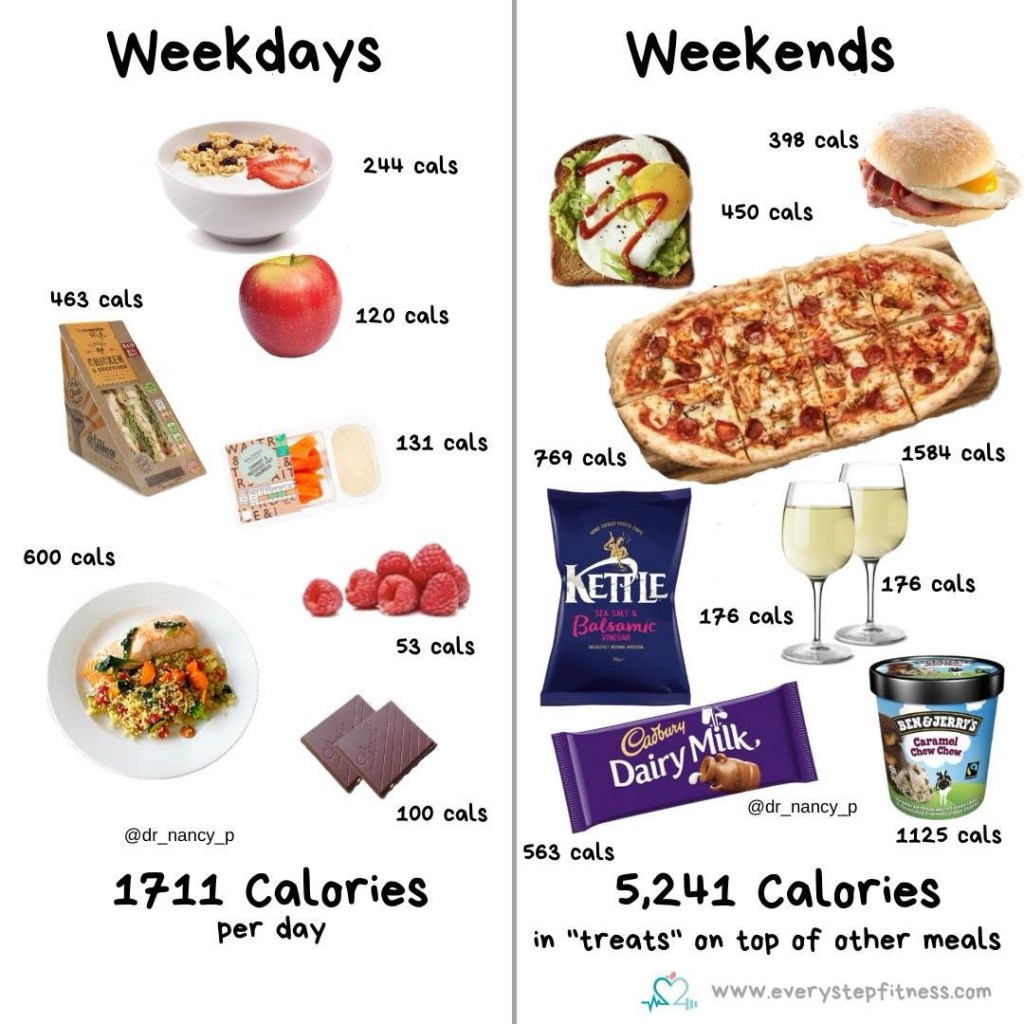
You may think that if you stick to your fat-loss calorie target for most of the time (5 days a week) that it’s ok to just relax at the weekend. Now sometimes this can work, but it rather depends how much you relax lol! In this example I’ve assumed a daily calorie goal of 1,800 cals for fat loss, or 12,600 calories per week. So Monday to Friday you hit those calories, or perhaps are even a little under (8,555 cals during the week in this example). Then on Saturday and Sunday you “relax” and have a few “treats”, because it’s the weekend right? You’ve been good all week so it’s fine… In this example I’ve included two weekend breakfasts, a pizza one night, a couple of glasses of wine, some crisps in front of a movie, sunday evening ice cream and chocolate etc. That’s 5,241 calories and doesn’t even include a full weekend of eating and drinking (especially if you start on Friday evening.. or even Thursday). Just those treats on top of the weekday calories take you to 13,796 calories for the week. So you’re already over by nearly 1,200 cals.

That extra 1,200 cals (or more) is why you won’t be losing fat. It’s very easy for that to happen. The things I’ve described for weekend treats aren’t crazy or particularly over indulgent. I’m sure we’ve all had weekends like that right? Now I’m definitely not suggesting you don’t enjoy some of these foods from time to time, but if you really want to lose fat then its worth getting away from the idea of weekends being focused on food and drink “treats”. Have the things you enjoy but in moderation and within your overall weekly calorie target.

Ways to do this include, reducing your weekday calories a little to give you a buffer for the weekend (be cautious with this though as if you take them too low you will find you tend to binge at the weekend which is counter productive so only aim to save 100-150 cals per day max). Also try going for smaller options of the weekend treats, a small bar of chocolate, a single portion bag of crisps, low cal ice cream etc. Pick one meal you want to let your hair down with rather than the entire weekend and keep tracking over the weekend so you can see where the extra cals are creeping in.

OR decide that life’s too short and you don’t want to restrict your calories over the weekend but then accept that you won’t be able to lose fat (which is absolutely fine too! You don’t need to lose fat – no one does).

🤗

Xx

Nutrition and Calorie Tips

Weight loss is rarely linear….

Weight loss is rarely linear…. 📉

I’ve had to remind a few clients of this recently so I thought it was worth re-sharing. Most people measure their fat loss progress by stepping on scales. This can create an all or nothing mentality and can impact not only your happiness but your behaviour. If the scales don’t go down when you’ve been ‘good’ then what’s the point? You may as well throw in the towel and enjoy that cake!

Weight loss is rarely linear. It’s normal for your weight to fluctuate on a day-to-day basis. There will be days where your scale weight goes up, just like there will be days where your weight will drop, and there will also be days (maybe even weeks) where your weight will stay exactly the same. Your weight can fluctuate up to 6kg during the day depending on what you eat and drink, and how you exercise. If you drink 2-3 litres of water a day that’s up to 3kg. Then how much do you pee, sweat and breathe out over the day? It’s impossible to measure. Our bodies are mainly water so changes in hydration cause significant weight fluctuations.

In addition a bowel full of food, a big meal the night before, fibrous or salty meals, and menstrual cycle hormone changes can all influence weight and cause greater daily fluctuations so real change can be hidden. Exercise can affect the scale both ways; if, after a workout, you’ve refuelled properly your muscles will be full of glycogen and water. On the other hand if you’ve sweated loads your weight will drop due to dehydration. Alcohol does the same; it’s a diuretic so will dehydrate you initially, but can cause cravings for salty foods leading to water retention.

For many of us, seeing that weight go up, despite ‘being good’, can make us give up. It’s vital to trust the process and think long term. This graph is real client data. Look at how the weight fluctuates and look at the overall trend. By trusting the process and not giving up when the scales went up they’ve continued their weight loss over time.

We’re conditioned to focus on weight but instead try to use other measures e.g. items of clothing and how they fit, or cm measurements etc. If you must step on the scales then look at averages over time rather than daily variations and focus on long term trends.

🤗 xx