Nutrition and Calorie Tips

Weight loss is rarely linear….

Weight loss is rarely linear…. 📉

Most people measure their fat loss progress by stepping on scales. This can create an all or nothing mentality and can impact not only your happiness but your behaviour. If the scales don’t go down when you’ve been ‘good’ then what’s the point? You may as well throw in the towel and enjoy that cake!

Weight loss is rarely linear. It’s normal for your weight to fluctuate on a day-to-day basis. There will be days where your scale weight goes up, just like there will be days where your weight will drop, and there will also be days (maybe even weeks) where your weight will stay exactly the same. Your weight can fluctuate up to 6kg during the day depending on what you eat and drink, and how you exercise. If you drink 2-3 litres of water a day that’s up to 3kg. Then how much do you pee, sweat and breathe out over the day? It’s impossible to measure. Our bodies are mainly water so changes in hydration cause significant weight fluctuations.

In addition a bowel full of food, a big meal the night before, fibrous or salty meals, and menstrual cycle hormone changes can all influence weight and cause greater daily fluctuations so real change can be hidden. Exercise can affect the scale both ways; if, after a workout, you’ve refuelled properly your muscles will be full of glycogen and water. On the other hand if you’ve sweated loads your weight will drop due to dehydration. Alcohol does the same; it’s a diuretic so will dehydrate you initially, but can cause cravings for salty foods leading to water retention.

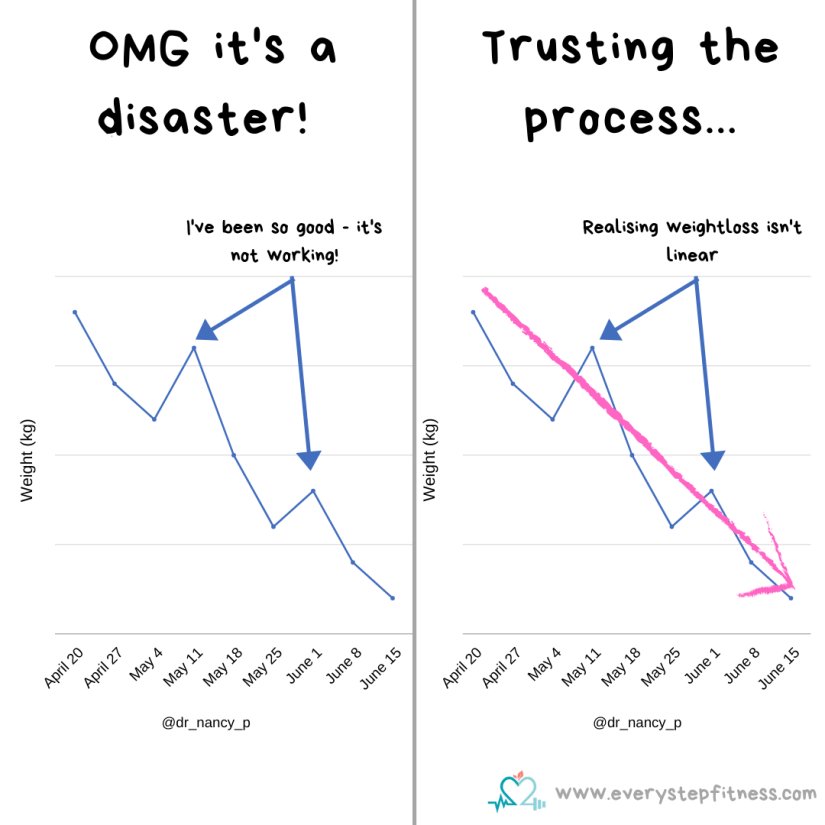
For many of us, seeing that weight go up, despite ‘being good’, can make us give up. It’s vital to trust the process and think long term. The graph above is real client data. Look at how the weight fluctuates and look at the overall trend. By trusting the process and not giving up when the scales went up they’ve continued their weight loss over time.

We’re conditioned to focus on weight but instead try to use other measures e.g. items of clothing and how they fit, or cm measurements etc. If you must step on the scales then look at averages over time rather than daily variations and focus on long term trends.

🤗 xx
Nutrition and Calorie Tips

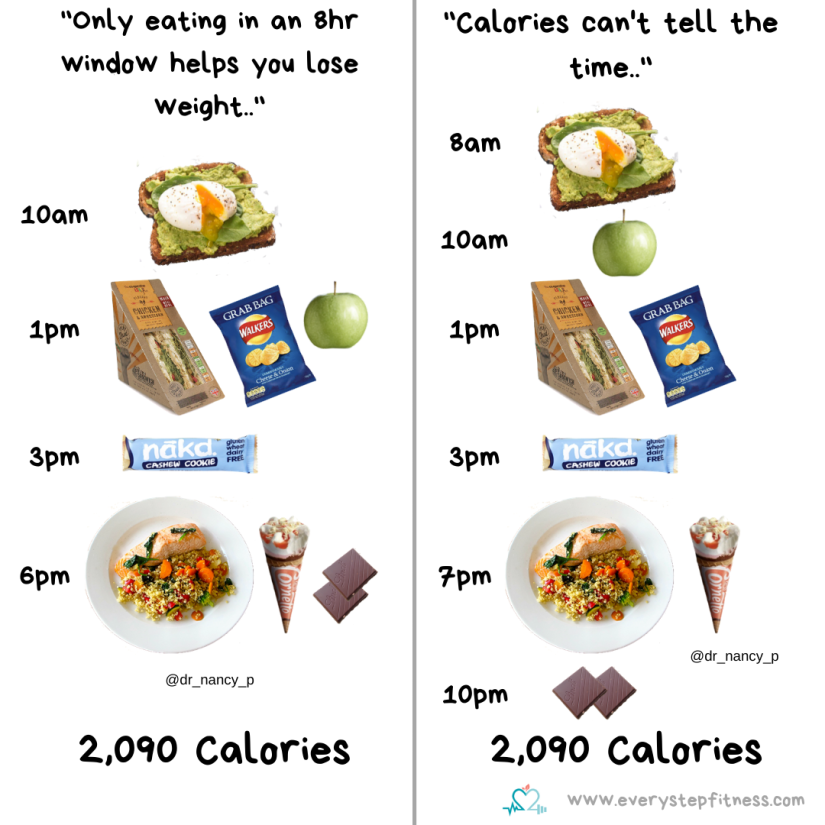
“Calories can’t tell the time…. “

“Calories can’t tell the time…. “ ⏰

It’s really easy to fall into the trap that eating your meals/snacks etc at certain times of day (or not eating at certain times of day) will help you lose weight (fat) more quickly.

One common idea is that you should fast for a certain number of hours during the day and only eat within a certain window of time. This varies but is usually an 8hr window or so. Proponents of this method suggest that by only eating during certain hours you can forget “complicated” diets etc and lose weight without doing anything more. You’ll hear lots of people saying they’ve achieved great fat loss using this method and they undoubtedly have. So surely it works then? Well yes it works – but only because those people have ended up eating fewer calories and therefore been in a calorie deficit, and lost fat/weight.

The problem with this method is that it doesn’t account for individual’s daily caloric requirements. So if someone started this method, but was eating more than their daily calorie requirement within that 8hr window, then they wouldn’t make any progress. Studies have shown that this method ONLY results in fat /weight loss when participants eat fewer calories than they are expending, and are therefore in a calorie deficit. Meal timing is irrelevant in terms of fat loss, it’s energy in vs out that matters.

Having said that, for some people, it’s easier to eat fewer calories if they restrict the hours in which they are “allowed” to eat. So if skipping breakfast, or not allowing yourself to eat after 8pm works for you then go for it! BUT you still need to be eating in a calorie deficit. For some people though, fasting for long periods of time, or skipping meals, isn’t a sustainable strategy long term. It can result in reduced energy levels, and excessive hunger, leading to periods of “binge” eating and therefore eating more than their daily calorie target. It can also lead to less activity (and therefore fewer calories burned) due to low energy levels.

So basically – do what works for you, but remember it’s the total calories that count – not when you eat them

🤗

Xx

Nutrition and Calorie Tips

Half an Avocado….

Half an Avocado…. 🥑

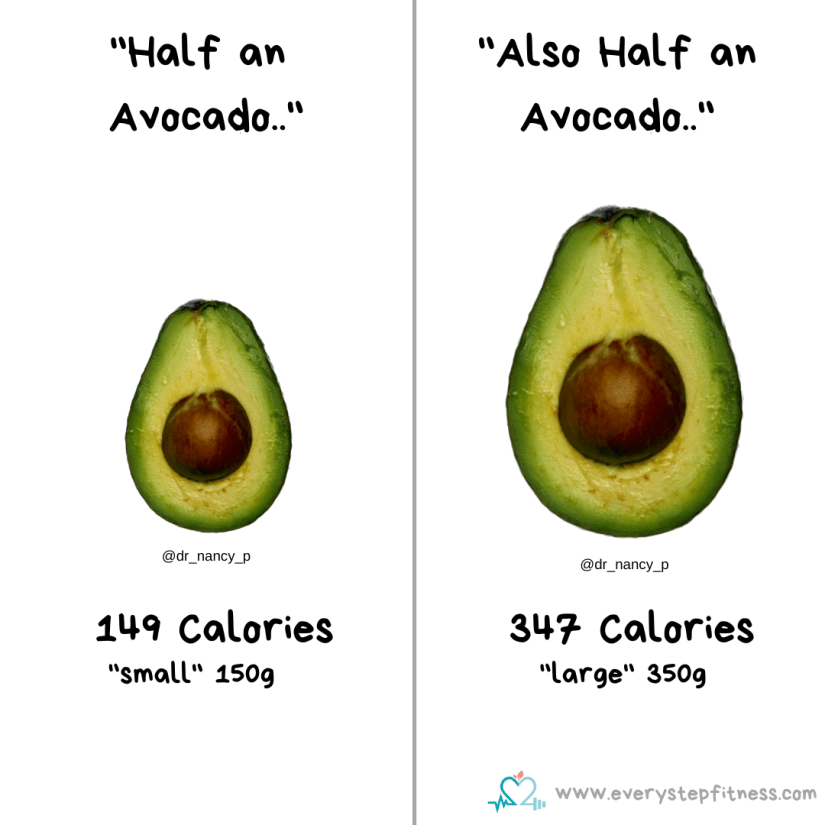
If you’re trying to lose fat and tracking your calories it’s really important to be as accurate as you can and this is why. If you’re using an app like myfitnesspal you might assume that the calorie value for half an avocado is a generic measurement for all avocados. Of course in reality avocados vary quite a lot in size – is that half an avocado a small one? A medium one? Or a large one? Obviously the nutritional value, and calories, will vary significantly with size. In this example one half is a pretty small avocado (150g), which means half will be around 149 cals. However, if you’re lucky enough to get a large avocado (350g) then you’d be looking at 347 cals for half!

So if you were just logging a generic half

an avocado at 149 cals but actually eating a large avocado then you’d be underestimating your calorie intake by 200 cals. If you’re an avocado fan and having some most days that could be an underestimate of 1000 calories or more a week – which is significant enough to prevent or slow fat loss.

If you’re having something low calorie then it won’t matter but with something calorie dense like avocado it really is important to know how much you’re having – assuming your goal is to lose weight/fat.

This is why I encourage my clients to weigh, in grams, rather than using generic, subjective measures like ‘half an avocado’. So if you’re trying to lose fat and tracking your calories have a go at weighing your avocado next time. You may be surprised! 😬

🤗

Xx

Nutrition and Calorie Tips

Rice cake or Crumpet?…..

Rice cake or Crumpet?….. 🥯

As I often say, the key to managing your dietary intake and weight or fat loss is about understanding that there is no such thing as a ‘good’ or ‘bad’ food. There are just different foods that serve different needs.

The nutritional breakdown and mirconutrients in food are important of course. So in that context you may feel that a rice cake, with peanut butter and banana is a ‘good’ snack. It’s full of good fats, protein and some carbs too. It will certainly keep you satisfied, but it is also perhaps higher calorie than you’d expect for a ‘good’ snack – averaging around 244 cals per rice cake (and let’s be honest I’d certainly have two!). Given the perception that this is a ‘good’ snack it would be easy to assume it was lower calorie or ‘better’ than the ‘bad’ snack – a crumpet with butter.

In fact the crumpet and butter is only

135 cals. Nutritionally it’s still good – with carbs and fats, but does contain less protein. That doesn’t make it ‘bad’. If your goal is weight or fat loss then it may be a better snack for you, that day, depending on your calorie target.

Most importantly you may actually just fancy a crumpet – and if so you should have it! Remember food also provides enjoyment too! And having things you enjoy will increase the likelihood of long term adherence and sustainability.

Personally I like both these snacks – and I’d happily have either! But being aware of the calories helps me make an educated choice.

🤗

Xx

Nutrition and Calorie Tips

Feeling down, need ice cream…

Feeling down, need ice cream… 🍦

It’s normal to feel emotional from time to time and many of us eat our way through it when it happens. At the moment chances are you may be feeling anything from stress, feeling low, bored, fed up, to anxious and worried etc or it may just be yet another ‘lockdown movie night’. So you may feel the need to work your way through an entire tub of ice cream – it’s natural, it’s human and it’s also damn tasty!

So how about making a simple swap? Rather than working your way through 1,300 calories of Ben and Jerry’s (or other standard ice cream equivalent) , you could instead have 620 calories of Ben and Jerry’s… just their lighter version! (or one of the any other equivalent low cal ice creams – I’m also an Oppo and Halo top fan).

But isn’t low calorie stuff loaded with sugar? No – it’s not actually, it’s lower sugar and fat than the ‘real stuff’ and it tastes amazing! 🍦

It’s ok to want to treat yourself when you’re feeling rubbish (or anytime

I’m fact!) and we don’t need to deny ourselves nice tasting stuff just because we’re watching our calories – try making some swaps instead. Check out the wide range of lower calorie options available now.

So you really can have your cake (*ice cream) and eat it! 🤗