Nutrition and Calorie Tips

‘I’m trying to lose weight so I’m avoiding carbs ….’

‘I’m trying to lose weight so I’m avoiding carbs ….’ 🍞

There is a common misconception that carbs are inherently ‘bad’ and that in order to lose weight you need to cut them out or avoid them completely. This usually means people cut out bread, pasta, rice, potatoes etc.

However they continue to eat fruit and veg without thinking twice when many actually contain more carbs. For example compared to a slice of bread a small Banana contains more calories, 3 times as many carbs and 15 times as much sugar! Now that doesn’t make the banana bad either – but why would you avoid the bread if you like it, yet happily eat the banana if you’re trying to avoid carbs?

In reality there is no reason at all to cut carbs from your diet. You can lose weight with or without carbs – it’s all about calories. Now obviously some people have medical reasons to avoid things like bread (coeliacs etc) but for the majority of people these foods are fine. The reason you may see weight loss when cutting these sorts of carbs is simply because you’re reducing your overall calorie intake. However unless you never want to eat carbs again then you’re not really setting yourself up for sustainable, long term weight management.

Obviously different carbs have different pros and cons – complex carbs will keep you fuller longer, whilst simple carbs (fruits mostly) will provide a faster hit of energy, you’ll get different nutrients from the different types too.

It’s important to have a balanced diet – including a range of carbs from bread to fruit. What works for you may not work for someone else and you may prefer to reduce consumption of carbs, but it’s important to be informed about what’s actually in the food you’re eating before you make that choice. Cutting out whole food groups is never a sensible or sustainable approach though.

Personally I enjoy all sorts of carbs – from bread, to fruit, to pasta, to potatoes – to doughnuts! Eat the carbs you like and enjoy and just be mindful of the calories! 🤗
Xx

Nutrition and Calorie Tips

“I’m being good and choosing the healthy brekkie…”

“I’m being good and choosing the healthy brekkie…” 🥗

Restaurant dining can be a bit of a minefield if you’re trying to watch your calories or lose weight. As I’ve said before, we often have a number of preconceived ideas about which the ‘healthier’ option is and equate that with lower calorie. In reality sometimes things aren’t quite as you’d expect.

Another great example of this are brekkie/brunch options – this particular example is from

Bills. If you were out for brekkie / brunch you might assume that something like the ‘Garden plate’ is the better choice. It sounds healthy doesn’t it? It’s got poached eggs, halloumi, roasted plum tomatoes, red peppers, smashed avocado, hollandaise, mushrooms, hash browns, baked beans etc. Compare that to the Big Brunch which is fried free-range eggs, bacon, sausages, tomatoes, mushrooms, hash browns, baked beans, black pudding etc and the choice is obvious isn’t it?

However that’s not the case. Garden Plate comes in at approx 1378 calories, while the Big Brunch is approx 1440 cals. That’s only 60 cals different – essentially the same.

This is a great example of how food marketing and naming can shape our assumptions. Dishes that sound fresh, wholesome or plant-based are often automatically labelled as ‘healthy’ and therefore assumed to be lower calorie. Ingredients like avocado, halloumi, oils, sauces and grains all have great nutritional value but they’re also energy dense, and when combined the calories add up quickly.

Now if you want the Garden Plate because you like it then definitely go for it, but if you’re choosing it when you’d prefer the Big Brunch maybe stick to what you like! If you do want to reduce the calories then choose something totally different!

Enjoy 🤗

xxx

Nutrition and Calorie Tips

‘It’s not worth recording…..’

‘It’s not worth recording…..’ ☕️

If you’re trying to lose fat and are working on reducing calories then you’re probably going to be recording your cals somehow. But are you really recording everything? It’s very easy to overlook some things because they seem so insignificant.

This is just an example of an average week for many people and where extra calories can sneak in. An extra spoonful of granola with brekkie every day (282 cals), a dash of milk in your tea or coffee (assuming 2 cups a day – 560 cals), a scraping of mayonnaise on your lunchtime sandwich (3 times a week – 300 cals), a slug of oil for cooking (3 meals – 360 cals), a sneaky spoonful of peanut butter because you’re hungry (237 cals), low sugar squash (a mere 18 cals for 100ml, but 3 litres of squash over the week – 540 cals), a few cashew nuts in the afternoon (a few every day – 221 cals), a squirt of ketchup with meals (5 meals – 172 cals), a drizzle of dressing on salads (3 salads – 540 cals), and finally gravy or similar sauces on your Sunday Roast (200 cals)…. That little lot totals 3, 412 cals over the course of a week. And let’s be honest for many of us we probably have even more of some of these….

But hey, they’re not worth recording right? Wrong! A sensible calorie deficit for fat loss is around 200 – 300 cals per day. With this little lot you’ve wiped out your weekly deficit without even noticing. All these little extras sneak in without really affecting how full we feel and without us noticing but they can really add up.

So if you are trying to lose fat, or your fat (weight) loss has stalled perhaps go back to basics and double check where some little extras could be coming in? And be a bit more mindful of these, or simply record them and have them within your daily calories. 🤗
Xx

Nutrition and Calorie Tips

Body Composition Changes: Is it Ageing or Menopause?

Body Composition Changes: Is it Ageing or Menopause? 🤔

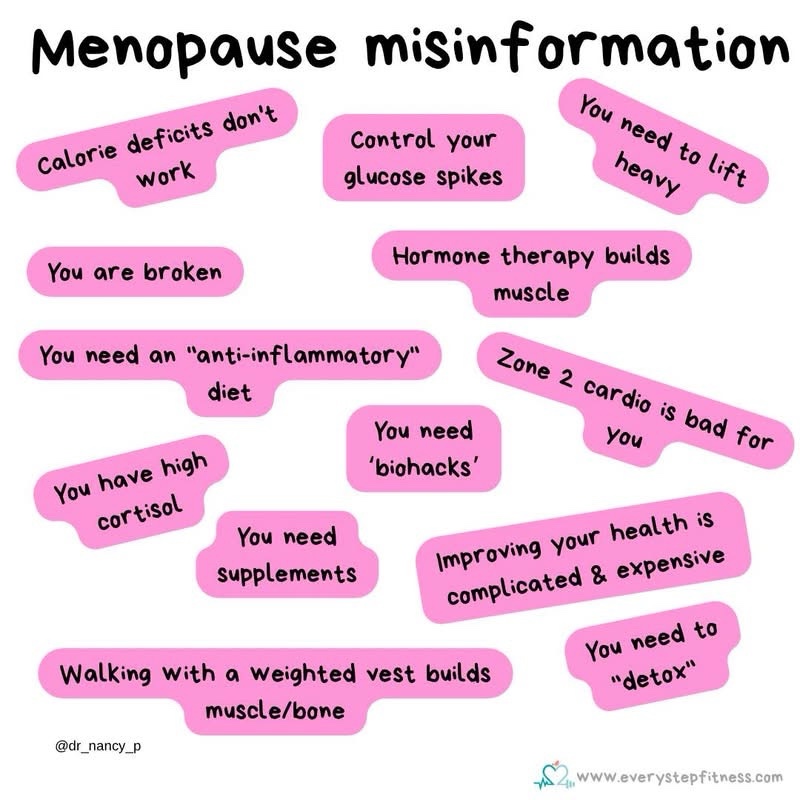
The top trendy topic at the moment on social media is menopause. There’s a strong tendency to blame changes in body composition — losing muscle, gaining fat, feeling ‘different’ in your body on menopause. And it’s completely understandable. It’s a big life transition, symptoms can be tough, and your body may not respond the way it once did. But how much of this is due to menopause and how much is just ageing which affects men and women? Why does it matter? Because people are preying on menopausal women and selling magic supplements and training programs as a way to make money.

On average, men and women actually lose muscle with age at a very similar rate. Body fat percentage also tends to increase gradually over time in both sexes at similar rates . In other words, many of the changes we notice are driven by aging itself rather than menopause alone.

That doesn’t mean menopause is irrelevant, far from it. Hormonal changes can affect where fat is stored, often leading to more central or abdominal fat gain, which can feel especially frustrating. Menopausal symptoms like poor sleep, low mood, hot flushes, joint pain, or fatigue can also make it harder to train consistently or stick to usual eating habits. That disruption can absolutely influence results because it impacts your behaviour and diet.

But it’s good news because it means women aren’t doomed, broken, or ‘past it’. Men and women of all ages can gain muscle with effective resistance training. Body fat can be reduced with a sensible calorie deficit. Progress may look slower, and strategies may need adjusting, but the fundamentals still work.
So rather than blaming menopause or feeling defeated, focus on what is within your control- sensible training, adequate protein, enough calories to fuel life, and realistic expectations. The power of exercise and nutrition is unequivocal for everyone, at any age.

🤗xx

Nutrition and Calorie Tips

‘It’s only a little sauce on the side, and a bit of oil for cooking – I don’t need to track that…’

‘It’s only a little sauce on the side, and a bit of oil for cooking – I don’t need to track that…’ 🤔

If you’re hoping to lose fat in a sustainable way you need to be aiming for a deficit of around 200-300 cals a day. Most people are pretty good at tracking the big stuff – the sandwich, the packet of crisps, the porridge for breakfast etc but how often do we overlook the little stuff. That little bit of ketchup on the side, that chilli sauce on your rice, that dash of oil in the pan…. And how often when you’re trying to lose fat do you deny yourself something you really want simply because you’re ‘on a diet’.

A cheeseburger comes in at around 805 cals – this is something you may not feel you can have whilst on your ‘diet’ and yet you probably don’t even think twice about the 1,284 cals you might rack up in sauces and oil (and tbh that’s a conservative estimate on the oil!). In one week that’s your whole deficit gone and you may not even realise it.

I always tell my clients to track everything – right down to the oil they’re cooking with as that can be the difference. So if you’re tracking cals and hoping to lose fat make sure you include these, and if you’re just trying to cut some cals maybe they’re a good place to start being more mindful too?

Oh and if you fancy a cheeseburger – just factor it in to your calories and have it! 🤗

Remember – calories count! 🤗xx