Nutrition and Calorie Tips

What happens when we restrict foods…

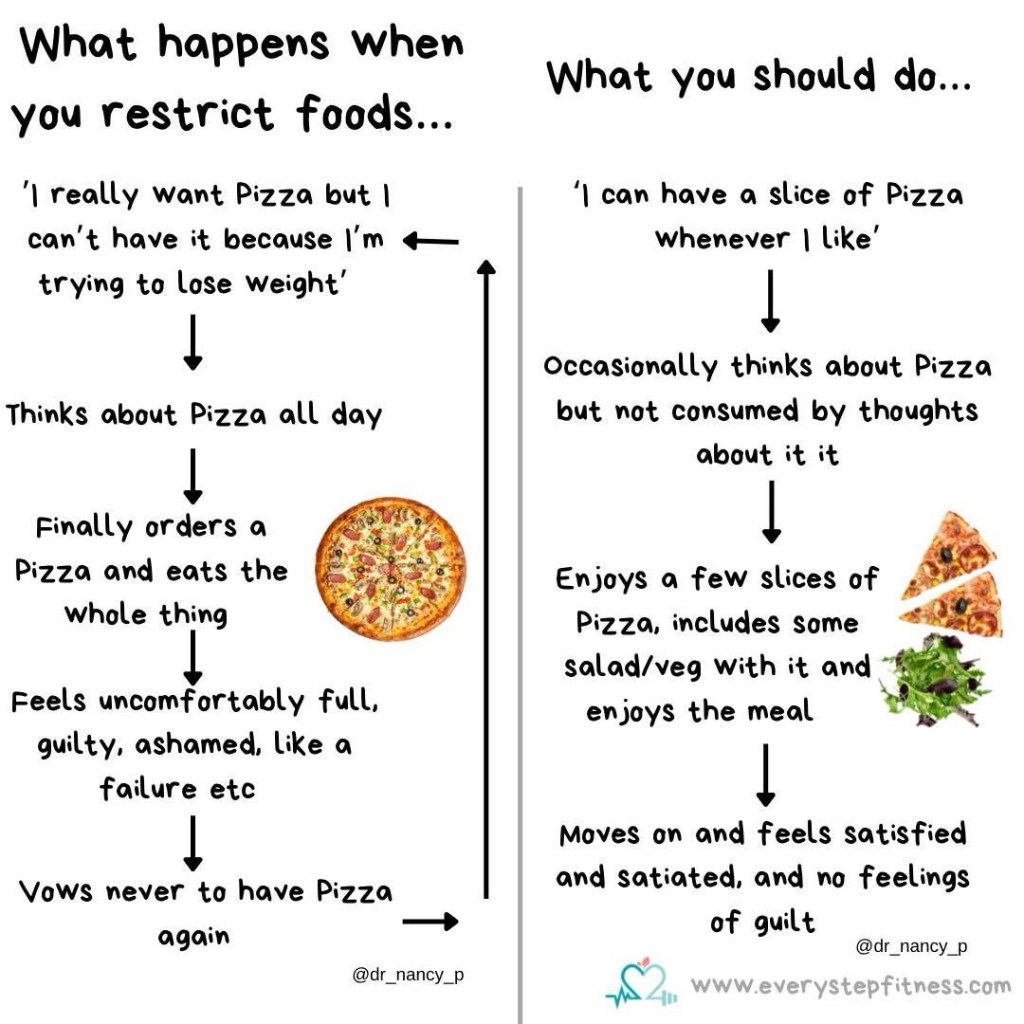
What happens when we restrict foods… 🍕

We all have cravings for certain foods or drinks at certain times. It may be for chocolate, biscuits, cheese, fries, Pizza – etc, whatever it is it’s usually perceived as a “bad” food. If you’re trying to lose fat/weight and on a diet then you may cut out or avoid foods like this, so if a craving hits you may avoid it at all costs. Why? because it’s “bad”. This can come from fear that it will
make you gain weight or “ruin” your performance.

This mindset that you have to eat “perfectly” all the time or that certain food are off limits can lead to serious issues, including; disordered behaviors around food, constant thoughts about food, uncontrollable cravings, restriction, bingeing, missing out on fun experiences, negatively impacting your social life, feelings of shame, guilt and anxiety, fear of food, under eating.

What tends to happen when we demonise foods and restrict them is that we can’t stop thinking about them, and that obsession leads to uncontrollable cravings. This often means that when you eventually do have that food you over-consume them because you feel like you can ‘never’ have them e.g. I can’t have pizza again so I better eat as much as possible right now! This then leads to feelings of guilt and shame, and impacts weight loss progress. A better approach is to accept that all foods can fit into our diets. It just means we need to have some in moderation. This is easier said than done i know, but it starts from reframing how we think about food. So if you have certain foods or drinks you feel you can’t have when trying to lose weight, instead remind yourself that you can always have any food if you really want it. It’s always available to you and always will be. When you want it, have it as part of a balanced meal. So if you want pizza – have a few slices, have some
salad or veg with it, enjoy it and factor it into your calories.

Enjoy!
🤗
Xx
Nutrition and Calorie Tips

Why the scale fluctuates …

Why the scale fluctuates … 📉

Most people measure their fat loss progress by stepping on the scales. This can create an all-or-nothing mentality and impact not only your happiness but your behaviour. If the scales don’t go down when you’ve been ‘good’ then what’s the point? You may as well throw in the towel and enjoy that cake!

Weight loss is rarely linear. It’s normal for your weight to fluctuate day-to-day. There will be days where your scale weight goes up, days where it drops, and days (maybe even weeks) where it stays exactly the same.

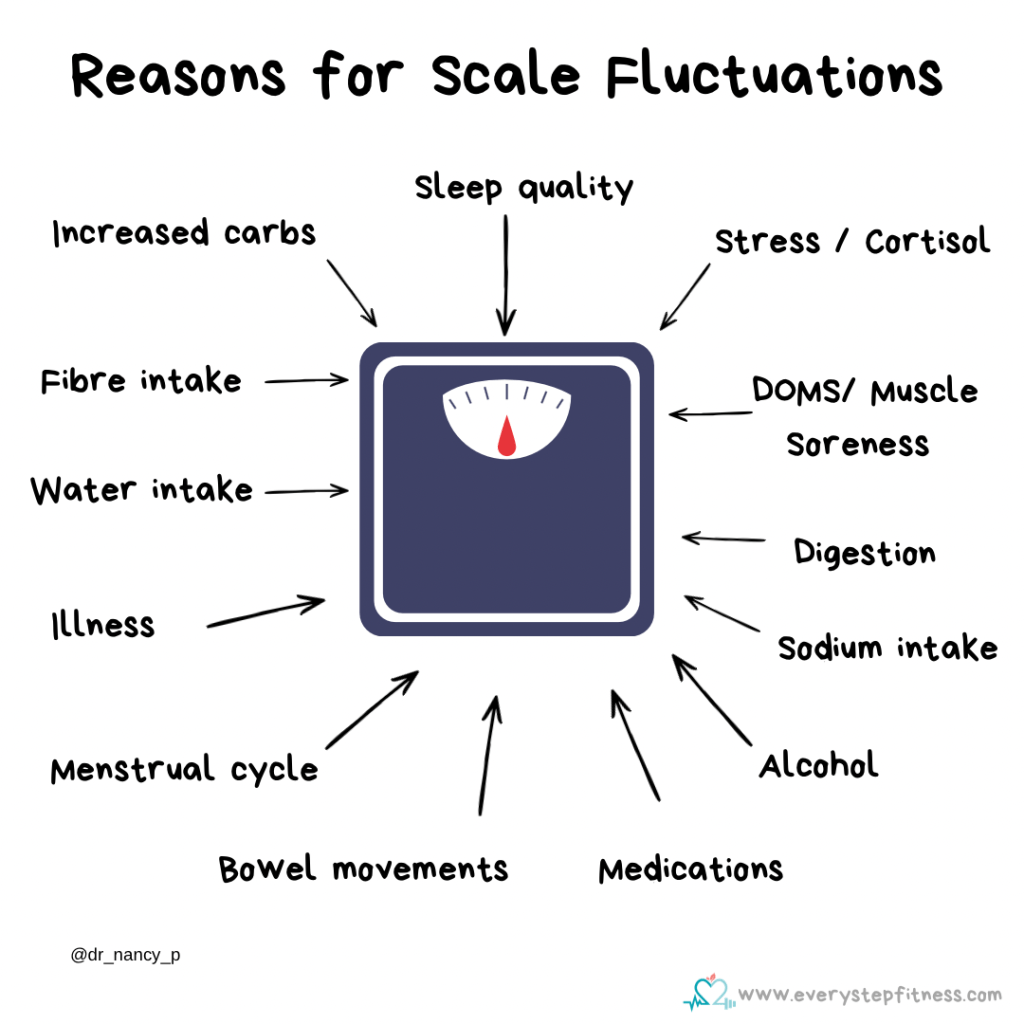
Your weight can fluctuate up to 6kg during the day depending on what you eat and drink, your digestion and how you exercise. If you drink 2–3 litres of water a day that’s up to 3kg straight away. Then how much do you pee, sweat and breathe out over the day? It’s impossible to measure. Our bodies are mainly water so changes in hydration cause significant weight fluctuations.

Food choices also play a role. A bowel full of food, a big meal the night before, increased carbs, high fibre or salty foods (sodium) can all increase water retention and temporarily push the scale up. Bowel movements and normal digestion patterns can also shift your weight from one day to the next.

Exercise can affect the scale both ways. If after a workout you’ve refuelled properly your muscles store glycogen along with water, which can increase weight. Muscle soreness (DOMS) from training can also cause temporary inflammation and fluid retention. On the other hand, if you’ve sweated a lot your weight may drop due to dehydration.

Other lifestyle factors matter too. Poor sleep, stress and higher cortisol levels, illness, medications, menstrual cycle hormone changes and alcohol can all influence fluid balance and appetite, leading to short-term scale fluctuations.

For many of us, seeing the scale go up despite ‘being good’ can make us give up. It’s vital to trust the process and think long term. We’re conditioned to focus on weight, but try using other measures such as how clothes fit, progress photos or cm measurements. If you do step on the scales, look at averages over time rather than daily changes and focus on the long-term trend.

🤗 xx

Nutrition and Calorie Tips

Why you shouldn’t eat back your exercise calories….

Why you shouldn’t eat back your exercise calories…. 🏃🏼‍♀️

Many of us use activity trackers / fitness watches; they’re fab tools to monitor activity and motivate us to get fitter, but they can also cause some issues.

The main issue is the figure they provide for calories burned, particularly when linked to food logging apps. Apps like myfitnesspal give you a daily calorie target or budget to spend, based on your current stats, goals and activity levels. If you have a tracker linked then it automatically adds any calories burned to this figure e.g if your goal is 1700 cals and you burn 500 cals in spin it gives you 2200 cals to ‘spend’ (eat).

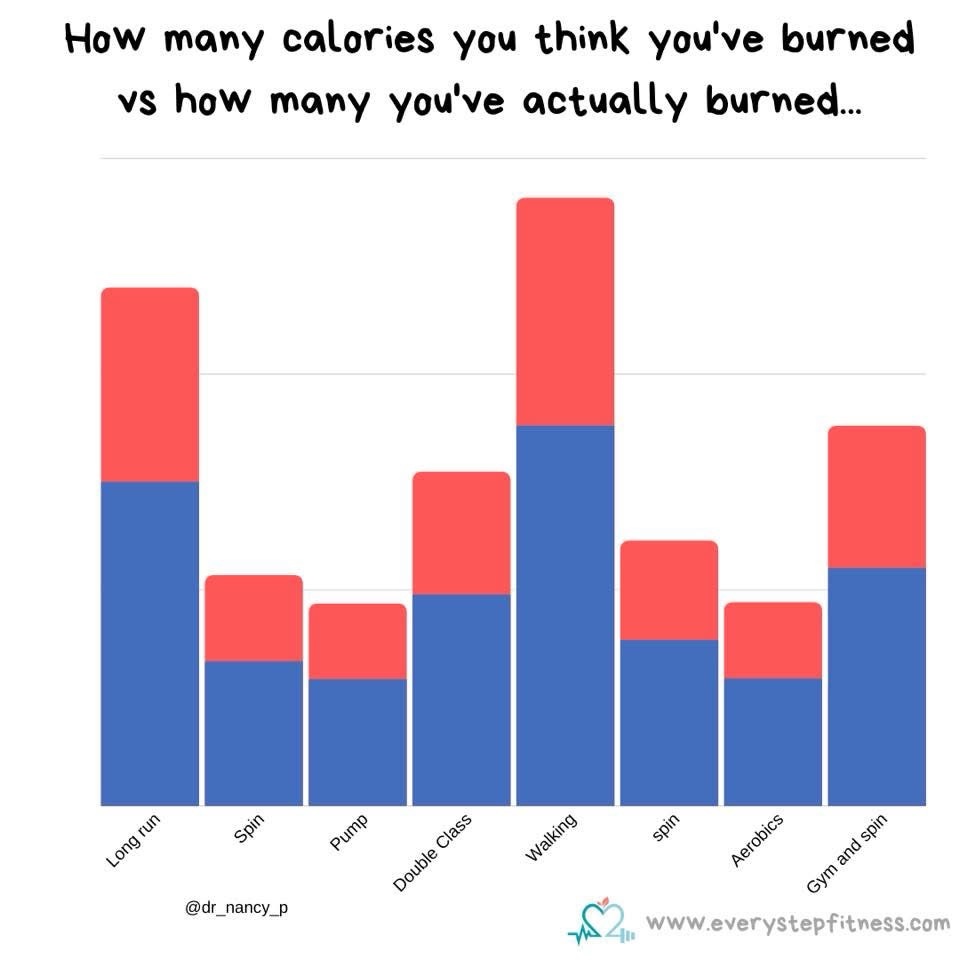
Great! So you can eat more right? Wrong! You shouldn’t be eating back those exercise calories. Aside from the fact that you have already accounted for your activity level in the daily calorie goal, the main issue is that the tracker is overestimating calories burned. Recent studies found that, despite being pretty accurate for heart rate readings, devices overestimated calories burned by 27 – 93% ! If we assume a 40% error rate you can see on the graph how much it overestimates (blue is actual burn, red is the tracker reading) e.g. a long walk burns 1500 cals on the tracker, but if you ate those back you’re actually over eating by 300 and 1450 cals!

This is why if you’re eating back those exercise calories you could easily wipe out the calorie deficit. Best-case, it slows progress, worst-case you overeat and put on weight. Also, as you get leaner and fitter the calories burnt in general activity and exercise decreases, so you’re burning even fewer calories than the device is reporting.

That’s not to say you shouldn’t record workouts and steps; it’s a great way to look at your relative effort and fitness. Use them as a way to encourage more activity but not as a reason to eat more. In the paid version of myfitnesspal you can choose not to add those extra calories, or simply un-link your tracker so it no longer gets that info.

So if you workout as a way to increase your calorie expenditure, that’s fine, just don’t eat back those calories, as it defeats the entire point of increasing activity in the first place.

🤗 xx

Nutrition and Calorie Tips

‘I’m trying to lose weight so I’m avoiding carbs ….’

‘I’m trying to lose weight so I’m avoiding carbs ….’ 🍞

There is a common misconception that carbs are inherently ‘bad’ and that in order to lose weight you need to cut them out or avoid them completely. This usually means people cut out bread, pasta, rice, potatoes etc.

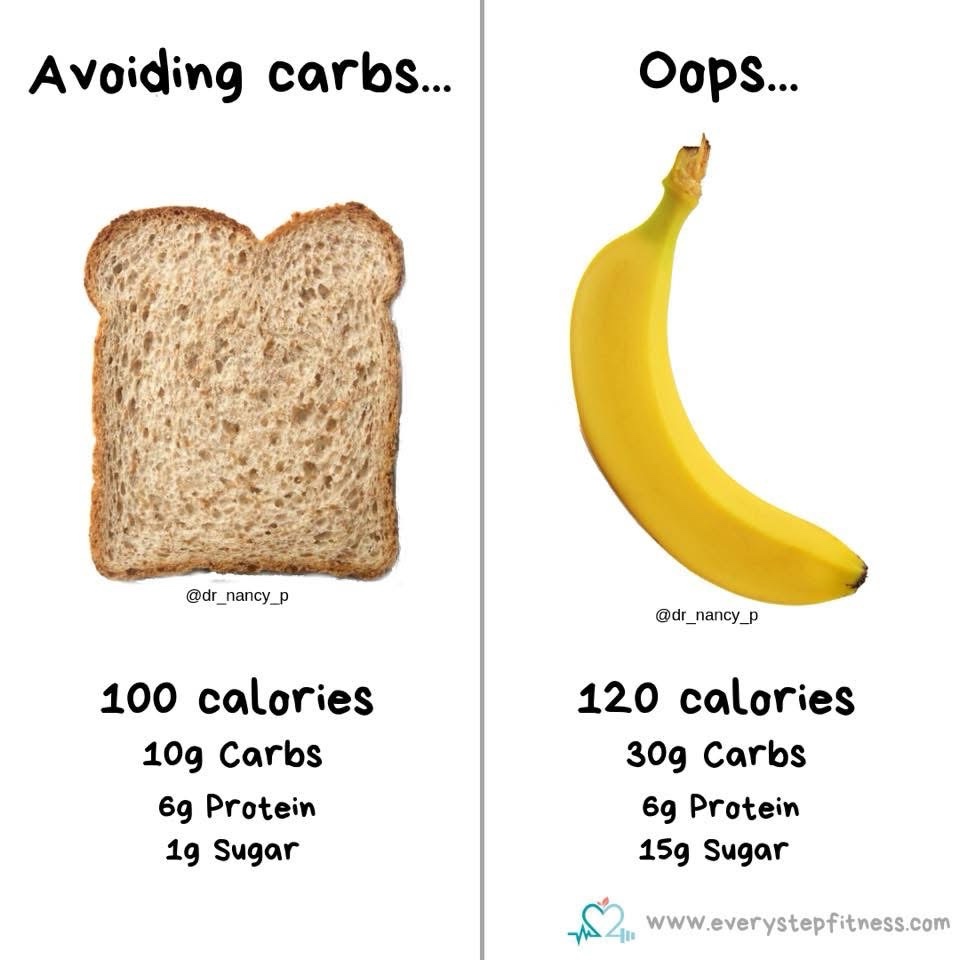
However they continue to eat fruit and veg without thinking twice when many actually contain more carbs. For example compared to a slice of bread a small Banana contains more calories, 3 times as many carbs and 15 times as much sugar! Now that doesn’t make the banana bad either – but why would you avoid the bread if you like it, yet happily eat the banana if you’re trying to avoid carbs?

In reality there is no reason at all to cut carbs from your diet. You can lose weight with or without carbs – it’s all about calories. Now obviously some people have medical reasons to avoid things like bread (coeliacs etc) but for the majority of people these foods are fine. The reason you may see weight loss when cutting these sorts of carbs is simply because you’re reducing your overall calorie intake. However unless you never want to eat carbs again then you’re not really setting yourself up for sustainable, long term weight management.

Obviously different carbs have different pros and cons – complex carbs will keep you fuller longer, whilst simple carbs (fruits mostly) will provide a faster hit of energy, you’ll get different nutrients from the different types too.

It’s important to have a balanced diet – including a range of carbs from bread to fruit. What works for you may not work for someone else and you may prefer to reduce consumption of carbs, but it’s important to be informed about what’s actually in the food you’re eating before you make that choice. Cutting out whole food groups is never a sensible or sustainable approach though.

Personally I enjoy all sorts of carbs – from bread, to fruit, to pasta, to potatoes – to doughnuts! Eat the carbs you like and enjoy and just be mindful of the calories! 🤗
Xx

Nutrition and Calorie Tips

“I’m being good and choosing the healthy brekkie…”

“I’m being good and choosing the healthy brekkie…” 🥗

Restaurant dining can be a bit of a minefield if you’re trying to watch your calories or lose weight. As I’ve said before, we often have a number of preconceived ideas about which the ‘healthier’ option is and equate that with lower calorie. In reality sometimes things aren’t quite as you’d expect.

Another great example of this are brekkie/brunch options – this particular example is from

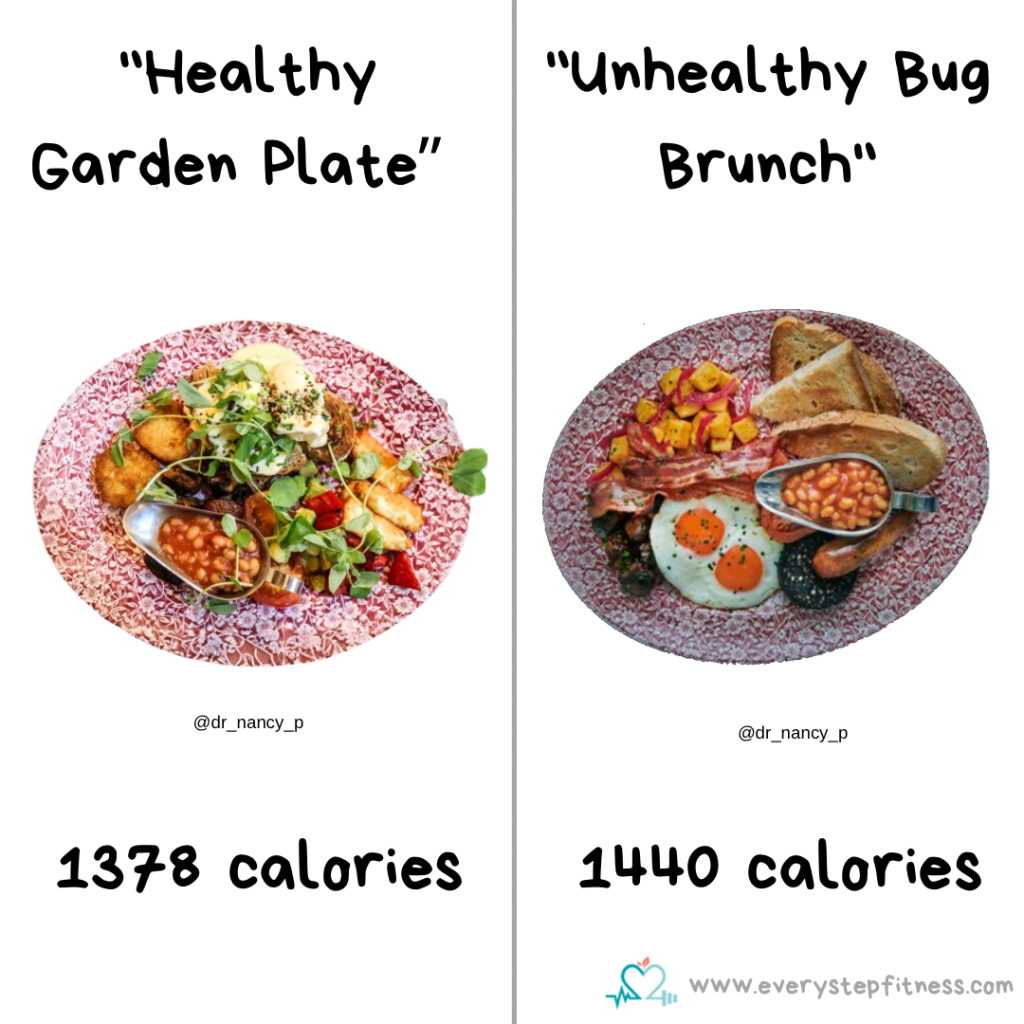
Bills. If you were out for brekkie / brunch you might assume that something like the ‘Garden plate’ is the better choice. It sounds healthy doesn’t it? It’s got poached eggs, halloumi, roasted plum tomatoes, red peppers, smashed avocado, hollandaise, mushrooms, hash browns, baked beans etc. Compare that to the Big Brunch which is fried free-range eggs, bacon, sausages, tomatoes, mushrooms, hash browns, baked beans, black pudding etc and the choice is obvious isn’t it?

However that’s not the case. Garden Plate comes in at approx 1378 calories, while the Big Brunch is approx 1440 cals. That’s only 60 cals different – essentially the same.

This is a great example of how food marketing and naming can shape our assumptions. Dishes that sound fresh, wholesome or plant-based are often automatically labelled as ‘healthy’ and therefore assumed to be lower calorie. Ingredients like avocado, halloumi, oils, sauces and grains all have great nutritional value but they’re also energy dense, and when combined the calories add up quickly.

Now if you want the Garden Plate because you like it then definitely go for it, but if you’re choosing it when you’d prefer the Big Brunch maybe stick to what you like! If you do want to reduce the calories then choose something totally different!

Enjoy 🤗

xxx