Blog

Nutrition and Calorie Tips

Body Composition Changes: Is it Ageing or Menopause?

Body Composition Changes: Is it Ageing or Menopause? 🤔

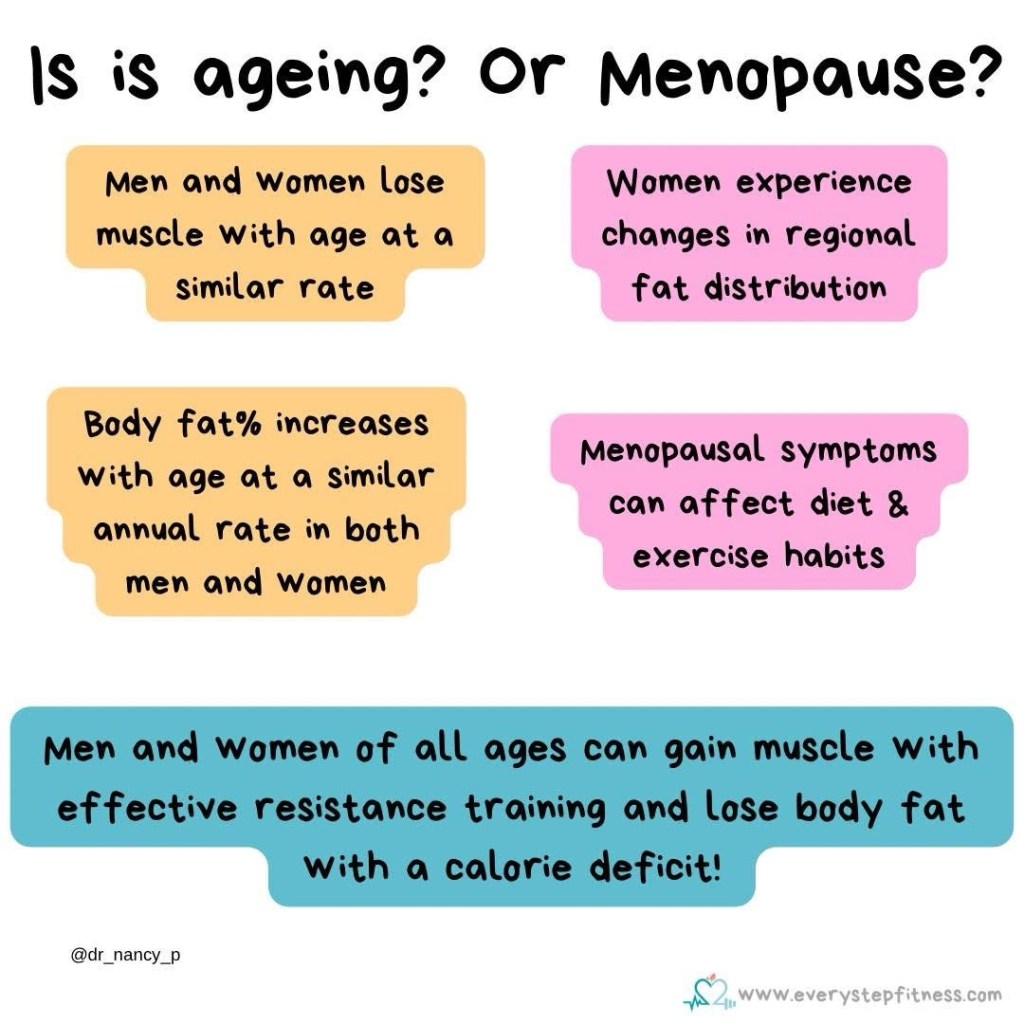
The top trendy topic at the moment on social media is menopause. There’s a strong tendency to blame changes in body composition — losing muscle, gaining fat, feeling ‘different’ in your body on menopause. And it’s completely understandable. It’s a big life transition, symptoms can be tough, and your body may not respond the way it once did. But how much of this is due to menopause and how much is just ageing which affects men and women? Why does it matter? Because people are preying on menopausal women and selling magic supplements and training programs as a way to make money.

On average, men and women actually lose muscle with age at a very similar rate. Body fat percentage also tends to increase gradually over time in both sexes at similar rates . In other words, many of the changes we notice are driven by aging itself rather than menopause alone.

That doesn’t mean menopause is irrelevant, far from it. Hormonal changes can affect where fat is stored, often leading to more central or abdominal fat gain, which can feel especially frustrating. Menopausal symptoms like poor sleep, low mood, hot flushes, joint pain, or fatigue can also make it harder to train consistently or stick to usual eating habits. That disruption can absolutely influence results because it impacts your behaviour and diet.

But it’s good news because it means women aren’t doomed, broken, or ‘past it’. Men and women of all ages can gain muscle with effective resistance training. Body fat can be reduced with a sensible calorie deficit. Progress may look slower, and strategies may need adjusting, but the fundamentals still work.
So rather than blaming menopause or feeling defeated, focus on what is within your control- sensible training, adequate protein, enough calories to fuel life, and realistic expectations. The power of exercise and nutrition is unequivocal for everyone, at any age.

🤗xx
Tuesday Tip

Tuesday Tip: Does Exercise Variety Matter?

Tuesday Tip: Does Exercise Variety Matter? 🏃‍♀️🏋️‍♂️

We often hear that more exercise is better. More steps, more minutes, more sweat. But a new study published in BMJ Medicine (2026) suggests that it’s a little more nuanced. It’s not just how much you move, but how many different ways you move that may matter for long-term health and longevity.

So what did the researchers actually find?

# 1 Variety Was Linked to Lower Mortality.

People who engaged in the widest range of physical activities had a 19% lower risk of death from all causes, and a 13–41% lower risk of dying from major causes such as cardiovascular disease, cancer, and respiratory illness. That’s a meaningful difference, linked not to extreme training, but to diversity of movement.

# 2 More Isn’t Always Better.

Interestingly, the relationship wasn’t perfectly linear. Benefits didn’t increase endlessly with more activity. Instead, there appeared to be a ‘sweet spot’ where gains levelled off. This challenges the idea that you always need to keep pushing harder to get health benefits.

# 3 Active People Had Fewer Risk Factors.

Those with higher overall activity levels were also less likely to smoke, and less likely to have high blood pressure or high cholesterol. While this doesn’t prove cause and effect, it highlights how movement often clusters with other healthy behaviours.

# 4 The Bigger Message

Being active in itself is beneficial. Long-term engagement in multiple types of physical activity may help extend lifespan.

So don’t just aim for MORE movement, aim for different movement. Think walking, cardio, strength, mobility, HIIT etc. Your body adapts best when it’s challenged in varied ways. No extremes required. Just consistency, variety, and movement you actually enjoy.

Happy Tuesday 🤗xx

Nutrition and Calorie Tips

‘It’s only a little sauce on the side, and a bit of oil for cooking – I don’t need to track that…’

‘It’s only a little sauce on the side, and a bit of oil for cooking – I don’t need to track that…’ 🤔

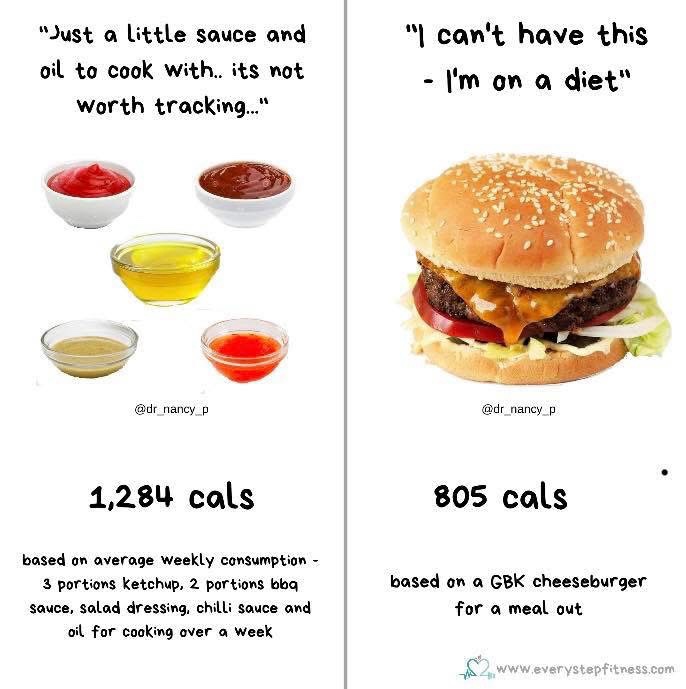
If you’re hoping to lose fat in a sustainable way you need to be aiming for a deficit of around 200-300 cals a day. Most people are pretty good at tracking the big stuff – the sandwich, the packet of crisps, the porridge for breakfast etc but how often do we overlook the little stuff. That little bit of ketchup on the side, that chilli sauce on your rice, that dash of oil in the pan…. And how often when you’re trying to lose fat do you deny yourself something you really want simply because you’re ‘on a diet’.

A cheeseburger comes in at around 805 cals – this is something you may not feel you can have whilst on your ‘diet’ and yet you probably don’t even think twice about the 1,284 cals you might rack up in sauces and oil (and tbh that’s a conservative estimate on the oil!). In one week that’s your whole deficit gone and you may not even realise it.

I always tell my clients to track everything – right down to the oil they’re cooking with as that can be the difference. So if you’re tracking cals and hoping to lose fat make sure you include these, and if you’re just trying to cut some cals maybe they’re a good place to start being more mindful too?

Oh and if you fancy a cheeseburger – just factor it in to your calories and have it! 🤗

Remember – calories count! 🤗xx

Tuesday Tip

Tuesday Tip: Snack triggers

Tuesday Tip: Snack triggers 🍪

Snacking can be a real issue when trying to lose fat. Being aware of the triggers can help to keep it in check.

# 1. Social Media

A recent study showed that socialising online with friends (via Facebook, Instagram etc) causes more snacking. It temporarily raises your self esteem, which lowers your self control, leading to increased snacking afterwards.

# 2 The News

Another study showed a link between watching/reading ‘bad’ news and high calorie snacking. The survey found that contemplating economic hardship and being subconsciously primed with messages to ‘live for today’ makes us seek out higher calorie foods.

# 3 Environment

The environment can trigger food cravings. A study showed that moviegoers would eat the same quantity of popcorn regardless of whether it was fresh or very stale, simply because they were ‘at the cinema’. In the same way sofa time after dinner can trigger snacking on chocolate or crisps etc.

# 4 3.23pm

3.23pm is the most likely time we are to snack, usually due to boredom, stress, and a dip in energy levels. To combat this have a balanced lunch (with protein and fats), plan in a healthy snack and save more enjoyable tasks for after lunch if you can.

# 5 Stress

Lower levels of serotonin when stressed also lead to carb cravings. Salt inhibits the body’s responses to stress. Craving salty food is the body’s way to cope with stress, so a salty, carby snack can help.

# 6 Lack of Sleep

Lack of sleep reduces your self control and willpower, and stimulates production of the hunger hormone ghrelin and lowers leptin levels (the satiety hormone). Studies found that those who are sleep-deprived eat 300 more calories per day.

# 7 Red

The colours red, yellow and orange are appetite stimulants, making you snack and eat more. Research shows that eating in a blue room reduced calorie consumption by 33 %. So try going for bluer hued lighting, blue crockery etc.

Being aware of the possible triggers can help you to not only recognise why you’re snacking more than you want to, but make changes to prevent it.

Happy Tuesday 🤗

Xx

Nutrition and Calorie Tips

Reasons you’re hungry…

Reasons you’re hungry… 🍔

A lot of my clients have been telling me how hungry they are feeling now the inevitable post Christmas ‘back on it’ season as started!

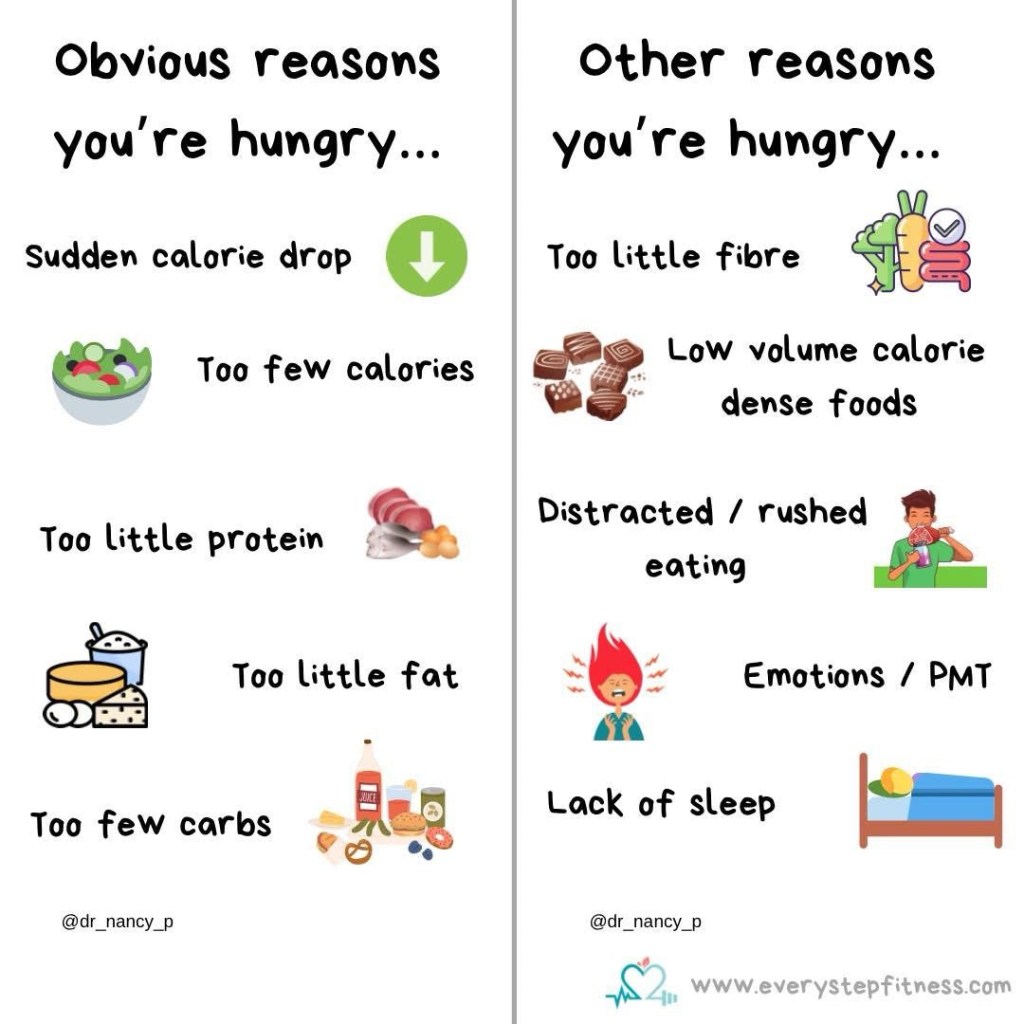
There are some really obvious reasons why you might be hungry. Remember a little hunger is a good thing so don’t be too quick to want to feed it! But if you’re starving hungry then it could be because you’re not eating enough calories – whilst obvious this probably isn’t the main reason tbh. You have probably just gone from eating several thousand extra calories a day over Christmas and new year, to eating normally or cutting calories – so yes you will be hungry! Your body is expecting large amounts of calories that you’re now not eating.

Other obvious reasons include perhaps not eating enough protein or fats – both these help you stay full and it’s common to avoid the fats especially when trying to ‘be good’. You may also not be eating enough carbs. Carbs are often the first thing people cut but really you need to try to ensure you’re still eating a good quantity of them to help you manage your hunger. Each macronutrient triggers a specific hormonal response which signals satiety (fullness) – fats cause the release of GLP-1, carbs cause the release of leptin, protein stimulates release of GLP-1, glucagon, CCK and PYY which tell the brain you’re full.

However there are probably a number of other reasons you’re hungry.
You might be low on fibre – it slows digestion, adds bulk and is fermented in the digestive system to produce short chain fatty acids which once absorbed tell the brain we’re full.
You might be eating low volume calorie dense foods. Whilst calories are king when it comes to fat loss, food volume really helps with staying full. So aim for high volume, lower calorie options to help if you’re hungry.

If you’re eating whilst distracted (watching tv/on the phone) or inhaling your food too fast multiple studies have shown you won’t feel as full as if you take your time and eat more mindfully.

Your emotions will definitely impact on your eating. If you’re bored, lonely, anxious or sad (or suffering from PMT) you may turn to food for comfort. It’s totally natural and fine to do, it’s also important to try to find other ways to make you feel better: calling a friend, speaking to a therapist, exercise, meditating, engaging in a hobby etc

Finally if you’re sleep deprived you will definitely be hungry – your body will be seeking energy to keep going and that’s going to lead to food cravings and less control around food. So work on getting a better nights sleep if you can.

Xx