Blog

Nutrition and Calorie Tips

What happens when we restrict foods…

What happens when we restrict foods… 🍕

We all have cravings for certain foods or drinks at certain times. It may be for chocolate, biscuits, cheese, fries, Pizza – etc, whatever it is it’s usually perceived as a “bad” food. If you’re trying to lose fat/weight and on a diet then you may cut out or avoid foods like this, so if a craving hits you may avoid it at all costs. Why? because it’s “bad”. This can come from fear that it will
make you gain weight or “ruin” your performance.

This mindset that you have to eat “perfectly” all the time or that certain food are off limits can lead to serious issues, including; disordered behaviors around food, constant thoughts about food, uncontrollable cravings, restriction, bingeing, missing out on fun experiences, negatively impacting your social life, feelings of shame, guilt and anxiety, fear of food, under eating.

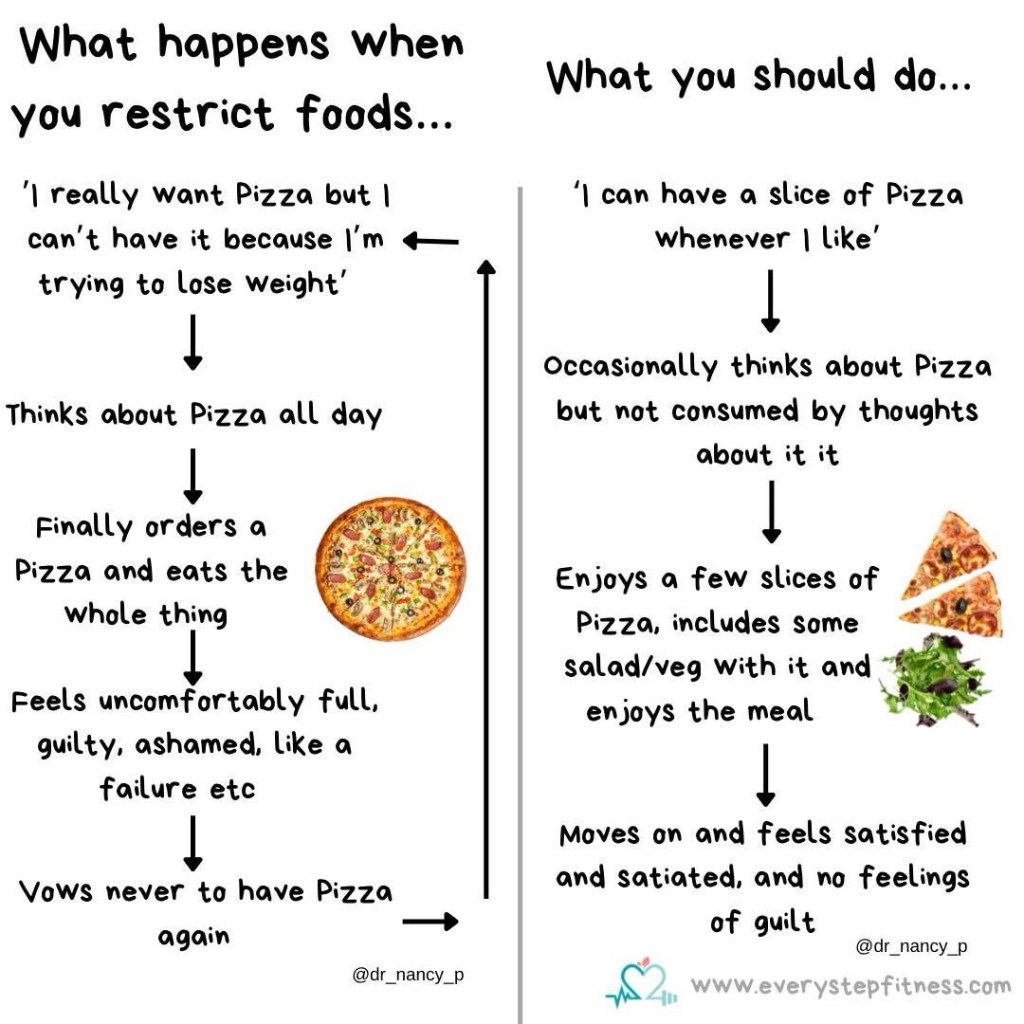
What tends to happen when we demonise foods and restrict them is that we can’t stop thinking about them, and that obsession leads to uncontrollable cravings. This often means that when you eventually do have that food you over-consume them because you feel like you can ‘never’ have them e.g. I can’t have pizza again so I better eat as much as possible right now! This then leads to feelings of guilt and shame, and impacts weight loss progress. A better approach is to accept that all foods can fit into our diets. It just means we need to have some in moderation. This is easier said than done i know, but it starts from reframing how we think about food. So if you have certain foods or drinks you feel you can’t have when trying to lose weight, instead remind yourself that you can always have any food if you really want it. It’s always available to you and always will be. When you want it, have it as part of a balanced meal. So if you want pizza – have a few slices, have some
salad or veg with it, enjoy it and factor it into your calories.

Enjoy!
🤗
Xx
Tuesday Tip

Tuesday Tip: Fat Loss Habits

Tuesday Tip: Fat Loss Habits✨

Fat loss is often sold as extreme diets, detoxes, or punishing workouts. In reality, the habits that work best are usually the boring ones; the ones that are repeatable, sustainable, and support your body rather than fighting it.

  1. Stop the All or Nothing Cycle
Avoid swinging between being completely ‘on it’ and completely ‘off it’. Fat loss works best when habits are consistent most of the time, not perfect for a week and abandoned the next.
  2. Build Meals Around Protein and Fibre
Structure meals around protein and fibre first, especially at breakfast. This helps stabilise hunger, improve satiety, and support better blood sugar control across the day. But you still need carbs too – no cutting them out!
  3. Strength Train Consistently
Lift weights to build and maintain muscle, not just to burn calories. Muscle supports metabolic health and helps maintain fat loss long term.
  4. Walk
Use walking as a simple daily habit to support movement, recovery, and stress management. It’s not about ‘earning’ food, it’s about supporting overall health.
  5. Prioritise Sleep
Poor sleep increases cravings, disrupts appetite regulation, and raises stress hormones. Consistent, quality sleep is vital.
  6. Take Stress Seriously
Chronically high stress can influence hunger, water retention, and fat storage. Setting boundaries, reducing overcommitment, and limiting late-night scrolling can help reduce daily stress load.
  7. Don’t Punish Overeating
If you overeat, avoid extreme restriction the next day. Return to your normal structure and routine instead.
  8. Address Emotional Eating
Rather than constantly battling snacks, focus on addressing the underlying stress or emotions driving the behaviour.
  9. Accept That Fat Loss Won’t Always Be Fast
During busy or stressful periods, progress may slow. That’s normal — forcing aggressive dieting often backfires.
  10. Eat in a Way You Can Sustain
Build habits that work during busy weeks, not just ideal ones. If it isn’t repeatable, it isn’t sustainable.

It’s all about consistent habits you can sustain – forever.
Happy Tuesday 🤗 xx
Xx

Nutrition and Calorie Tips

Why the scale fluctuates …

Why the scale fluctuates … 📉

Most people measure their fat loss progress by stepping on the scales. This can create an all-or-nothing mentality and impact not only your happiness but your behaviour. If the scales don’t go down when you’ve been ‘good’ then what’s the point? You may as well throw in the towel and enjoy that cake!

Weight loss is rarely linear. It’s normal for your weight to fluctuate day-to-day. There will be days where your scale weight goes up, days where it drops, and days (maybe even weeks) where it stays exactly the same.

Your weight can fluctuate up to 6kg during the day depending on what you eat and drink, your digestion and how you exercise. If you drink 2–3 litres of water a day that’s up to 3kg straight away. Then how much do you pee, sweat and breathe out over the day? It’s impossible to measure. Our bodies are mainly water so changes in hydration cause significant weight fluctuations.

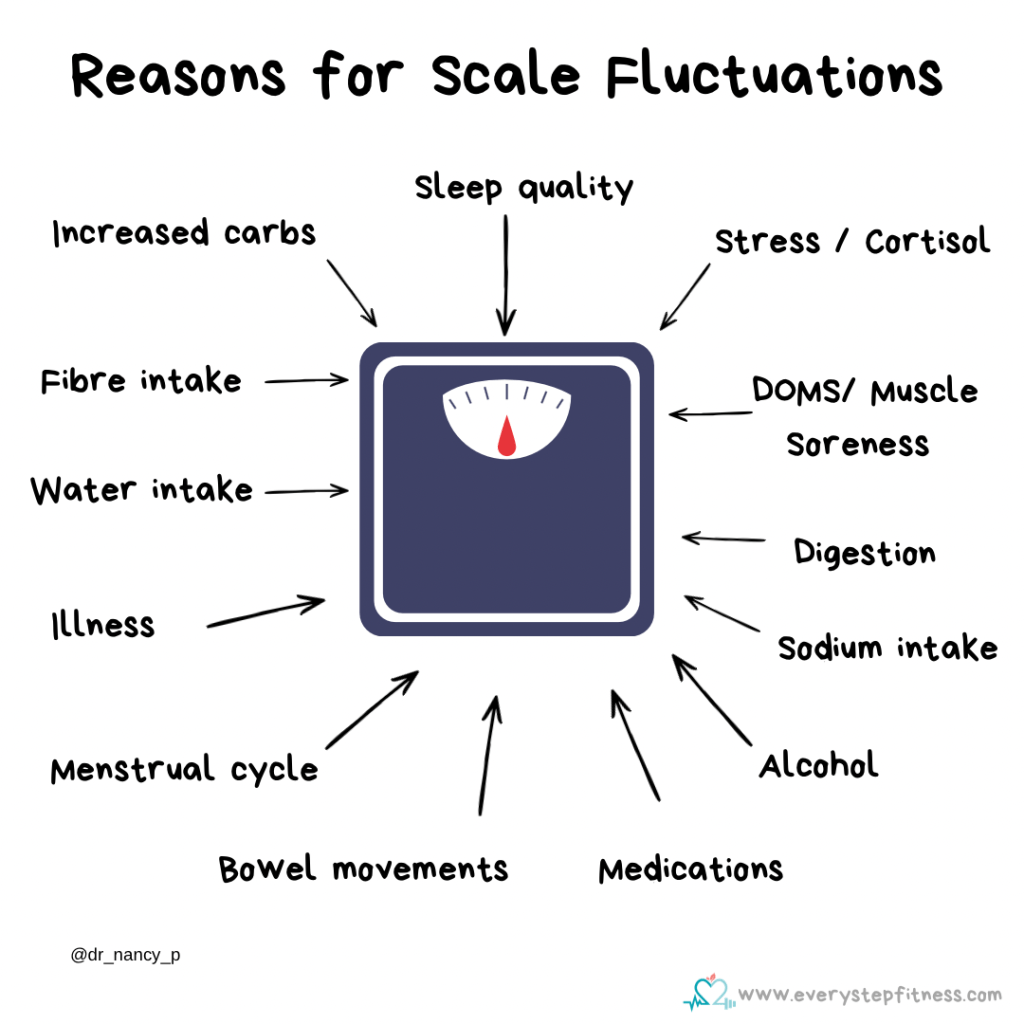
Food choices also play a role. A bowel full of food, a big meal the night before, increased carbs, high fibre or salty foods (sodium) can all increase water retention and temporarily push the scale up. Bowel movements and normal digestion patterns can also shift your weight from one day to the next.

Exercise can affect the scale both ways. If after a workout you’ve refuelled properly your muscles store glycogen along with water, which can increase weight. Muscle soreness (DOMS) from training can also cause temporary inflammation and fluid retention. On the other hand, if you’ve sweated a lot your weight may drop due to dehydration.

Other lifestyle factors matter too. Poor sleep, stress and higher cortisol levels, illness, medications, menstrual cycle hormone changes and alcohol can all influence fluid balance and appetite, leading to short-term scale fluctuations.

For many of us, seeing the scale go up despite ‘being good’ can make us give up. It’s vital to trust the process and think long term. We’re conditioned to focus on weight, but try using other measures such as how clothes fit, progress photos or cm measurements. If you do step on the scales, look at averages over time rather than daily changes and focus on the long-term trend.

🤗 xx

Tuesday Tip

Tuesday tip: Strategic Snacking

Tuesday tip: Strategic Snacking 🍪

Often clients tell me they ‘just need to stop snacking’ and they’ll lose weight, but that’s rarely the solution. Snacking has a bad rep, but there’s nothing wrong with a snack in itself. Many of us need smaller intakes of food spread across the day rather than 2 or 3 large ‘meals’, it’s mindless snacking that’s the real issue.

Remember whether you call something a meal or a snack is basically meaningless; some snacks are more cals than meals anyway! It’s just a window of time when you eat. So try to view them all as part of your overall daily food intake, they’re just names! The key is planning them in. If you don’t then you will end up feeling guilty every time you have a snack and that can lead to the f*ck it mentality and then overeating.

Identify first of all when you tend to or want to ‘snack’ and then allocate some calories for it; the same way you might for breakfast or lunch etc and adjust your meals to accommodate. By factoring it in not only are you ensuring you’ll be within your calories, you’re also managing your expectations and giving yourself permission to have that snack. It doesn’t matter what it is, choose snacks that work for you; if it’s biscuits fine, if it’s fruit that’s also fine, within the context of a balanced diet you can have anything you want!

If you find the problem is that once you start you can’t stop then try getting your snack item out at the start of the day and having it on show and somwhere easy to grab. That way hopefully you’ll be more likely to stick to it rather than rummaging through the cupboards or heading to a shop to get it at the time you’re most ‘snacky’ and will power is lower.

Everyone is unique and the desire and need to snack are influenced by age, emotions, activity, main ‘meals’ etc so you have to work out what’s best for you. One good approach is strategic snacking at around 3/4pm to help stave off evening hunger, and there is some scientific evidence to suggest a plan of three balanced meals and one snack (4 windows of time where you eat) works well for weight loss.

Happy snacking! 🤗xx

Nutrition and Calorie Tips

Why you shouldn’t eat back your exercise calories….

Why you shouldn’t eat back your exercise calories…. 🏃🏼‍♀️

Many of us use activity trackers / fitness watches; they’re fab tools to monitor activity and motivate us to get fitter, but they can also cause some issues.

The main issue is the figure they provide for calories burned, particularly when linked to food logging apps. Apps like myfitnesspal give you a daily calorie target or budget to spend, based on your current stats, goals and activity levels. If you have a tracker linked then it automatically adds any calories burned to this figure e.g if your goal is 1700 cals and you burn 500 cals in spin it gives you 2200 cals to ‘spend’ (eat).

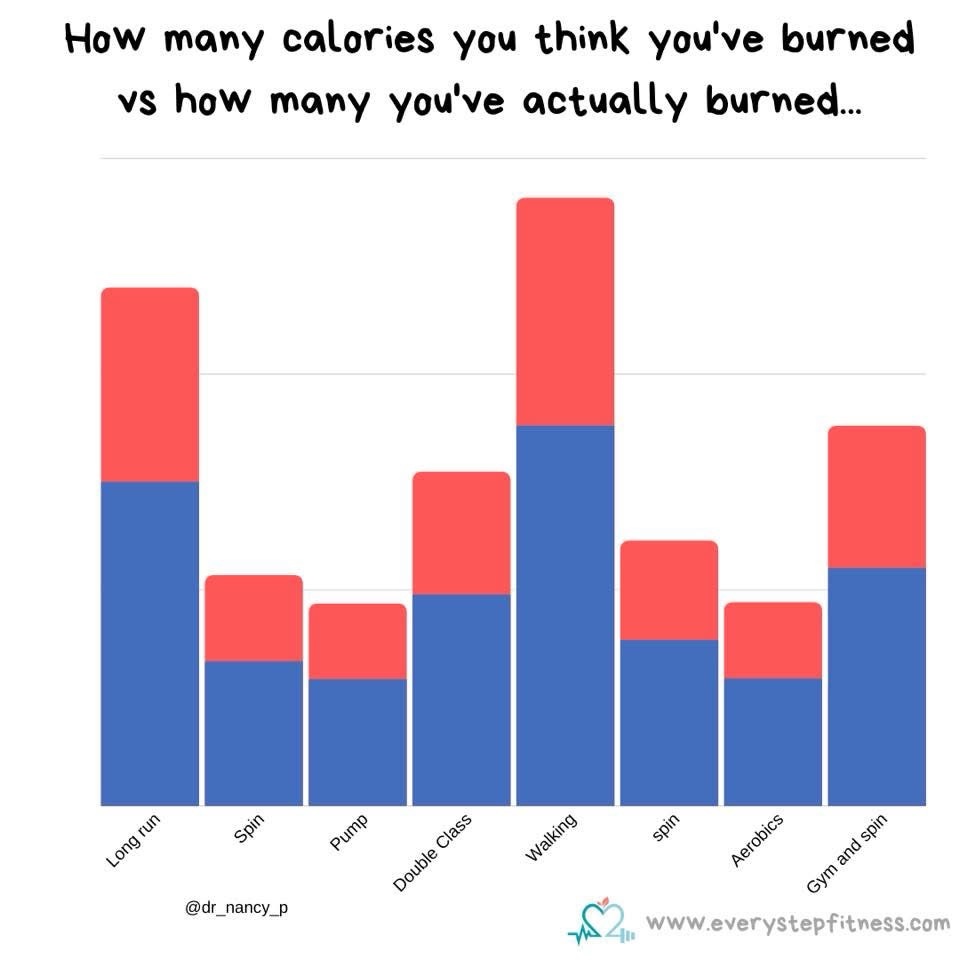
Great! So you can eat more right? Wrong! You shouldn’t be eating back those exercise calories. Aside from the fact that you have already accounted for your activity level in the daily calorie goal, the main issue is that the tracker is overestimating calories burned. Recent studies found that, despite being pretty accurate for heart rate readings, devices overestimated calories burned by 27 – 93% ! If we assume a 40% error rate you can see on the graph how much it overestimates (blue is actual burn, red is the tracker reading) e.g. a long walk burns 1500 cals on the tracker, but if you ate those back you’re actually over eating by 300 and 1450 cals!

This is why if you’re eating back those exercise calories you could easily wipe out the calorie deficit. Best-case, it slows progress, worst-case you overeat and put on weight. Also, as you get leaner and fitter the calories burnt in general activity and exercise decreases, so you’re burning even fewer calories than the device is reporting.

That’s not to say you shouldn’t record workouts and steps; it’s a great way to look at your relative effort and fitness. Use them as a way to encourage more activity but not as a reason to eat more. In the paid version of myfitnesspal you can choose not to add those extra calories, or simply un-link your tracker so it no longer gets that info.

So if you workout as a way to increase your calorie expenditure, that’s fine, just don’t eat back those calories, as it defeats the entire point of increasing activity in the first place.

🤗 xx