Tuesday Tip

Tuesday Tip: Common Tracking Errors

Tuesday Tip: Common Tracking Errors 😳

Tracking calories is a tool we can use strategically at certain times to accomplish specific goals, whether that’s improved health, sports performance, fat loss, or muscle gain. It can teach us quite a bit about food and nutrition as well, such as learning the energy and macronutrient composition of various foods.

Tracking accurately is a skill though and it’s very common for people to unintentionally and unknowingly under-report or under-track their food intake in general. Small mistakes with tracking can really add up over the days and weeks and can mean the difference between you losing fat or maintaining your weight.

Here are some common mistakes:

Eyeballing portions

Estimating and eyeballing portion sizes can be the difference between being in a calorie deficit or not. Weighing with a food scale in grams or ounces is the most accurate method you can use.

Grazing and mindless bites

Untracked grazing, bites, snacks, sips, and licks still count towards your calories and can really add up. Often , we’re not even aware we’re doing this, so increasing your mindfulness and awareness can be key. Plan out your snacks ahead of time and consider portioning things out in advance into serving containers or buy your snacks prepackaged.

Raw vs Cooked

Food loses and gains water weight when we cook it. For example, rice and pasta “gain” water weight while potatoes, protein sources, and vegetables “lose” water weight when they are cooked. Cooking methods and times affect how much water is gained or lost. The most accurate method is to weigh your food raw – or before you cook it. But what matters the most is that you are consistent with the method you chose and you choose the right calories to log – so check whether the cals listed are “cooked” or”raw” entries.

Generic meal entries

Your homemade spaghetti bolognese will have vastly different calories than many of the generic entries available in your tracking app. Track your meals by either entering each ingredient or (a more efficient way) use the recipe function in the app.

Oils, dressings, condiments etc

Cooking oils, mayonnaise , mustard, ketchup, BBQ sauce, butter, milk in coffee, sauces, preserves and salad dressings are easy to forget. However, they can quickly add up to be a few extra hundred calories. Don’t forget to track the oil you cook with (or swap to a 1 cal oil spray), condiments, milk, and dressings etc.

Not checking the accuracy of entries

Certain tracking apps (like MFP) are notorious for having inaccurate or misleading entries. Sometimes the serving size is incorrect, sometimes the actual calories are out, so if you can double check the entry against the label then do. Also, make sure your serving sizes are accurate in bought items and in your own pre-loaded meals or recipes (we tend to change servings over time so worth revisiting now and then).

Forgetting to log

It’s so easy to forget what we’ve consumed – studies all support this and even trained nutritionists don’t recall everything. The best way to prevent this is to track in advance or as you go along. Before something goes in your mouth just open the app and log it. Don’t wait until the end of the day to log things. Aside from forgetting what you’ve had it’s also too late to make any changes once you’ve eaten it.

Happy Tuesday 🤗xx
Nutrition and Calorie Tips

OMG I’ve ruined my diet ?…..

OMG I’ve ruined my diet ?….. 🍦🍪

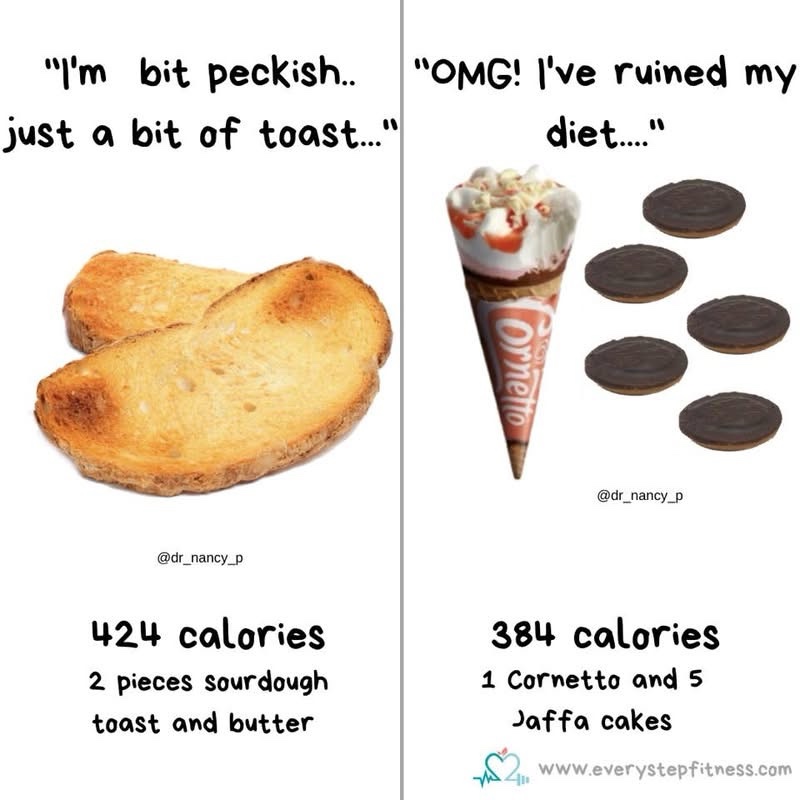
We all know the feeling, it’s mid afternoon, we’re a bit peckish but we’re ‘being good’ so don’t want to reach for a biscuit. Instead we grab a couple of slices of toast – nothing wrong with that right? It means we’re still on track with our ‘diet’ and all’s well….

But some days you may not have that will power… sun’s out, so you grab a cornetto out the freezer.. then have just one Jaffa cake… which becomes 2, 3, .. or maybe just one more – so that’s 4 and perhaps a final one… so you finally stop at 5! Now you’re wracked with guilt! How could you be so stupid? You’ve totally ruined your ‘diet’! Why don’t I have any self control you say to yourself?!

Hold on just one second! Perception is a wonderful thing… and it can also be a terrible thing. That toast that seems ‘ok’ may not be that much better. Two slices of sourdough toast with butter is up to 424 cals. That cornetto and 5 Jaffa cakes… a mere 384 cals! So neither is a great choice if you’re trying to stick to a particular calorie goal, but in most cases you’ll view the cornetto/Jaffa cake saga as a total disaster on the diet front, whilst probably overlooking the toast completely.

It pays to be aware of the calories in what you’re eating. That way you can choose with knowledge rather than your preconceived or conditioned ideas about what’s ‘bad’ or ‘good’. Being aware of the calories in different foods empowers you to make that choice and can help remove the guilt. Knowledge is power!

🤗
Xx

Tuesday Tip

Tuesday Tip: Are Seed oils bad?

Tuesday Tip: Are Seed oils bad? 🛢️

Apparently seed oils are the latest food to demonise. Rapeseed/canola, sunflower, sesame oil etc are apparently toxic, inflammatory and the worst thing you can eat. But does the evidence actually support this?

Some of the fear has a fairly logical origin. For decades, partially hydrogenated oils containing trans fats were widely used in margarines, processed foods and commercial frying. Trans fats genuinely are harmful, particularly for cardiovascular health. However at some point hydrogenated oils = bad morphed into seed oils = bad, but they’re not the same thing.

In addition lots of ‘junk’ foods such as chips, doughnuts, fried fast food, crisps, biscuits and other ultra-processed foods also contain seed oils. People who eat a lot of junk food may have poorer health , junk food often contains seed oils so it must be the seed oils that are bad. In reality these foods are just energy-dense combinations of refined flour, sugar and fat that’s very easy to overeat.

The major scientific warnings against seed oils come from studies tracking commercial fryer oil that has been heated for hours or days at a time (which causes it to breakdown producing potentially toxic by products) . Critics online took these findings and misapplied them to ordinary home cooking. In reality, using fresh seed oil at home for standard cooking, baking, or light frying produces negligible breakdown products and is entirely safe. Regularly eating deep-fried takeaway food is rather different from using some rapeseed oil to cook your stir fry .

There’s also the myth that omega-6 causes inflammation. Human research doesn’t support this; normal consumption of linoleic acid, the main omega-6 in many seed oils, doesn’t increase inflammatory markers. In fact, when unsaturated vegetable oils replace saturated fats, LDL cholesterol generally drops which helps cardiovascular health.

So don’t panic over a teaspoon of seed oil in your dinner or as an ingredient in the food you enjoy. As usual, the boring stuff matters far more: overall diet, fibre, fruit and veg, protein, calorie balance, exercise and sleep.

Happy Tuesday 🤗

Xx

Nutrition and Calorie Tips

“I’m being good and choosing the healthy steamed seafood…”

“I’m being good and choosing the healthy steamed seafood…” 🥗

Restaurant dining can be a bit of a minefield if you’re trying to watch your calories or lose weight. As I’ve said before, we often have a number of preconceived ideas about which the ‘healthier’ option is and equate that with lower calorie. In reality sometimes things aren’t quite as you’d expect.

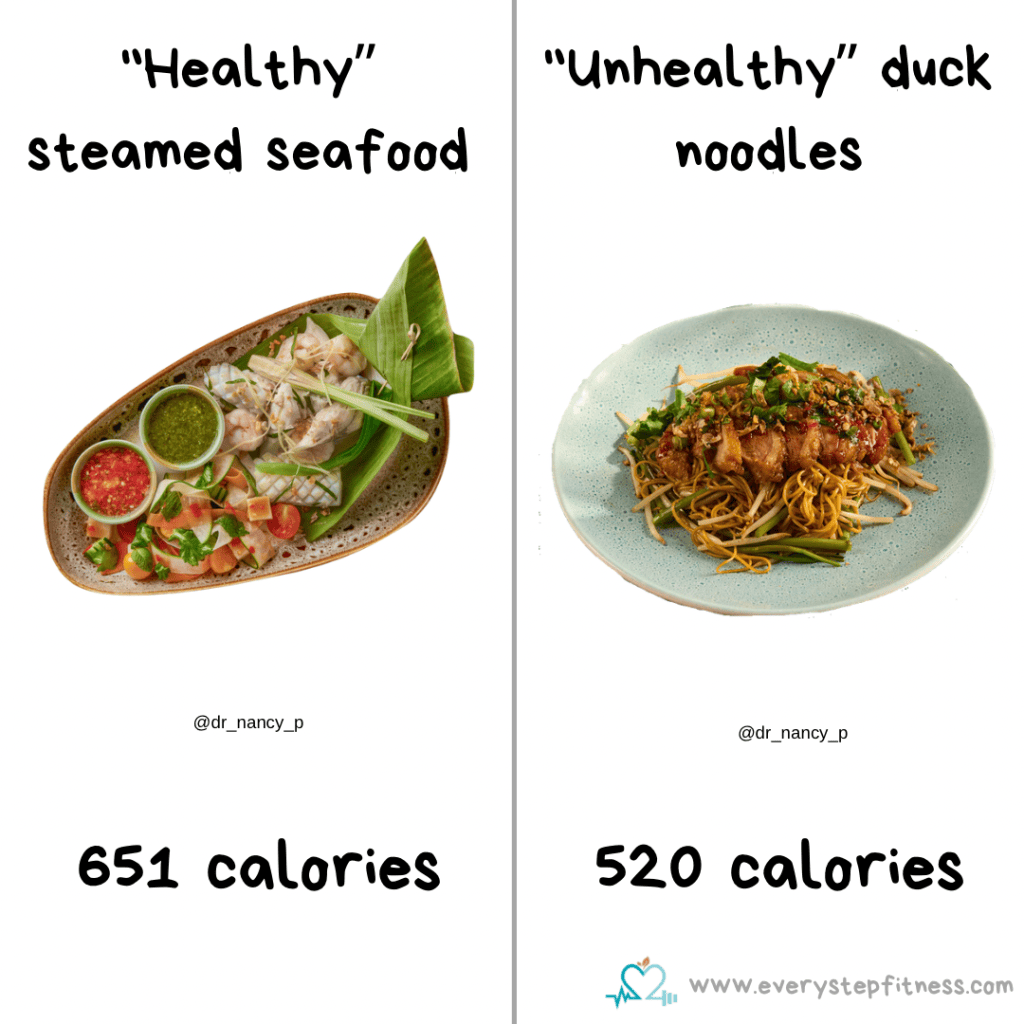
Another great example of this is T his particular example is from a Thai restaurant . If you were out for dinner you might assume that something like the steamed seafood is the better choice. It sounds healthy doesn’t it? It’s just steamed squid, sea bass and prawns – no rice or noodles. Tamarind duck noodles – which is a crispy duck leg served on a bed of noodles with a tamarind sauce and the choice is obvious isn’t it?

However that’s not the case. The seafood dish comes in at approx 651 calories, while the noodle dish is approx 520 cals. That’s only 69 cals different – but the seafood dish comes without any accompaniment so chances are you’d want something with it – rice, noodles or some veg or something.

Neither is a large amount of calories for a dinner so both can easily be accommodated within a daily calorie goal. However, this is a great example of how food marketing and naming can shape our assumptions. Dishes that sound fresh, wholesome or fish-based are often automatically labelled as ‘healthy’ and therefore assumed to be lower calorie whereas the natural assumption would be that duck and noodles are high calories (and often they are!).

Now if you want the seafood because you like it then definitely go for it, but if you’re choosing it when you’d prefer the noodles then maybe stick to what you like! That’s why checking the calories can be so important and illuminating! Knowledge is power!

Enjoy 🤗

xxx

Tuesday Tip

Tuesday Tip: are you eating enough fibre?

Tuesday Tip: are you eating enough fibre? 🌱

Fibre is often overlooks it’s one of those things that has a surprisingly big impact on our health and most of us aren’t getting enough. In the UK, adults are advised to aim for around 30g of fibre a day, but average intakes are considerably lower.

So what are the benefits and why does it matter?

1. It’s good for your gut.
Fibre helps keep things moving and prevent constipation, while certain types feed the beneficial bacteria living in our gut.

2. It can help keep you fuller for longer.
Higher-fibre foods generally take longer to eat and digest and can increase feelings of fullness — useful if you’re trying to manage your weight without feeling permanently hungry!

3. It can help with blood sugar control.
Soluble fibre can slow digestion and the absorption of carbohydrate, helping reduce rapid rises in blood glucose after eating.

4. It can help lower cholesterol.
Certain soluble fibres can help lower LDL (“bad”) cholesterol.

5. It’s associated with better long-term health.
Higher fibre intake is linked with a lower risk of cardiovascular disease, type 2 diabetes and colorectal cancer.

There’s also another interesting benefit . You may actually absorb very slightly fewer calories from a high-fibre diet. The calories contained in food and the calories our bodies actually extract aren’t always identical. In one study, people eating a high-fibre diet excreted more energy in their stools; equivalent to around 116 calories a day. That doesn’t mean eating 50g of fibre magically gives you 116 ‘free calories’ but it’s certainly an interesting potential benefit. Fibre, resistant starch and the physical structure of less processed foods can all affect how much energy we extract.

Wholegrains, beans, lentils, chickpeas, fruit, vegetables, nuts and seeds are all great sources of fibre. If you currently eat very little fibre, increase it gradually and drink plenty of fluid, suddenly doubling your intake may give your digestive system rather more excitement than you bargained for!

Happy Tuesday 🤗

xx