Fitness and Exercise, Nutrition

How to Fuel Properly For a Long Cycle or Run

It’s only just over 2 weeks now until the 100 mile Ride London so I’m starting to get prepared. I’ll be riding for Bowel Cancer UK this year and I’m beginning to feel the fear – not least because I’ve not even been on a bicycle since 2017 and I’m still recovering from the multiple stress fractures in my foot – so it’s going to be an interesting one!

But whilst I may not be able to train on the bike I can at least make sure I’m fuelled properly. I have clients and friends who are also riding and have been asking for advice on how to fuel themselves before, during and after the ride. So I thought I’d share a few tips. These are relevant to any endurance event – not just cycling.

So here are my tips!

In the week leading up to the big ride try to eat normally but well, so have three good meals a day, and snacks as needed, avoid all alcohol, and get some good carbs in where possible (brown rice, sweet potato etc).

48hrs before the ride is the time to start ‘Carb loading’. Carbs are the best source of fuel, so you need to make sure your muscles are full of glycogen before the ride. For the 48 hours before the ride, base all your meals around carbs and have carb based snacks throughout the day. So for example breakfast could be cereal, toast with peanut butter and banana, fruit and yogurt.

For lunch, go for wraps, jacket potato, pasta salad etc. And for dinner, try to eat something rice-based, pasta, or lean meat/veggie protein with potatoes. Have something like yogurt and fruit for desert.

For snacks go for energy drinks, dried fruits, and cereal bars.

On the ride day morning have a good carb-based breakfast two hours before the start (or as early as you can if you have a very early start time). Aim for at least two servings of any of these: cereal, toast and jam, porridge with fruit juice, and cereal bars and yogurt.

When you’re actually on the ride the glycogen supplies in the muscles will last about 90 mins so you need to keep topping up. Don’t worry about the first 45 minutes, but from there you need to take in around 60g of carbs every hour (the maximum amount an average body can absorb). energy drinks, gels, bars, or other easy-to-digest carb snacks are good as they’re designed for easy digestion and quick absorption. Or you could go for cereal bars chopped up or dried fruit. My preference is chopped up cereal bars and jelly tots 🙂

Be careful during the ride at feed stations and avoid any foods such as cake, biscuits, pastries, crisps or sandwiches containing cheese or mayonnaise. These are high in fat and will sit heavy in the stomach, taking time to digest. This will make the following 10-15 miles after the stop quite uncomfortable so not ideal!

At the end of the ride you need to replenish the glycogen stores in the muscles and repair the damage to your muscles so you need fast digesting carbs and protein, so things like scrambled eggs on white toast, white rice and chicken and veg, tuna pasta etc

An ideal post ride drink is chocolate milk – perfect combo of carbs and protein etc so try to have that as soon as possible after you finish. You can also get various protein based recovery drinks which work too.

Then get back to normal eating after that!

So there you go – a few tips for you! Note I’m not suggesting specific foods as such – just giving examples and the figures on timing and quantity of carbs etc are based on scientific studies and evidence based research.

This is what I’ve done every other year I’ve taken part and I’ve always been fine and recovered quickly and not ‘crashed’ (energy-wise) during the Ride.

Hope that helps – safe riding everyone! See you there ! 🤗xx

Ps. I’m riding to raise money for Bowel Cancer UK – as a current sufferer and for everyone else affected by it. If you wanted to and could spare a few pennies then I’d be very grateful 🙂

https://www.justgiving.com/fundraising/nancy-priston-2019

Nutrition and Calorie Tips

Lower Calorie Ice Cream Option

Saturday night – movie, sofa and some ice cream – perfect right? We all feel the need to work our way through an entire tub of ice cream now and then – it’s natural, it’s human and it’s also damn tasty! But how about making a simple swap. Rather than working your way through 1,200 calories of Ben and Jerry’s (or other standard ice cream equivalent) , you could instead have 320 calories of Halo top (or one of the any other equivalent low cal ice cream brands available). But isn’t low calorie stuff loaded with sugar? No – it’s not actually! And it tastes amazing! 🍦

We don’t need to deny ourselves treats and nice tasting stuff just because we’re watching our calories – try making some swaps instead. If you’re an ice cream fan check out the Halo Top range of tubs and sticks (there are also supermarket own brand versions and other companies doing the same – in fact even Ben and Jerry’s do their own low cal flavours now!).

So you really can have your cake (*ice cream) and eat it! 🤗 xx

Nutrition and Calorie Tips

‘About a teaspoon…..’ 🥄

‘About a teaspoon…..’ 🥄

If you’re trying to lose fat and tracking your calories it’s really important to be as accurate as you can and this is why. You could easily record the peanut butter that you have on your toast as a teaspoon’s worth… but how much is a teaspoon? Is it a level teaspoon? Is it a slightly heaped one? Is it a very heaped one (I can get A LOT of peanut butter on a teaspoon I assure you! 😋), is it the small spoon you have for stirring your coffee? Is it a baking measure?….etc etc

The problem with volumetric measures is they’re not very accurate. Now if you’re having something low calorie it probably won’t matter too much but something calorie dense like peanut butter really does matter, especially if you’re trying to maintain a moderate calorie deficit. Two teaspoons of peanut butter could be 158 cals or as much as 474 cals! That’s nearly 296 cals difference… you only need a 200-300 calorie daily deficit to see fat loss so you could wipe it out in one small spoonful! 😬

This is why I encourage my clients to weigh, in grams, rather than using measures like teaspoon or tablespoons. So if you’re trying to lose fat and tracking your calories have a go at weighing some of the foods you’ve been logging by tsp/tbsp and see how accurate you’ve actually been with those calories? You may be surprised! 😬

Xx

Nutrition and Calorie Tips

‘Clean eating’… not so clean?

‘I’m clean eating’… 🍓

‘Clean’ eating is a relatively recent trend but I often hear people telling me they are ‘eating clean’ in order to lose weight/fat. ‘Eating clean’ is essentially the idea that you’re eating foods which are perceived to be better for one reason or another (that might be based on properties the food supposedly has, or nutrients it contains etc).

There is nothing wrong with that at all – I’m not a fan of demonising foods but if you want to eat certain foods for whatever reason then that’s fine. The problem is that the common misconception is that because a food is ‘clean’ or promoted as healthy, that it is automatically going to help you lose weight/fat and that it must be a ‘better’ option than other foods you may also love.

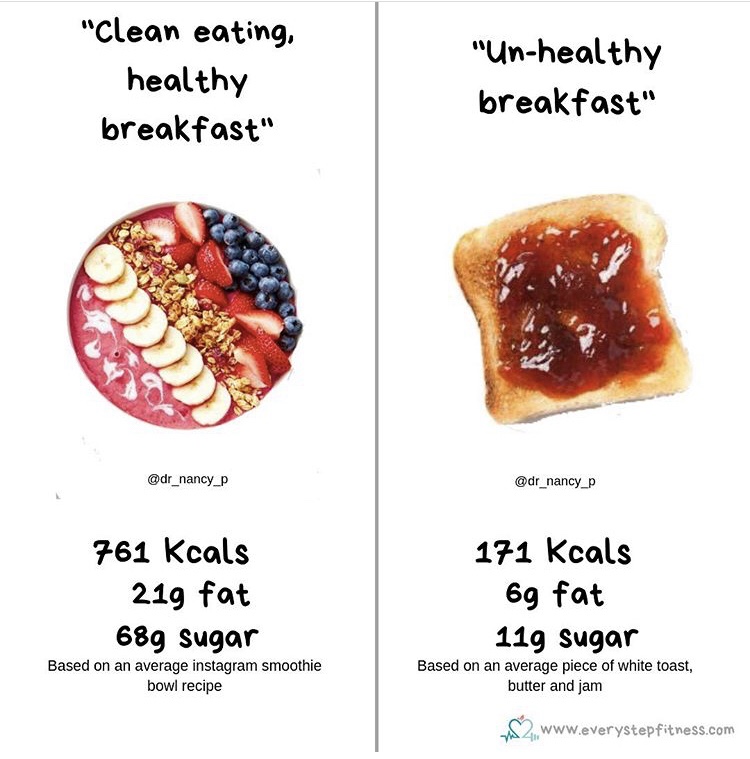
The breakfast smoothie bowl is a great example of this. They’re very photogenic and found all over Instagram. It’s essentially a smoothie in a bowl topped with fruit, seeds, nuts etc. They’re delicious and full of great nutritious foods, but they’re also rather high in calories and sugar (mostly from the large amount of fruit used).

In comparison jam on white toast, which is often perceived as a ‘bad’ choice is approximately a quarter of the calories and sugar.

So if you’re trying to lose weight/fat, and you really enjoy jam on toast for breakfast then go for it! As long as it’s part of a balanced diet which contains fruit and veg etc it’s fine! Don’t be swayed by beautiful Instagram photos and Instagram experts telling you that you need to eat clean to be lean. You don’t.

Enjoy a range of foods and be mindful of the calories and you’ll be fine! 🤗xx

Nutrition and Calorie Tips

‘I don’t eat much but I can’t lose weight…’

‘I don’t eat much but I can’t lose weight…’ A piece of toast for brekkie, bit of fruit for a snack with coffee, healthy snack bar and a sandwich for lunch with a ‘healthy’ drink, and a ‘healthy’ dinner of fish and salad….. that’s not really much for a day?…right…… 🤔

Often we think we’re not eating much and can’t understand why we don’t lose weight. It’s not until you actually add it all up that you realise you’re probably eating a lot more than you realise. The coffees, the couple of biscuits you forget about, the dried fruit snack (it’s fruit – it’s fine right?), a ‘healthy’ dinner of fish and salad … it must be ok?

It is ok and there is nothing wrong with any of that, but when you actually add it all up you’re looking at over 2,700 calories… for a ‘good’ day! Now for most people trying to lose weight or fat that is going to be far too many calories to be in a deficit which would let you lose fat.

So if you feel you aren’t eating much but you’re not losing weight/fat then maybe it’s time to just write down everything you’re eating on those days and see how much you really are consuming 🤗. Remember – calories count! Xx